What would have been the most common use for 70 ton covered hoppers, especially in the Utah, Wyoming region of the UP?
Secondly, would another description for these be 2 bay hoppers?
What would have been the most common use for 70 ton covered hoppers, especially in the Utah, Wyoming region of the UP?
Secondly, would another description for these be 2 bay hoppers?
If the hoppers had two bays, they are two-bay hoppers. If the cars had roofs with hatches, they’d be called two-bay covered hoppers.
If the cubic capacity of these 70-ton cars were about 2000 cubic feet or less (which a two-bay hopper would most likely be), they were usually used for concentrated loads such as cement (usually their primary use) or sand.
Mark
Thanks Mark. Would 100 Ton Hoppers pictured below have been used in the 50’s in the area I mentioned. And what would they have been used for.

I don’t have information on Union Pacific hoppers…Nevertheless, such a car in the 1950s is unlikely. 100-ton freight cars didn’t become popular for interchange and general service until the 1960s. If you’re going to haul coal or such in a hopper car, I’d recommend 50/55-ton two-bays and 70-ton three/four bay open hoppers. Many western railroads preferred drop-bottom gondola cars for such loads. If you have a prototype railroad you are emulating, I’d recommend you do some research. Also, check the build date on the models if you can (one advantage of a LHS) as the car lettering usually provides a built date.
Mark
The designation for these cars could be HC (Hopper, Covered), some railroads would have a number added to HC to denote different classes. Another material hauled in these cars was bentonite which was used in the oil fields, I believe it was mixed with water to create a lubricating mud for the drills.
Rick
100 ton open hoppers would not be in general service in the 50’s. The tip off is that ‘consolidated lube stencil’ above right truck - that is a 80’s/90’s thing. In the 50’s, the typical maximum load limit was around 70 tons. You should be looking for cars with 140,000 lb capacity.
Jim
I am not familiar with the HC designation, at least not as a standard AAR designation.
In my April 1954 Official Railway Equipment Register, the 70-ton 2-bay covered hoppers are normally given an AAR Mechanical Designation of LO. The covered hoppers in the middle ground of this photo are LO.
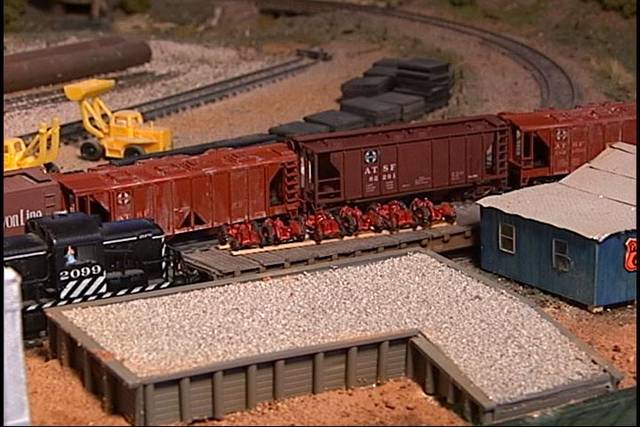
In addition to the standard AAR designation, many railroads also had class designations for groups of similar cars or cars purchased or built at the same time. Perhaps the HC designation that RedGrey62 mentioned was used by an individual railroad. Santa Fe used GA (“gondola”) as a class designation for that railroad’s gondolas, open hoppers, covered hoppers, and ore cars, unless they were cars such as ballast cars strictly for non-revenue maintenance-of-way use only. Suffix numbers were added as each class was ordered, regardless of sub-type. Santa Fe 2-bay covered hoppers like the models in the photo included classes GA-45, GA-52, GA-58, GA-65, etc.
A few cars which were originally built as open hoppers but later were coverted with roofs are in AAR Mechanical Designation HTR. HT includes 3-bay (and I believe 4-bay) open hoppers. When they had roofs added because of a car shorta
[quote user=“leighant”]
I am not familiar with the HC designation, at least not as a standard AAR designation.
In my April 1954 Official Railway Equipment Register, the 70-ton 2-bay covered hoppers are normally given an AAR Mechanical Designation of LO. The covered hoppers in the middle ground of this photo are LO.
In addition to the standard AAR designation, many railroads also had class designations for groups of similar cars or cars purchased or built at the same time. Perhaps the HC designation that RedGrey62 mentioned was used by an individual railroad. Santa Fe used GA (“gondola”) as a class designation for that railroad’s gondolas, open hoppers, covered hoppers, and ore cars, unless they were cars such as ballast cars strictly for non-revenue maintenance-of-way use only. Suffix numbers were added as each class was ordered, regardless of sub-type. Santa Fe 2-bay covered hoppers like the models in the photo included classes GA-45, GA-52, GA-58, GA-65, etc.
A few cars which were originally built as open hoppers but later were coverted with roofs are in AAR Mechanical Designation HTR. HT includes 3-bay (and I believe 4-b
Rick, subsequent writers (previous to this post) were correct. You may have confused a railroad’s class code with ARA/AAR car-type designations.
ARA car classification “HC” meant an open-top hopper car equipped with coke racks (1/1917-2/1926). Car classifications codes were subject to change over time, so the classification for a particular car could also change.
In its classification scheme, the Southern Pacific Railroad made no distinction in alpha-code between covered and open hoppers beginning in the early twentieth century. They’d both be “classified” as “H.” For instance, an H-70-2 was an open hopper, and an H-70-18 was a covered hopper. (Letter designation was car type, first set of numbers was the capacity in tons, and the last number was a sequence number identifying the specific car series for that car type.)
There are many ways to distinguish the appropriateness of a particular car for your era, all of which should be considered if that’s important to you. Most obvious is the built date and that’s often easy to find if the model is appropriately lettered. End-of-service dates take research of railroads’ rolling stock inventories. Particular railroads will revise their paint and lettering schemes over time (more research). Physical attributes are another way. For instance, cars with archbar trucks wouldn’t be in interchange service after 1941 nor those with KC brakes after 1953. In 1966 new cars could no longer have running boards, and new cars’ brake wheels were to be mounted low. I’m not “Railroad Encyclopedia Chuck”: there
Excellent information folks. As I have read all the responses it appears for the era I’m modeling, 1950’s, 70 Ton Hoppers, open or covered would be what fits that time frame. I have purchases some hoppers that have the following car designations:
Thanks for the good information
| HK-70-1- |
|---|
| CH 70-2 |
|---|
| CH 70-1 |
|---|
Designations: The UP used a “Common Standard” system for their own designation of car classes, “HK” meant ballast hopper, and “CH” was for covered hoppers. The second number was an approximate capacity, so -70 refers to a 70-ton capacity car, and the last number was the design series. So “CH-70-2” would be a covered hopper of 70-ton capacity from the second series of 70-ton covered hoppers on the UP.
UP was not a big operator of covered hoppers until the adoption of high-capacity covered hoppers for grain in the 70’s-80’s. As stated previously cement, sand (including company sand for locomotives) and other chemicals would be common commodities. UP did start getting into Airslide covered hoppers circa 1954 for flour service.
100-ton open hopper. In the 1950’s the 70-ton car was more common, starting to grow into the 90 tonners in the late 50’s through 60’s, then growing into the 100-ton types. Marklin made a nice H-70-1 open hopper several years ago, an interesting UP car. Atlas makes a nice 70-ton ballast car that is close to UP’s HK-70-1 and HK-70-2 cars - these carried coal as well as ballast.
Gary