Looking every bit like a model you just purchased, brought it home, took it out of the box and put it on some rails just to admire your latest acquisition. Is it a Lionel?, HO brass?, N Scale beauty?
No…it’s the real thing…I think.
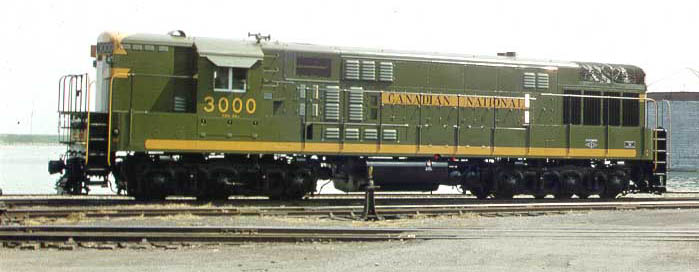
3000 CN’s one and only CLC/Fairbanks-Morse H24-66 Train Master. FM/CLC 7/1955 Canadian National
This powerful unit was ahead of its time. At 2400 hp it could out pull anything! First used in Winnipeg it was later used in Toronto (Hamilton) and Montreal commuter service (it was built with a steam generator) it was equipped 4/1964 for hump service in Toronto and 9/1964 Montreal as its best use was searched for. Renumbered to 2900 it was retired 2/1966.
Maybe it’s the lighting, maybe it’s the paint job, maybe it’s just something, but that Train Master really does look like a model!
If I’m correct the last Train Master is in a rail museum in Canada. I’m not sure if it’s this one or a former CP unit.
“Looking every bit like a model you just purchased…” Funny you should say that, I bought a Lionel Train Master at a train show several months back. Made in 1986 and still new in the box, a steal at $150, and in Jersey Central markings yet! How could I pass it up? Runs great too!
If you photoshopped out the background and showed the picture to modellers I’m certain you would get 4 comments 1) Those handrails are too big, not to scale, 2) the truck spacing does not look right,3) better fix that horn, it’s askew, 4) they never had those window shades. Then tell them it’s a real locomotive and watch their faces!
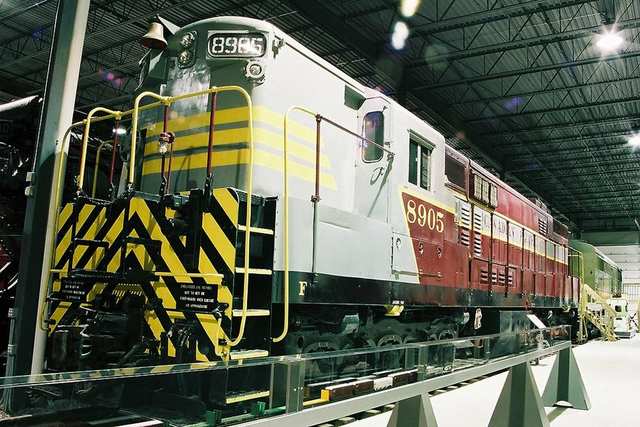
The only surviving “intact” Trainmaster is at the CRHA museum in Saint-Constant, Quebec, CPR # 8905. There is a slug preserved, ex NS, ex N&W, at the Reading Railroad Heritage Museum in the US.
Not quite a Train Master, but this thing still exists too. Completely rebuilt around 1990 it seems, and operating in revenue service for years afterward:
In another thread it was noted that CSX would use three GE C40-8’s to bring loaded coal trains to the plant, and then the FM would drag the same train around the yard by itself. It is located here, unfortunately orphaned on a small stretch of track:
That’s interesting, thanks for posting that video! I had no idea an H-16-66 was still around.
In addition to the Train Masters the Jersey Central also operated some H-16-44’s. “Baby Train Masters” is what they used to call them.
And it’s a CP unit preserved in Canada. I’d ask if it’s operable but I doubt that’s the case.
Certainly the Train Masters were ahead of their time, but maintanance crews hated them, they were a pain to work on, and road crews weren’t too crazy about them either. If they weren’t run short hood forward exhaust fumes would drift into the cab nauseating the crew.
I wanted to talk about this in more detail, but the arrival of Train Masters, aka 8900’s, on the CPR was huge.
It was the first locomotive CP ever owned, steam or diesel, that could lift a train loaded to the “A” ratings of the units, from a stop, uphill, on the west side of the Kicking Horse Pass at the Continental Divide. This changed operations, dispatching in particular, as it gave a huge increase in options in many situations. Both EB and WB trains could now be put into sidings as required.
Other brands of diesels might be able to get a train started, but the first transition would not be smooth enough to avoid a pull apart. The gap between having to pull the Train Masters off the Laggan Sub. due to their ureliability, and the arrival of the SD40’s was a huge problem.
It has been speculated that had mechanical forces been afforded modern in-house traning courses, instead of having to learn on the job, the life spans of these units might have been much longer.
I always felt the FM’s with the opposed pistion prime movers that were originally designed for maritime usage were not suited to railroad operations. In the marine enviornment they could operate at a steady throttle setting for hours on end. In the railroad enviornment the throttle was being constantly manipulated up and down. Throw in the vibrations transmitted through the carbody and engine from couplings in yard service to slack action in road service and it wasn’t long before the FM’s were blowing oil all over the place.
At least that was my experience when I was a Trainmaster in Baltimore Terminal that e
I have had some discussions about this with one of the lead engineers that designed the ‘railroad’ version of the OP engine. It was interesting to find out what had, and what hadn’t, been assumed when the detail design of the engine was conducted.
The problems you describe are much more specific to OP use in switching service, particularly flat service involving kicking cars, than to use in the kind of service normal for something like a TrainMaster. Not sure that road shocks, even in an engine coordinating two dephased and heavy rotating assemblies with a geared shaft, would lead to increased wear clearances (and initial oil ‘blowing’ per se) over other kinds of engine running at comparable speed. On the other hand, it became pretty clear over the years there were significant problems, some that competing engine technologies simply didn’t have.
I had thought the principal ‘unsuitable’ issue was a seemingly peripheral one: overhauls involving what would have been simple power-pack replacement on an EMD engine would involve pulling the whole upper crankcase assembly, and then of course replace it and adjust things when done: that likely resulted in the locomotives being left as long as possible between that kind of intervention. Meanwhile some of the lubricant that might leak out of loose clearances in the upper rotating assembly might find its way down along the rods or cylinder walls to the back sides of the upper pistons, where it might pass loose rings on the intake stroke or start coking and block recirculation. Apparently this was a major issue if the engines saw any extended period of idling once wear had been allowed to accrue, leading to the infamous blue haze (which I think is what Balt means when he says 'bl
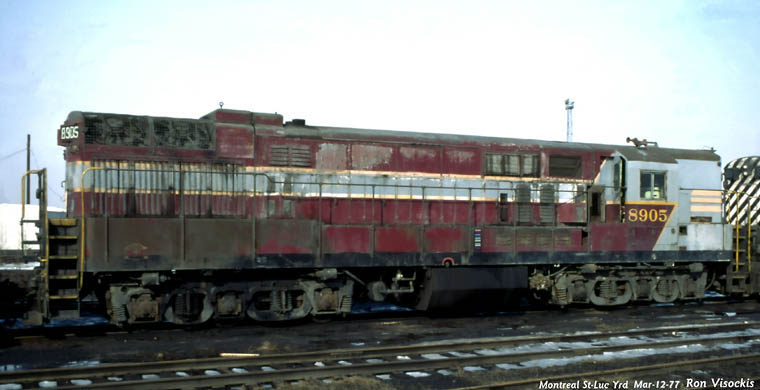
Here is a picture of the 8905, the only FM H 24-66 preserved,as shown earlier in this thread, still in regular service but near the end of her career. Looks like they have some cleaning to do.
Compare this to the first picture on the thread “new out of the box”.
The exact opposite.
One of the last three (8900 8904 8905) of 21 Canadian Locomotive Company Fairbanks-Morse H24-66 2400 HP 75 MPH Train Master units in use, already retired 6/1976. (Rest assured the CPR got the last mile out of these units, first at Alyth yard and then St.Luc; most had been retired in 1968.) #2922 6/1956 Note: Traction motors from eight Train Masters were
traded-in for use on new MLW units C-630 4500-4507. 8905 has been preserved and is now displayed at Exporail. Ron Visockis
So, a question to all our FM afficinadoes … is all that dirt and grime plastered all over the 8905 a result of the opposed piston and throwing/leaking/exhausting oil all over the place as has been mentioned?