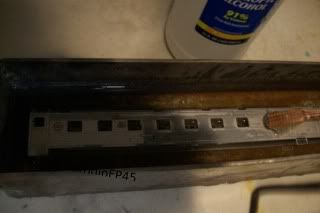
Originally I was going to wait until I finished these units, but then thought ‘Why not share what I have so far?’
Subject: 3 HO passenger cars shells. A Rivarossi Sleeper, Walthers Baggage-Dormitory, and a Rivarossi Coach.
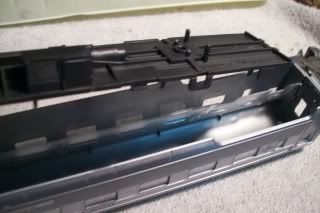
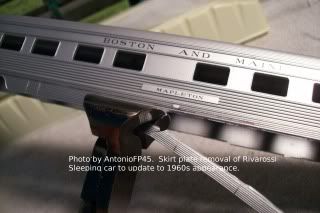
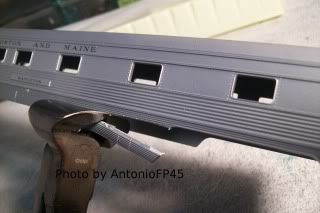
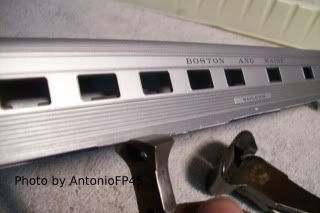
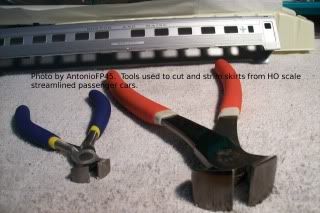
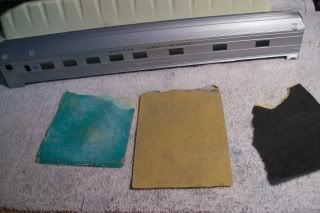
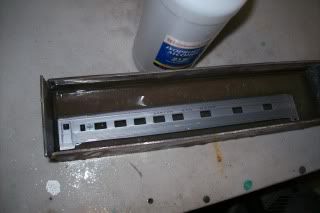
Rivarossi Sleeper: Proceeded to disassemble the unit, trim off the skirting, and finish-sanded the wall bottoms with: 80 grit, 220 grit, and 500 grit abrasives.
The Rivarossi Sleeper and Walthers Baggage-Dorm units were paint stripped with 91% Isopropyl alcohol:
Good to see your works in progress, and am looking forward to seeing the finished product. I ran out of Alcald on my last coach, so nothing more until I buy some more!!
Thanks guys. This process has become a lot of fun and once you get past the initial feel for it, imho, it becomes a breeze! I posted the paragraph below on the Atlas forum and hope that it can be of help. From my understanding a more modeler railroaders have become interested in metalizing; especially since out-of-stock Walthers and BLI plated units fetch a premium on ebay.
NOTE: Some of you indicated that the thread on the Santa Fe Pleasure Dome unit was helpful. However, we’re human and make mistakes (I certainly do!). If after having metalized a shell, you feel that the finish is too rough, orange peely, or appears patchy…don’t panic and throw in the towel! You don’t have to paint strip the Alcladded shell. After it’s cured, put warm soapy water (Dawn or Ivory Liquid) in your sink or small container. Wet-sand your shell with a 3M Gray Scotch Pad in long strokes and check the surface every 30 seconds. Then wet nib-sand between the windows. The Scotch Pad won’t damage corrugated pleats. Finish wet-sanding the shell with 3M 1500 grit. Check for smoothness. After drying, the shell is good to go and ready for a new base coat followed by Alclad and clear coat. Guys, I’ve done this twice each time in less than 10 minutes! Piece of cake.
Regarding the Rivarossi coach in the above photos. You can see how white-like the surface appears using the Alclad Light Gray base. This, imho, would be good for an ACF unit or a Budd with a very faded tone (worn or reflective)
Although the prototype was a beautiful train, I don’t think I’ll be going for the El Cap units as my focus is primarily the SCL, ACL, and New Haven. My current goal is creating a metalized versions of
The SCL Champion with Walthers and Rivarossi units pulled by P2K E7s and E8s.
A New Haven Railroad commuter train with E&B Valley car kits and (hopefully) an GE EP-5 electric.
IMHO, the “new look” that Walthers has applied to their latest unit(s) would be more appropriate for a later era (1960s forward) as stainless steel gradually lightens in tone. But that’s just my opinion. I hope to see one of these new units up close.
BTW: I purchased an HO Amfleet unit off of ebay. I don’t model modern Amtrak, but since I have access to the prototype (hopefully still) I thought I’d try this challenge with the unit pictured below:
I’ll likely apply a dark gray base color on this unit.
For those of you metalizing your passenger cars, this may be helpful.
Got a photo from a modeler Alcladding a plastic HO 85t coach. He feels awkward about having his photo posted here so I’ll respect that.
His finish looks blotchy. It’s easy to see areas of his dark gray base color showing through the Alclad. The Alclad itself, shows little reflectivity. He can redo the shell again by wet-sanding it with a gray 3M Scotch Pad and reapplying a fresh basecoat. IMHO, I think I know what the problem is.
Guys, not a put-down, but I’ve noticed a consistent habit with some modelers over the years, evident by some of the photos of painted model freight cars and locomotives on several forums: They worry about getting runs or sags when applying gloss paints and/or clears. So they airbrush them on either
A. Too quickly. B. From too great a distance. C. With too high of an air pressure setting. D. Don’t thin them sufficiently for good surface flow out. E. A combination of one or two of the above.
I felt similar feelings of apprehension as an apprentice collision repair tech years ago. It’s worth it to PRACTICE on some scrap plastic material and take mental notes of your stroke speed and distance. You will improve! You’ve got to get that basecoat and/or clear coat on WET and SMOOTH before applying Alclad.
Please forgive my repetitiveness…
Make certain that the base coat color, regardless of the tone, has a gloss finish. If it appears dull and/or rough; don’t apply the metalizer. Wet sand that base color, re-apply a new coat of gloss base color or high gloss clear. Walk away from it after you finish, do something else around your home, and come back later as your mind will be fresh when viewing your finish.
Airbrush stroke pattern with Alclad: The term “mist coat” might be misunderstood as to mean "spray at high speed so
The cars look awesome. I’ve wanted to try the Alclad finish out and I have some CN Trailers that are supposed to be stainless steel. I had already Floquil primered them because they are a soft white plastic (Promotex). Can I just go over that or do I have to use Alclad’s primer? Thanks
 Walthers-