A couple of months ago, I used some spare parts from failed projects to kitbash a no. 9 for the BVLC:
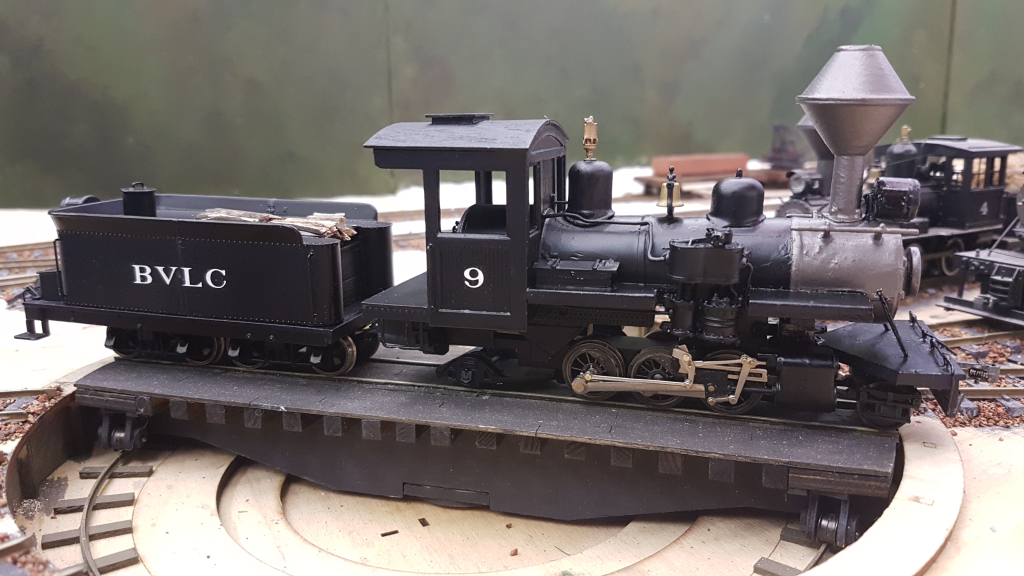
However, this model didn’t really run smoothly. It had a ‘limp’, and a tendency to slow down at a couple of spots on the track that didn’t give any other engines trouble. I tried to fix these faults. However, I was unable to do so, and ended up with a model that could barely run in a straight line. As such, I decided to consign it to the ‘graveyard’, my shoebox of failed projects.
While doing so, the question of what to do for no. 9 came to mind. I did consider purchasing one of the outside-frame 4-4-0s made by Bachmann, but they’re too long to fit on my turntable. However, there was another mechanism in the graveyard that I thought I may be able to use.
Back when I’d first gotten into On30, my very first attempt at a HO–>On30 conversion was a Backwoods Miniatures 2-6-2ST kit, which used the mechanism from a Bachmann HO scale saddle-tank switcher. At the time, I hadn’t been able to get it to work satisfactorily, either. The short wheelbase didn’t provide for much of a power pickup footprint, and the mechanism had a tendency to ‘bunnyhop’ down the track. Furthermore, in the time since then, I’d ‘borrowed’ the brushes and springs from this model’s motor to keep another one going.
However, there was one other model in the graveyard, a Roundhouse ‘old-time’ 2-8-0 which I’d attempted to convert. It had run into the same problems as the 2-6-2 above - namely, the mechanism would stall at some points that didn’t give the other engines any problems. But although the chassis from this model wasn’t reliable, the motor from it was still good.