this might be a shock to you but my great grandfather is the current owner of S-1!
I have gotten to drive the S-1 before
Does anyone here have further interest in how ‘fireless cookers’ work – or what the fun point of a caustic-soda locomotive was?
There were some great and deeply-involved threads on the subject of energy-storage locomotives on the old steam_tech Yahoo group, but the archives died last December and the group itself is slated to disappear at the end of this year along with Yahoo Groups itself. There is a parallel group set up at groups.io but many members of the old group have ‘issues’ with groups.io, will not join, and don’t want their content or old posts archived there.
Harry Valentine did some extensive work on ‘modern’ versions of the idea, and someone interested in modern modeling might ‘do’ a version of one of his locomotives, especially now that Progress Rail is trying to flog the Joule as a kind of fuelless switching ‘weapons system’.
Could electric power heat water to steam to power a locomotive and replace the current electromagnetic drive?
The Hornby OO scale locomotive idea scaled up to prototype.
People are silly. Groups.io actually works, unlike Yahoo. You can even do proper replies when receiving feeds in digest format! Can’t believe they ‘trust’ Yahoo but not groups.io. Glad all my groups have been moved over.
There is an interesting bit on a “soda motor” in the Baldwin book I have - seems they built at least one.
The enormous amount of energy stored in high pressure, high temperature steam seems to be a tough concept to wrap the brain around. Launching parts of an ordinary steam locomotive over a mile after a boiler explosion should be some clue. It’s all about the controlled release of said energy.
–Randy
WHat would the benefit be? There’s a loss every time you change to a different medium, so using the overhead that feeds electrically driven trains to instead boil water to power a steam engine is goign to be many times less efficient than just running the electric motors. And using a diesel engine, to turn an alternator, to heat water to drive a steam engine - that’s beyond silly. Less efficient than just burning the fuel oil to directly heat the water, like an oil fired steam engine.
–Randy
It’s been done, in Switzerland.
Technically it’s not as daft an idea as it looks ‘thermodynamically’. If you were to implement a fireless cooker, you could use the electrical elements to ‘make up’ some of the heat lost in the steam consumption, or lost to the environment with the engine standing. Think of it as an active equivalent of what the caustic soda does with the exhaust water in a soda motor…
Unfortunately that doesn’t seem to be how the engine was designed: it used electric elements in place of the ‘fire’ and suffered just the lack of efficiency you’d expect from radiant heat misapplied in practice. It has always seemed strange that they’d ‘miss’ so badly…
The operative principle appeared to me, when I was younger, to be that hydropower was ‘too cheap to meter’ up where that locomotive was switching, while coal or other fuel certainly wouldn’t be. In wartime or postwar conditions where expensive electrical traction gear might be expensive to procure, a bunch of Calrod-style elements might be easier to arrange for a cheaply-available ‘preexisting-condition’ switch engine.
Now, as an ‘optional range extender’ for service between fixed fireless ‘recharges’ … or for a ‘burst of flavor’ if doing flat switching, the idea of electrical heat or even superheat might make superficial ‘sense’. The catch is in providing the electrical overhead in a yard or industrial facility to make the trick work. A cheap alternative might be to set up a ‘dock’ of some kind, perhaps with crude electrical contacts, and put the locomotive there to soak instead of using sparged high-pressure steam for recharging every time…
In my opinion making an electrical ‘flash boiler’ as in
There are two specific issues. The first is that, in the fine print in legal, there is a clause that states the owner of groups.io has full rights to use the content in any way he deems fit, without notice, compensation, or recourse. This is standard boilerplate for many hosting sites, but a large number of steam_tech members are European and object violently to the implied lack of control over ‘their’ content.
The second issue is that steam_tech has a very large files and photos section. Hosting even a small part puts it into the ‘pay’ tier in groups.io pricing; the whole archives involves an upper price tier. The group was founded as ‘free’ and there is little support in going (like the Civil War modeling group) to a paid membership model.
Not that kind of soda – they meant caustic soda, but for obvious reasons didn’t want to say the c-word or the l-word where the public might cotton to there being 5 tons or more of sodium hydroxide only a boiler explosion away… [:-^]
See in particular the Honigmann locomotive design here. This is about as good a ‘fireless’ design as probably any fireless use needed; note the arrangements for light superheat to improve the mechanical performance. The problem with using a more modern high-pressure fireless design is that boiler feedwater in those has to be better purified or distilled, and this would be an additional regeneration cost. Interestingly modern materials have probably solved the cost-effective regeneration of the “soda” without heavy regenerator corrosion… I thought this cycle was a strong contender for the California “Sun Train” project a few years ago.
Yes, I know they ran on sodium hydroxide. The burp commehnt was actually made by the author of the book as part of the caption - also tongue in cheek as I’m pretty sure Fred Westing knew it didn’t run on cabonated water either. Or sodium bicarbonate. Hmm, baking soda and vinegar made for good little rockets… naaah.
–Randy
I know you know, and I remember Fred Westing knowing (but I don’t remember him in The Locomotives that Baldwin Built telling exactly how the trick was done.
I still think Perkins gets a gold star for making calcium chloride work…
Theoretically, anything that generats a gas at pressure can be used. Some things are more efficient than others, and some do not generate a gas that causes sudden death, but other than that…
One of the options to electric cars is hydrogen - could try that, too. But even more so than in a car, the integrity of the pressure vessel is critical, at the kind of pressures they are using. Plus gaseous hydrogen in the presence of oxygen is rather flammable, as the passengers and crew of the Hindenberg found out to their extreme detriment.
–Randy
A fireless steam locomotive UK style. The locomotive is now at the ‘Locomotion’ Musum, Shildon, County Durham, England.

David
All these engines are steam engines, pure and simple. I confess that when I first read Westing’s book circa age 12, I thought the ‘soda’ motor used CO2 (like the old Cox toys with the compressed-gas ampoules made for at-home seltzer and cream-whipping) but that was wrong-o.
If you remember the original Fowler’s Ghost, you know that ‘heat recovery’ by condensing exhaust steam into feedwater is a losing proposition in a comparatively short time: the latent heat of condensation being so great that 1lb of condensing steam raises over 6lb of water to the boiling point from room temperature. So a better source to stick the exhaust – condensers using air being bulky and likely needing fan power – and condense it quickly needed to be found. The idea is to pass the steam through a chemical that reacts with it… and ideally releases heat in the process. If you jacket a fireless locomotive ‘boiler’ with this stuff inside, you can get a triple treat: the water exhaust and its residual heat disappear, the jacket keeps the hotter supercritical water charge hot longer, and by passing the (inherently saturated) throttle steam to the cylinders through the hot material in the jacket you can get up to 40 degrees F of superheat at pressure, which cuts down on wall and nucleate condensation just as in fired engines.
Then you can use any applicable heat source to ‘boil off’ the water from the jacket material – slowly if necessary – to reuse it. (It was this part of the process that made early commercial ‘soda motors’, like the Perkins design earlier, uneconomical … and of course the introduction of practical electric trolleys ‘subsidized’ by developing utility companies, and then development of practical-scale gas engines, put the final kibosh on the idea for street transit or subway use…
Since someone revived this thread my answer to the original question is YES.
For fun, I purchased this fireless locomotive (a European Liliput model) and converted it for the North American context. For some reason, Europeans put the pistons near the cab for their prototypes. So, I managed to reverse the pistons on this Lilliput engine that I found on Ebay, and converted it to DCC with an LED headlight. I also shaved the wheels a bit to make it work properly on our North American rails… Did that with my Dremel with the engine turning upside down. I tried a needle file but that would have taken forever. I gave her a new color and did a bit of weathering. I painted the engine with Vallejo acrylic paint. The first coat did not stick to anything, so I used Vallejo acrylic primer for my second try. That seemed to work.
Simon
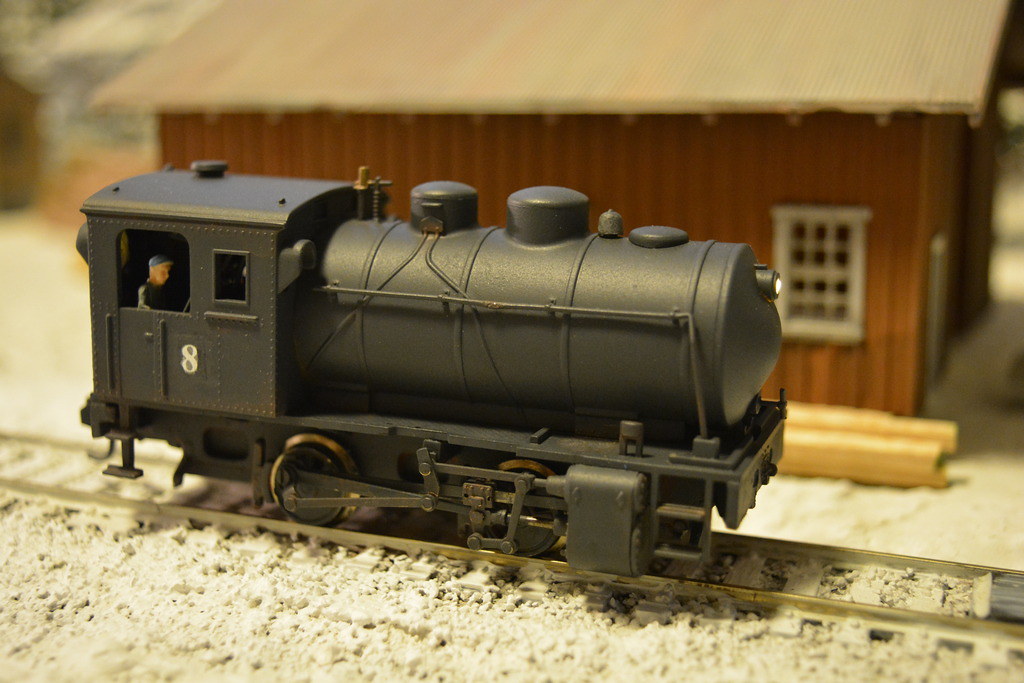 0-4-0 fireless_0004_zpsvfwofwpt on Flickr
I know of a new company called Apogee Locomotive Works that produces 3d printed shell kits of fireless locomotives. They fit on Ho scale Bachmann Porters. Last I checked they have quite a few different ones.
Interesting stuff these guys make – not just fireless cookers
It is a misnomer to say these locos had a boiler. They have a steam tank not a boiler hence the size. National Cash Register in Dayton Ohio used one until about 1970. It is now in a park near the plant. Very slow speed. I never saw it move more then 2 cars.