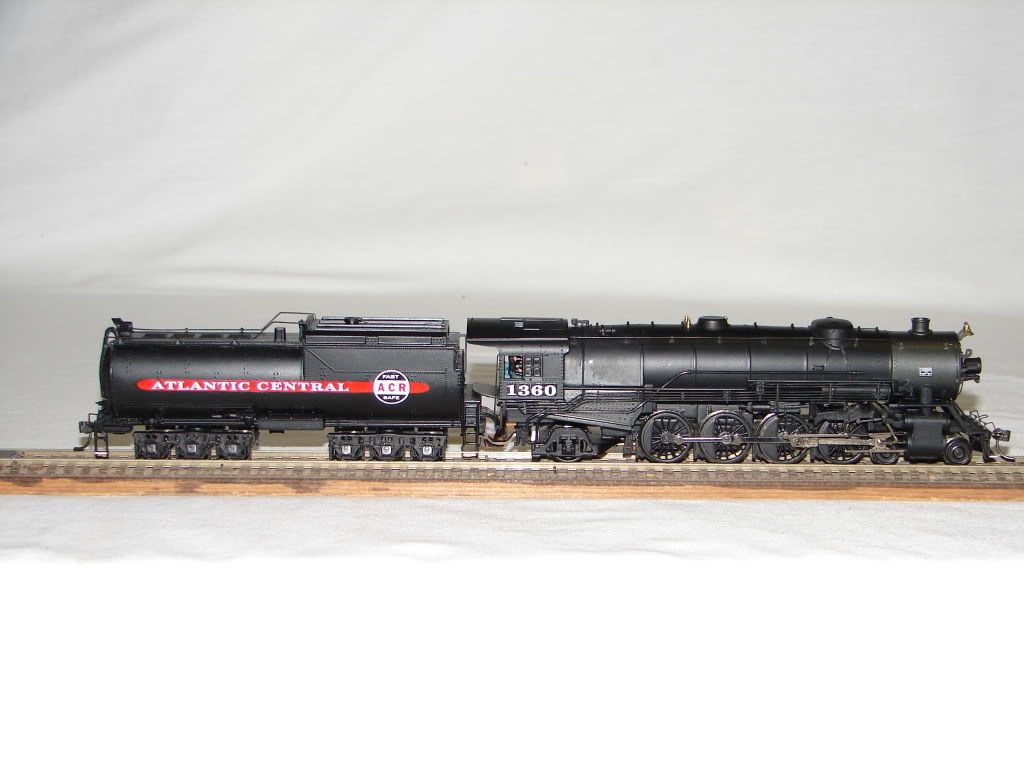
I was getting ready to apply water-soluble type standard decals on a smooth painted surface of a water tank when I happened to look at Jeff Wilson’s advice about flat paint and decal application (don’t!), as he mentioned in his Basic Painting and Weathering book.
Now, I used good old Rustoleum red oxide auto primer. The finish is smooth- at least at a non-microscopic level, but Jeff felt that there were surface irregularities that resulted in many small air bubbles, remaining even when using micro-sol to help the decal lay flat.
Before I ruin this latest project, can anyone give me some advice on this issue- any experience with decals and flat finishes?
As Jeff Wilson mentioned, don’t. Apply a coat of clear and apply the decals then. Otherwise you have the possibility of the decals “slivering” - tiny pockets of air trapped underneath in the rough flat surface. You’ll waste the decals, your time, and maybe a paint job. Better to be safe than sorry!
It’s good advice, unless you want your decals to crack, dimple and peel. But, sometimes that’s exactly the look you want, particularly if you are modeling a weathered, sun-beaten surface.
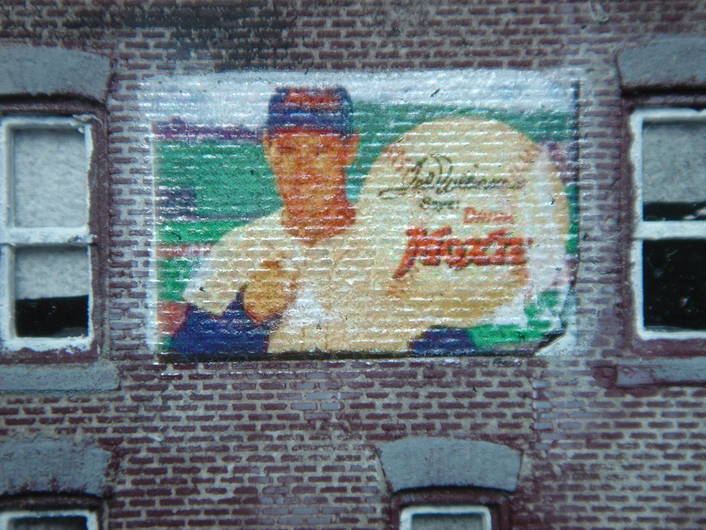
Years of sunlight, wind and rain have taken their toll on this one-new-looking ad for Moxie:
I applied this home-made decal over a rough brick surface, which had been mortared and Dul-coated, and then painted with flat acrylic white rectangle to get the colors to come out right. I applied Micro-Sol to settle the decal in, and then gave it another shot of Dul-Coat to seal the decal permanently.
Where did the idea start that Rustoleum or other “hardware” paints are suitable for model work?
Model paints have much finer ground pigments so as not to fill in and hide detail.
Decals should always be applied to a gloss surface, the best and easiest way to do this is simply use gloss paint in the first place - like Scalecoat or Scalecoat II.
Then apply clear flat or satin over the whole model to give whatever luster is desired.
The fewer coats of paint, clear or otherwise, the better your model will look.
An airbrush is much prefered over rattle cans for a good quality finish.
But what do I know, I’ve only been doing this since 1968.
I am aware of paint particulate differences, but have no problem with specific applications of certain spray paints for HO structural models. In the use I made of Rustoleum primer, it is on a smooth plastic surface (water tank courses) thru which the rivet details show quite clearly after a careful 2-pass spray treatment.
The best course of action I have found is to take a new exacto blade and poke the tiny bubbles, reapply decal solution, let dry and repeat. Eventually you will get rid of the bubbles (a layer of gloss coat will help decals adhere better before applying them)
If you find your not getting results with the microscale (if your using the blue set try using the red) you can try champ decal set or as a last resort walthers solvaset (dont let solvaset pool on your model)
When was it published that they are not good paints for Models? Why not? I will buy these paints, shoot them through a straw and then airbrush with them. Is that wrong or is that frugal?
You keep telling us what you “know”, but never show us pictures of your work. Why not publish them for our benefit so we can aspire to your work? Who knows, the OP’s work might out shine yours.
Most of the advise you’re getting is correct. Std procedure is to clear coat (in the color coat is at all flat), apply the decals (with a decal solvent, to make them lay flat), let dry thoroughly and then dullcoat. Extra weathering can be done over the dullcoat, if desired.
IF your “lazy”, here’s another trick. Brush on a coat of Future floor wax over the area to receive the decals, let dry, then apply the decals as above. After they’ve dried, at least a few days, spray or brush over a dullcoat.
Unfortunately, the end result has to match what YOU are looking for, so you may have to experiment.
Never apply decals to a flat painted surface if much or some of the decal is clear decal film. You will never completely get rid of the ‘silvering’ effect caused by minute air bubbles under the surface of the decal film. If it is a sign that is totally opague as in MisterBeasleys’ example, then you can get away with putting it on a flat or irregular surface although I would still try to get it on a glossy one.
Sometimes, if I know the exact dimensions of a sign; let’s say 1 x 2 inches, I will mask off the area on my plastic structure. After spray painting I will remove the masking tape and apply the decal to the unpainted slick service. This of course only works with a completely opague sign where no clear decal film is present.
I would never use spray cans of Rustoleum or any other brand to paint rolling stock, but they are excellent for painting brick or concrete structures. Many of the primer paints are an excellent brick color.
Dale Latham, Piedmont Southern RR, Great Model Railroads 2009
I try to always give some thought to the texture of surfaces. When we look at something, we don’t actually “see” the surface, we see the light which bounces off the surface. In building a model, we will perceive it as more “realistic” if light reflects off of it the same way it does off the prototype.
So, a shiny new car needs to have a smooth surface, resulting in a “specular” reflection, where most of the light follows the simple rule angle of incidence = angle of reflection. On a dull surface, the incident light is scattered in many directions, so you don’t get a bright reflection at all.
Plastic is good for modeling metal, because both give a clean, specular reflection. It’s not so good at modeling wood, rock or brick. That’s why an unweathered plastic model looks so wrong. The fine-grained surface just doesn’t match the prototype at all. Fortunately, there is Dul-Coat.
A decal is a nice smooth surface, so it’s the kind of thing you want for that fresh-from-the-paint-shop look on a locomotive. For any other need, though, it’s got to be “taken down a notch” to break up that sharp light reflection.