Using birch veneer plywod for benchwork is a good solution to the problem of finding nice, straight dimensional lumber. I won’t even consider using MDF. It has very little structural integrity and as others have mentioned is does not hold nails or screws well. Maxman is correct in that the differences between CDX and the birch plywood are the number of laminations and the lack of voids in the furniture grade plywood. The more laminations, the stronger the plywood and less likely to warp. The lack of voids is important since you wouldn’t want to have voids as you rip the plywood to length and width. Murphy’s law says the void will always be in the wrong location. I’ve been building modules for years using 3/4" bircher plywood with excellent results. At a minimum I would use a BC grade plywood; smoother and fewer voids and defects. Just go to your local home center and look at the CDX plywood and compare it to the birch plywood. Which one lays flatter and truer?
Real birch plywood is more expensive than the generic ‘hardwood’ plywood at the local Home Depot. So I’ve been using the generic stuff. It comes with 9 layers and is generally pretty flat (as opposed to the doug fir plywood which almost universally has quite a bow to it).
So far the hardwood plywood is serving me well. Nearly all the joists under my layout are made of the stuff. And I also use it for the flat places like a town.
It can be ripped to nearly any size needed and is pretty stable dimensionally.
Regards,
Charlie Comstock
As you can read from many of the replies, there are many suggestions and pointers. What I would like to say is, if money is no issue for you, and you can readily obtain birch plywood, it is certainly very nice to work with, and is used extensively for cabinetry. It would be considered “overkill” here in the States however. I used 3/4" cdx plywood. ( See webshots site at the bottom, and you can find photos of my benches before and after 2" foam glued to top of plywood.)
The climate here varies from -10F to 95F for temperature range ( extremes can hit -22F to 105F, but this is rare ). The Dew Point ranges from -20F to 75F, so it can get extremely dry, or extremely humid. I have not had any warpage with my plywood under these conditions. The plywood is screwed down well with decking screws.
If you care about appearances, where the wood will show, cdx plywood is not the best choice. I didn’t care because everything was being covered with foam and scenery.
Hope this helps,
I just started building my benchwork last week using 1x3s ripped from birch plywood (see my pics at the bottom of this post). I will never use anything else. I started using pine 1x3s , but after I received a lot of negative feedback on this forum and from friends regarding warping and sagging, I switched to the birch. BTW, the birch is the top of the line, but you are not paying more for birch per se, you are paying more for a multiple-layered cabinet grade hardwood (for example, oak plywood and birch are both about $46 a sheet at Home Depot around Atlanta). I considered using a lesser grade plywood, but looking at the stacks of CDX, you could see they were slightly bowed and warped a bit, while the stacks of birch and oak were perfectly flat. My wall brackets made from the birch are very solid–they dont wiggle, jiggle or do any other “iggle” when I pull on them. By the way, today I carried the bundles of my pine 1x3s out of the layout room to make way for more construction, and while they were all straight when purchased last month, some of them are now bowed at least an inch out from the rest of the stack. That made me feel really good about switching to birch.
While I have not used MDF, I have been following the construction of another n-scale layout that is using it almost exclusively. Looks like it is going well so far:
http://www.owensvalleysub.com/
Here are some pics of my birch benchwork:

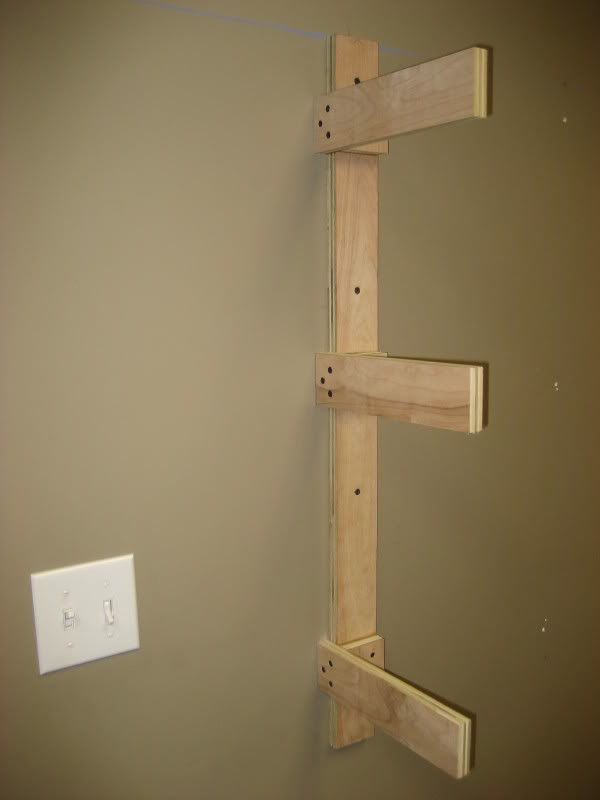
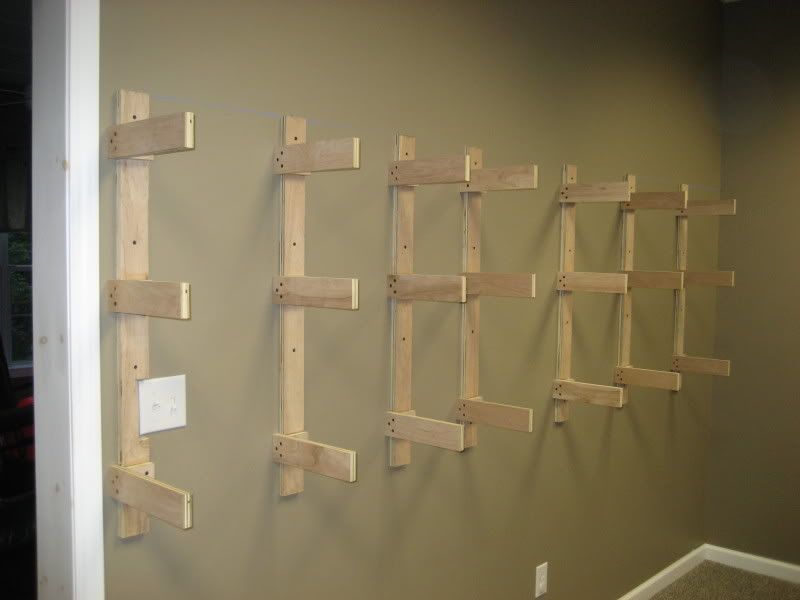
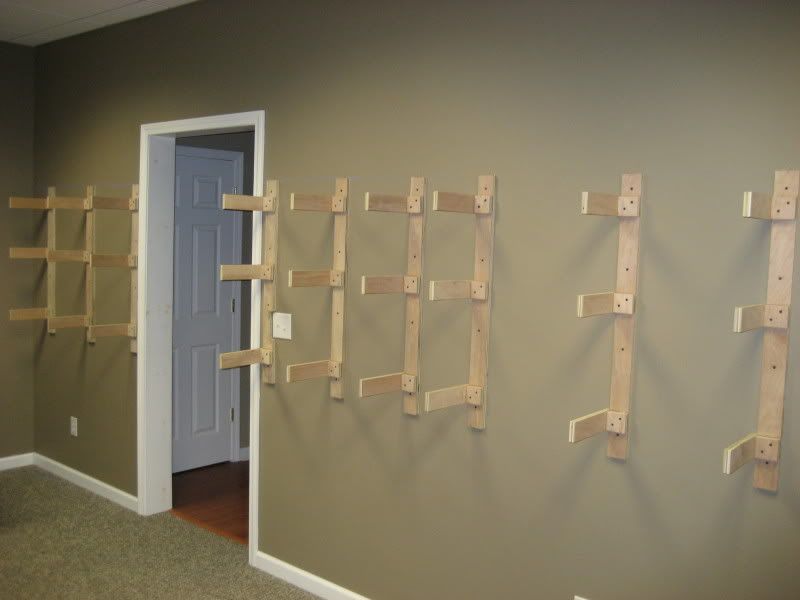
Jamie
I have a follow-up to report on this topic. I continue to be very happy with the results of the benchwork built from ripped birch plywood (as reported in my previous post). Last week, I went out to buy two more sheets for the next round. However, at the Home Depot I went to this time, they were out of birch and the last remaining sheets of oak were not in good shape. So, I purchased two sheets of 3/4" Sandeply. The stack looked nice and flat and the surfaces are very smooth (though not as smooth as birch or oak). I had HD rip the two 8x4’ sheets down to four 8x2’ sheets for easy transport home.
Yesterday I went to go work with this new material. Lo and behold, two of the four 8x2’ sheets have already curved up at the ends nearly 1/2" at each end. After ripping one down to 1x2" boards, some look like I could build an arch bridge without having to bend the arch. In fact, one of the 1x2" board archs up so much in the middle that the bottom of it is above the adjacent 1x2" I ripped from the birch. I can actually work around this by laminating two 1x2s together, but I’ll never use it again. And the stuff is not cheap–I paid $46 for the birch and this was $40 a sheet. I said I would never go back from birch, I did, and I got burned. Oh well…live and learn.
Jamie
I was curious as to what Sandeply is, so I put it into GOOGLE. Here is one person’s opinion:
Quote:
| Originally Posted by Corndog  O.K. I thought I’d heard of everything but WHAT is Sandeply??? |
| - |
It’s like the pot luck of plywood…usually made of some crappy wood from Malaysia or China and if you’re lucky the veneer won’t bubble after painting it. It has a nice clear appearance and the price is tempting for those bargain hunting, but I would never recommend it for anything other than “fun” experimental projects. I’ve used it to rip for shelving.
I guess he didn’t like it either!
I am currently re-building two 24 year old 2 x 6 HO modules; using ripped birch as framework. Transport issues mean I am building three 2 x 4 modules. First frame is ripped; planning on ripping rest of frames and cutting tops in the next couple of nights. If I remember to do it; I’ll post some pictures.
Hard deadline of Temple Train Show in September.
Also working on an AMB Santa Fe depot; 2 vertical tanks (one water & one oil) and several other structures.
If all goes to plan; a 4th module will be added that creates a junction with a yet to be built Free-Mo layout based on the San Saba division of the ATSF in Central Texas; Lometa to Brady to Eden/Menard.
Thankfully all of the Sandeply on my layout will be used for non-critical structural parts such as front boards. So if the veneer tries to delaminate, there will be Masonite fascia screwed to the front keeping it together, and the wavy-gravy nature will be taken care of by the fact it is screwed to the joists every 16". It is still way better than pine boards but not even close to the same zip code as the real hardwoods. Jamie
After reading all of this, steel studs are starting to look pretty promising!
Electrolove, two reasons we use Birch cabinet grade plywood for Free-mo modules, and for my benchwork at home: 1. More plies with no voids, so it is stronger than regular plywood or board lumber, and, 2. It is dimensionally stable with no warping. jc5729 John Colley, Port Townsend, WA
The post has wandered just a little bit hasn’t it!?
I have not had occasion to work with it but my woodworking mags give Baltic Birch ply accolades for stability. Per square foot it is close to twice the expense of 3/8 inch pine. I’m not quite sure just what particular materials Mr. electrolove has available to him in far off Scandahoovia but if Baltic Birch was reasonable in price I suppose I would go with it!
Some 20 years ago I made a 4 ft long book shelf using 3/4" birch plywood for the shelves supported only at the ends. In all that time they have never sagged even though I load them up with books and stacks of magazines. If I were going plywood, I would use birch.
Enjoy
Paul
I’ve used 3/4 inch birch plywood for most of my layout, and it’s great, straight and solid. Then again of course, all of my benchwork is way over-engineered, a truck could run over it. But I’ve also used 1/2 inch Sandeply on stretches on my upper level, and I was curious about the responses here because I’ve had no problems at all with the Sandeply, no warping, and it seems like high quality stuff to me. And my basement is definitely on the humid side. I was very careful ab out picking the straightest pieces however, but again on just about anything YMMV.
I am still having Sandeply nightmares! It is so NOT in the same league as the birch plywood yet it is certainly in the same price range. Of course, I would probably be just fine with it if I hadn’t started off with the birch. And it will probably perform just fine over the life of the railroad–I am just now a hardwood-only guy [:)] Jamie
Electrolove-I’m sorry that I do not have any pictures to show you, but if you are familiar with the “worlds Greatest Hobby” video, hosted and narrated my Actor Michael Gross, it shows step by step how to construct a light weight, yet VERY sturdy layout using 1/2 inch Birch veneer Cabinet Grade plywood.
I have been a Cabinetmaker for quite a few years now, and if I recall, in Europe you have available to you Baltic Birch plywood which comes in approximatly 1.5 meter squares, and has about 7 layers in the 12~13 mm thickness (that’s 5’ x 5’ x 1/2" for us Imperialist…lol). This Baltic Birch product of Europe in much denser than what we use here in the States.
Our Cabinet Grade ply, which many people, including myself, swear by, actually has a Poplar core of only 5 layers in 1/2 inch thickness(7 layers in 3/4 inch), ((less commonly a spruce/pine, core is sometimes used))and very thin Birch veneer on each side. 95% of what we use in our particular Cabinetshop is grade C-3. this gives one nearly flawless surface, second surface may not have as nice of an appearance (matching of veneer grains, knots in surface veneer, color variances in veneer surface, etc), and would contain less than 3% voids plus voids in each layer would be oriented such that no 2 layers would have a void within 6 inches of the next layers void. As others have stated, US Cabinet Grade plywood can be had with just about any veneer wood surface, but what makes it so nice to work with in the predominatly Poplar core material. Poplar is a moderatly soft wood, but has much better stability charicteristics than Pine.
But back to your Baltic Birch. By all means, use that Birch plywood, but I would advise pre-drillin
Outstanding response there KingConrail76! Outstanding response!
Based upon an experience I will second your suggestion of always predrilling plywood!