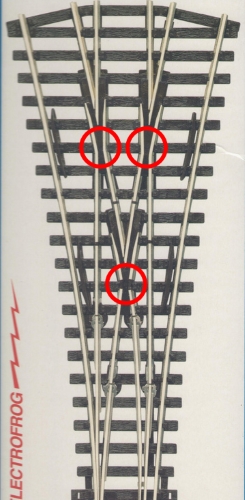
During my last operating session, I discovered that my diesel locomotive was shorting out when it tried to cross the 3-way turnout I have on my layout. Every other loco works fine over that turnout, and the diesel works fine over every other turnout. As such, I’m a bit stuck on where to start looking for the cause of the issue.
The diesel is an Athearn mechanism controlled by a TSU-1100 decoder. For the turnout, I use a Tam Valley Depot dual frog juicer to control the polarity of the various frogs. The shorts happen regardless of how the 3-way turnout is set.
The only thing I’ve noticed is that the wheels on the diesel are a bit dirty, even though it still runs. Other than that, I’m stumped and would appreciate any advice.
Since it’s an Athearn mechanism - is this a newer style one with the internal bearings or an old one with metal sideframes and outside bearings? If the latter, perhaps the sideframe manages to touch somewhere? Or if the newer style, maybe the internal metal sideplate is coming into contact with the rail somewhere?
Does it short no matter what speed? If so, your best bet is to get it to crawl as sloow as possible and carefully watch it, focusing only on one area of the truck at a time, and see exactly what is touching when a short happens.
It’s one of the newer style mechanisms. I’ve got a Dunkirk running on one of the older mechanisms, and that goes through the 3-way without any issues. I’ll give it a creep test and check for the plate, as it does short at any speed.
Rich,
I’ll check the gauge on the wheels, too.
EDIT:
The 3-way turnout is the Peco HO scale code 100 one.
Assuming that it is a short, is it a momentary short as opposed to a dead short?
The red circle on the Peco Code 100 3-way turnout is tightest clearance on the turnout between two rails of opposite polarity. Check there for a momentary short.
The blue circles have more clearance but still tight between two rails of opposite polarity. Check those two spots as well.
I’ve checked the wheels, and they seem to be in gauge, although one axle seems to be a little tight in the slots in the NMRA gauge. Here’s a video of what happens when it hits the turnout:
If you listen carefully, you can hear the sound of the decoder resetting and starting up again, just over the buzzing. When this occurs, one of the tail lights under the layout is lit - this is my short-circuit protection.
All indications are that the wheelset is shorting the turnout. When I mention the word “tight”, I don’t mean to suggest that the wheel is wedged in the turnout but rather that the rails of opposite polarity are so close that the offending wheel is touching both rails simultaneously, causing the short.
Apply some clear nail polish in the area circled in red in my diagram, not much just enough where those two rails converge.
Out of interest, does it do exactly the same when the loco is turned around or another Athearn chassis is run over it? It may be that the truck (bogie to we Aussies) does not quite have enough swing when changing direction. Rich is right about the insulation as well… I found nail polish wore quite quickly so I am playing with some ACC (super glue to us) painted on as an insulator which seems to work better for me at least…
Electrofrogs shouldn’t have that problem. The two ‘legs’ of each frog are electrically the same. There’s no narrow bit of insulation as with an insulfrog, where touching boooth sides of that insulation at the same time does cause a short.
Thank-you to everyone who’s provided advice. I’ve done a bit of poking around, and I think I’ve found what the problem is.
I took one of the axles out of the diesel and rolled it along the turnout, pushing it with my finger. What I found was that at the points circled in the picture above, the back of the wheel was contacting the rail of the opposite polarity, causing a short. These crossovers don’t occur in regular turnouts, hence no short circuits there.
Based on this discussion, I think I have three options:
File down the the pinch points so that there’s a bit more width. This may affect the rails and the tracking/running of the other trains.
Apply clear nailpolish to the points in question.
Replace the wheels on the diesel with the code 88 replacements sets from NWSL. It’s currently got their code 110 sets on it, as I figured I should match the original wheels. However, I’m not 100% sure this will fix the issue.
As I mentioned in an earlier reply, clear nail polish is the easiest solution. Give it a try and see if that solves your problem. Just do a small area so you don’t create a dead zone.
The back of the wheel touching usually means the back to back gauge of the wheels is too tight.
Do not file out the space indicated, you will destroy the tracking through the frog.
Shorting at the top 2 makes no sense if you have a Frog Juicer powering the frogs (you are using two different Forg Juicer outputs, right?). All rails in the red circle on the top two should be the same polarity at any given time as that is all part of the frog assembly. Did you cut the jumpers, if the 3 way even has them, connecting the frog to the point rails? On a regular Electrofrog turnout with a Frog Juicer this isn’t strictly required. There is a gap in each rail that meets at that frog, on the point side, and then you need insulated joiners on the diverging frog rails at the other end. All of that is powered by the Froog Juicer, so there’s no way the rails coming in to the frog from the point side should have different polarities.
I didn’t have track power on when I was doing the testing. I just noticed that that was where the wheel backs managed to touch both rails. When I test-run the diesel itself, it doesn’t get past the first one. I’ve also checked the gauge on the wheels with my NMRA HO scale gauge.
As for the 3-way itself, I didn’t make any modifications to it prior to installation, and still haven’t. All I did was install it, then connect the two wires coming off the sides to the frog juicers.
I’ll try nailpolish on the lower one and see if that works.
clear nail polish does work on typical frog shorting…you coat the top of the railhead in the divergent railheads. This sounds like a short between the back of the wheel and the vertical side of the opposing rail…I don’t think nail polish will work either at all or for very long. You need something more viscous…we use JB weld for these shorts…after applying take a narrow file and smooth off the JB weld. The frog rail spacings are (hopefully) on the high end of the spec. and a little artfully placed JB weld will not compromise the required spacing below the min. works for us.good luck.
I have three Walthers Shinohara Code 83 3-way turnouts laid end-to-end at the entrance to my passenger coach yard. I had problems with all three turnouts shorting where the rails converge beyond the first frog.
Since the clear nail polish proved not to be a permanent solution, I wound up cutting tiny, narrow strips of masking tape and placing the strips over the converging end of one rail on each turnout. That worked and the strips are still in place four years later. You cannot even see that there are small strips of masking tape on the rails.