I need to build a bridge 320’ scale feet long. I’m going to use Micro Engineering bridges. I have 2 85’ deck girder bridges and 3 50’ through girder bridges. To be somewhat prototypical, does it matter what order i install the bridges? I want to put the 50’ sections of the through girder bridges at each end because of the shelf height of the Chooch abutments i’m using and put the deck girders next leaving the 3rd 50’ through girder in the middle. Would that be somewhat prototypical?
This bridge has a mix of deck and through spans:
http://www.historicbridges.org/other/annarbor/
Generally deck spans would be preferred. Through spans are a potentional obstruction. However as shown on the linked page through spans are used where more clearance under the bridge is needed.
INMHO, I think you can put them in any order that works.
I have 2 50’ and 3 30’ deck girder bridges crossing Hammer Creek. DJ.
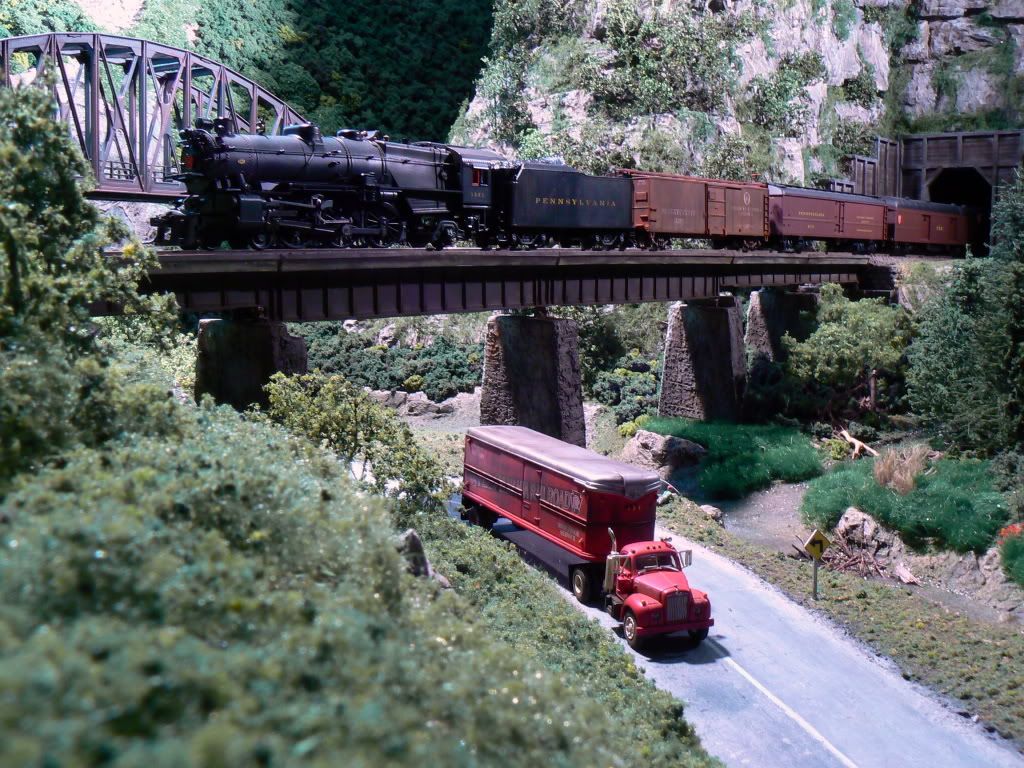
Going purely by the order given, that would be prototypical for a river crossing with roads (or a road and a rail line) on both banks, and a narrow navigable channel. The deck girders would span the shallow water/swamp, while the tthrough girders would clear small towboats, trucks and the competitor’s double stacks (maybe.)
I will admit that the central channel would usually be wider than 40 feet, which is about what would be left after putting piers in the river.
Chuck (Modeling Central Japan in September, 1964)
The type of bridge used is often suited to the site, with through types used where increased clearance was required below. Otherwise, deck-type bridges are generally preferred, as they don’t limit the railroad’s side clearances.
Another consideration is the terrain being crossed, and whether it’s more practical to use more spans with a correspondingly increased number of supports, or longer spans with fewer supports. Of course, a major factor affecting the design is the cost, and the usual approach is to use the cheapest solution which addresses the requirements.
If you don’t need the additional underneath clearance afforded by the through girders, I’d suggest re-working them as deck girders. Then the selection of span length would be determined by the terrain below the bridge: longer spans over water, especially where the support piers are in the water, and, where there’s no water, longer spans where the terrain is at its deepest, as fewer tall (and more expensive) piers will be required.
Wayne