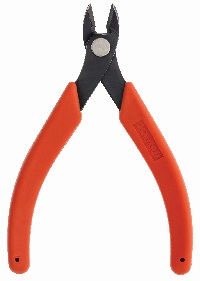
I have a busted Atlas Straight Flex Track #Code 4260104. One end is missing a section of sleepers and the rail is cracked/badly kinked. The rest of the track is fine. It happened when my room was getting rearranged. Rather than throw the track away, I decided to just cut off the broken section, however I’m not sure what to use. Does anyone know the type of plyers to use with this track? If so please provide the tool name and a picture.
Either a Xuron Rail Cutter, or a Dremel with a cut-off disc.
Regular side cutters will distort the rail ends.
The Xuron Rail Cutters are true “Flush-cutting” pliers, with the smooth flat side of the tool leaving a very smooth flat straight edge that needs minimal filing to dress.
Dremel with a cut-off disc will make a purely straight cut, with even less filing needed to dress the rail end. (If any at all.)
You want the Xuron 2175B Track Cutter with the orange handle (above photo). They’re ~$15 and well-worth the investment and having on-hand. Don’t use them for anything else. Finish off the cut ends with a small flat file.
I use the MisterBeasley and tstage method and also have used a fine tooth saw and a plastic block with grooves to match the rail gauge to hold the rail down when making the cut with the saw.
I have three #2175, one is engraved 1/10/09 and one #2175B. Going by XURON’s website, the #2175B must have a different/better cutting jaw pattern for rail then the #2175. (both the #2175 and the 2175B show a ‘‘Shearing action’’ jaws[:O]) Just a better mouse trap I suppose. On testing (25 cuts each with all four tools) both the #2175 and the #2175B on HO c100 brass and NS, c83 NS, cutters making the cut from top of rail to bottom, the end of rail cut pattern when looking under the scope looks the same.
I’ve used the Xuron and the Dremel successfully for decades. Some may disagree, but I always followed the cuts with a swipe of a flat needle file.
One thing to keep in mind…using the Dremel with the cut-off disc works extremely well - but is potentially very dangerous. It can slip/jump off the rail and cut you, or the disc can shatter and throw bits with pretty good force. With that in mind, always wear safety glasses and don’t let yourself get distracted.
For two usable pieces of flex track an Exacto metal backsaw with aluminum mitre box is a good tool. I concur with and emphasize that the Dremel cut off tool requires respect. Clamp down the flex track if you use a Dremel and wear at least eyeglasses, preferable safety shield glasses. I wear eyeglasses only but I am EXTREMELY careful when using a Dremel cut off disc.
Xuron cutters are by far the easiest cutter to use. Three tips: as remarked by others make sure you cut with the flush side against the usable piece of rail. Make sure the plier blades are as close to vertical as you can manage, ideally you want a clean 90 degree cut end for the usable track piece. Get a modellers needle file (buying a set of files with handle is a good addition to your tool kit) and clean up the cut. The flange top and bottom, the railhead top and end face. I’ve found a marginal difference between cutting with the pliers horizontal to the rail and cutting vertically. Horizontal cuts seem to distort the cut end less than vertical cuts, less clean up filing. Maybe that’s four tips but I’m not sure about the last one so try it yourself.
Finally, when making a final cut to length when fitting flex track (not your clean up situation) to exact length to fit a final gap in your track reverse the pliers so that the flat face is away from the final cut end and mark the spot by just pinching the plier enough to nick the flange on both sides. The flat side of the blade is placed against the squared off end of the track you are joining up to. Then re-orient the pliers flat face towards the usable finished end and slide the blades into the nicks, then cut. That positions the cut point exactly where you need it. Perfect length every time and no measurement required. You can feel the plier blades engage into the nicks after a few tries using this technique.
I’ve been using the Xuron cutters for years, and every once in a while I will use a cut-off wheel in my Dremel. I went to a train show a couple of weeks ago and wound up with a metal diamond encrusted cut-off wheel that makes a very fine kerf. You just need to hang on tight and pay attention though.
I have so much trouble with those brittle Dremel wheels – the slightest twist or angle against the kerf will shatter them explosively – that I have gone entirely over to those cheap eBay diamond-saw discs instead. These have a somewhat wider kerf and may leave a bit more pronounced abrasion marks behind, but I’d at least consider them as an option.
At one time I used a thin-kerf backsaw with roller guides; these do not have the slip and progressive-wear issues that regular miter boxes do, and it is in my opinion easier to use.
We have had discussions in the past about adapting a mini ‘chop saw’ with thin-kerf blade to be used to keep a rotary blade truly square with a rail to be cut, both horizontally and vertically. To do this with a regular Dremel can be difficult unless a fairly large-diameter blade is used – a bonded thin-kerf cutoff wheel of that diameter might be over the speed of sound at its edge with predictable consequences.
Eye protection is a must. Last Spike Mike mentioned it when talking about a cutting disk in a Dremel motor tool. Protect eyes when using other tools too.
I had a blade break off of a Xuron rail cutter which flew across the train room. I would not have wanted it to hit one of my eyes.
I have had cut rail fly across the layout when trimming rail on the layout. If I am holding flex track in my hand, I hold the end of the rail being cut so that it doesn’t go flying.
Atlas itself makes a relatively inexpensive track saw
I stopped using the standard Dremel cutting discs years ago, and now use the reinforced discs. They last longer, cut better and do not shatter.
If you get and use the Xuron tool, I suggest marking the handle that it is to be used for track and/or soft wire only . The Xuron tools all look alike to me
When nipping small pieces off the ends of flex track the Xuron cutters will ping the cut off with considerable force and speed. The cut piece will fly off and bounce around. Not to diminish the other hazards but this cut off piece is the most likely bit to cause eye injury.
Since this has now passed into judgmental interpretation of personal preference:
To be honest, I have never used either the Xuron tool or a flush-cutting plier for rail cutting past my initial testing. In part this is because I don’t like the sound and impact feeling, or the speed that small cut-off ends depart at, or the vestigial rib that still needs filing when I do it; in part it’s because I think a solution that also doesn’t allow low-kerf gapping or easy cutting for section removal is a false economy. That the tool edges suffer greatly if used to flush-cut anything but track, many years now since industrial hard-edge materials and coatings make that obsolescent at best, is another disincentive.
The Xuron tool is ‘better’ than a typical high-grade flush-cutting plier because its nose profile is thinner, allowing easier sighting when cutting rail. On the other hand that predisposes broken jaws, with higher departure velocity of the busted piece, if the tool is overloaded. That is NOT to say that the Xuron tool isn’t beautifully made or unfit to purpose – just that I don’t like using it for particular reasons.
I started out with miter-assisted cutting with a thin-kerf saw, and some variant of that is still what I consider the skilled person’s correct way to cut rail. For in situ cutting and gapping, I think some version of thin-kerf diamond disc saw is the skilled worker’s gold standard. I can get about 180 of these, with mandrels, for the current price of a Xuron ‘improved’ plier, and they are useful for many other things as well.
I have the complete set of Xuron track tools and they are very good!!! Several years ago I couldn’t locate my Xuron cutters and used a pair of Harbor Freight flush cutters to cut an Atlas code 83 rail, it left the rail in perfect condition and looked as nice as if I had used my Xuron cutters.
Since then I have used the HF cutters, they don’t last as long as a pair of higher price cutters so I buy a new pair every year or so. I have a pair of HF cutters stashed everywhere, very easy to find a pair.