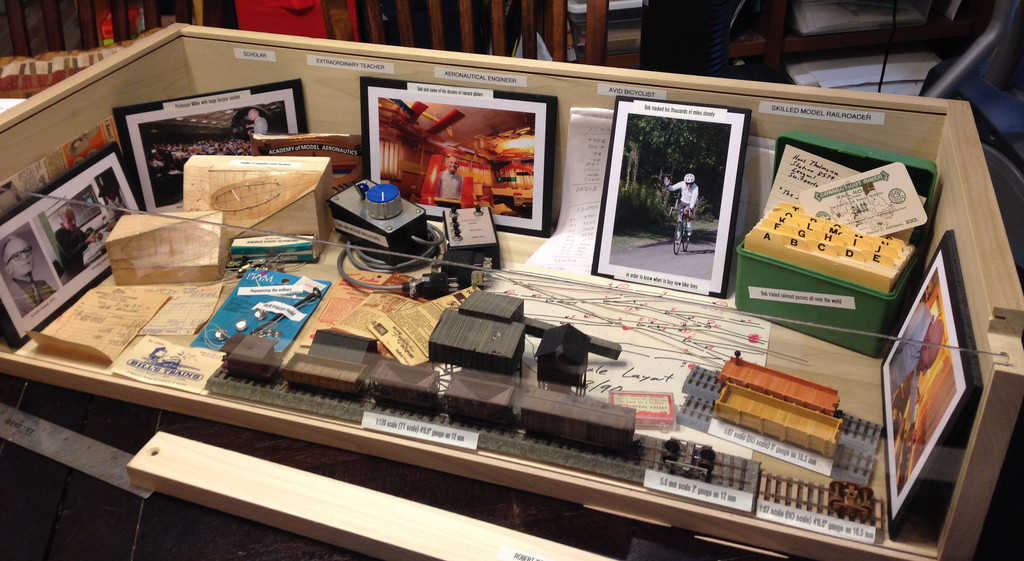
I am building a T-trak module, and I went big time with a “triple” that is 14" deep and 36" wide. I want to build a clear display cover for it so that I can keep it safe and dust free, and perhaps display it somewhere nice. I looked online and found no model display cases that were big enough for what I needed.
I am thinking I might need to build one. If I try and to it myself, what typle of plastic should I use: acrylic, plexiglas, etc? I don’t want real glass as it will be too heavy and fragile. And what glue should I use to try and assemble it?
Plexiglass and clear acrylic are basically one and the same thing. It just depends on what school you attended, as I refer to the material as Perspex ® which is actually a propriety brand name.
I’ve used both MEK and “super glue” to bond Perspex® though as you’re making a display case, I’d recommend the use of “super glue” as it would give you far more control in applying it.
Here’s what I did in building a simple case for a memorial to one of our recently departed division members.
Four side of the case are wood. It’s slotted so that it holds the 2 sheets of acrylic that form the other two sides of the box. You can do this easily with a table saw. In the next pic the front is slid in place and the slots that hold the top are clearly visible.
In this last pic, the wood “corner” is visible at the bottom. It’s double-slotted and slides in from the end of the box, the attached with a screw at either end to fasten it down securely. There is no glue on the acrylic with this design, which saved me a mess more than likely.
Acrylic is one of the materials that is best solvent-welded, which is good because the prep is so easy, the material so cheap, the method of applying the solvent so economical, direct, and self-limiting, and the result so ‘perfect’ in appearance and strong.
There are many guides and videos on the Web for acrylic prep and fabrication, and some ‘purpose-built’ solvent mixtures that enhance the ease of making the joints. But I suspect even the ‘usual suspects’ default solvents will work with just a little more careful design thinking and prep…
I use a small squeeze bottle with a long metal needle tip, and carefully remove any little saw marks on ‘butting’ edges so the components fit squarely without gapping. Some of the ‘cements’ contain a little dissolved acrylic or filler material of comparable refractive index for ‘gap filling’
Yes, I did. I used a special acrylic cutting knife, looks a little like a misshapen putty knife, to scribe a line on the sheet. Then I carefully bent it until it snapped along the line.
I actually owe you Chaps an apology! I haven’t used normal (?) super glue for years and when bonding styrene or the like, I either use MEK or “Super Glue Gel” and without thinking (does the Bear actually think???) omitted the Gel from my original answer to the OP, an embarrassment in this case as occasionally I have to write instructions for workshop manuals for the day job, and such an omission would be inexcusable! [:$][banghead]
MEK with it’s wicking and welding properties would, IMO, make for the strongest bond, BUT I can just imagine the fogging!! I suppose it could be done if the MEK was applied accurately and sparingly; however accurately, sparingly and the Bear can be, and often is, a contradiction in terms.
Which is why I use the “Super Glue Gel” where matters of vision are the prerequisite, as due to its viscosity it shouldn’t run were it is unwanted, causing fogging! This presumes that the Bear is taking extraordinary care!
TAP has a special adhesive for acrylic/plexiglas that dries optically clear. However, it seems to be some prety nasty stuff - needs lots of ventilation and you want to wear gloves to keep it off your skin.
Only thing I made with acrylic other than just drilling holes to make a control panel is a pencil holder I made in wood shop in 8th grade, that was just a single piece of fairly thick plexiglas, corners rouded, edges polished, and then bent by heating. A piece cut to cover the open side, plus two side plates, and it would have been an enclosed case.
Interestingly enough, a family friend manufactured ‘binary clocks’ this way in the early 1970s: the clock case being a continuously-bent curved tube, and rectangular pieces solvent-welded on the ends. The circuit board was mounted on standoffs, cord grommeted through a drilled or reamed hole, etc., before the end caps were welded on.
This used those funky incandescent-segment displays (in multipin sockets!) that were briefly popular before LEDs … and when one of those lost a couple of segments it became highly irritating that it was impossible to access it! I finally popped off one side plate with a slide hammer to get in there, only to find that no one on Canal Street or off had any idea where to find replacements by that time.
Considering how easy it is to bend heated acrylic, yes, this is a useful technique to fabricate cases.