I am looking for erection drawings of camelback locomotives either real design drawings or model drawings. Ther are few types of this model available in the greater hobby so it looks like I have to scratch build ones for my railroad. Scale is no problem.
IHC sells a 2-6-0 that is a model of an O&W U-1 class 2-6-0.
“Locomotives of the Reading and Philadelphia and Reading” by Wisswesser has tons of pictures and diagrams of camelbacks. Also check with the Reading Company Technical and Hisotical Society.
Mantua 0-6-0 Camelbacks. Reading, Southern, Rio Grande, ATSF, and undecorated. I may just get one to have on my rail marine roster.
Hi “O&W,”
See the Model Railroader Cyclopedia, Volume 1, Steam Locomotives, available on this Web site. It includes drawings of three Camelback locomotives, a Reading 0-6-0 and 2-8-0, and a Central of New Jersey 4-6-0. Model Railroader has published other drawings of Camelback locomotives; see the online index of magazines at the bottom of this page.
Have a great weekend,
Andy
I’m not aware the DRGW, ATSF, or Southern railroads had 0-6-0 Camelbacks. Am I ignorant?
Mark
No, the Southern one is a fake. Real Southern Camelbacks are painted green.[swg]
Enjoy
Paul
Yah, and the Rio Grande ones all had front-hung air pumps on the smokebox door and ‘eyebrow’ Elesco feedwater heaters. [:P]
Tom [:D]
Yeah! I surely would like to see that, especially something in the 0-6-6-0 persuasion! (or am I confusing that with an 0-8-8-0 Camelback?). [:-,]
Mark
Yes, I was confusing it with an 0-8-8-0. Erie’s L-1 class locomotive was the only articulated Camelback locomotive.
Thanks for the leads
The IHC is out of 2-6-0 camelbacks that is what started this search
The 0-6-0 is a copy of the Reading’s although stylized. But , thanks for the info.
Thank you for the lead
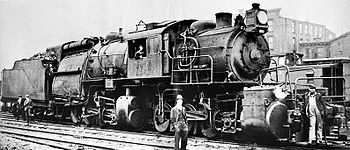
To my knowledge, this is the first Camelback. Many at the time, 1850, called it a Camel. Note the “hump”.

Rich
It is a “camel” but not a “camelback”. Two different designs.
The first camelback was the P&R 412, a conventional cab, Wooten firebox 4-6-0. It went on a demonstration tour of Italy, but was too tall to fit through the tunnels. So the engineer cut the cab off the back of the firebox top and mounted it over the boiler.
Holton’s history of the Reading has a portion of a chapter devoted to it.
Yes, I know that but there are people who do use the Camelback terminology for the Winans Camel that is why I mentioned it. I have a lot of data concerning the Camel as it is a loco that has interested me for some time.
Rich
I hate to say it for all the ebay haters but they do come up fairly often. I got a never used one at a very good price. Runs nice and smooth and very slow if need be. Only problem I have with it is that I have not been able to get it opened up to put a decoder in it. I like it but I think I might sell it at some point and buy a shay instead.
Good luck
Please note that some model manufacturers will letter a new product for roads that never had a locomotive or a freight car of the type advertised. Almost anything will be lettered “Pennsylvania” or “Santa Fe” and lately there are a number of other roads that they’ve decided to letter stuff up for. The Reading (RDG), Jersey Central (CNJ), Lehigh Valley (LV), New York,Ontario & Western (O&W) and a few other roads, primarily in the northeast had Camelbacks. [They were developed to burn anthracite and needed the wide grate area to develop enough heat to build up steam from a shallow fire.] To the best of my knowledge, the only road in the western part of the country that had Camelbacks would be the UP, which had one or two small Camelback Americans built by Rogers in the late 1800’s. Do your homework about your prototype if you arre interested in being “true” to the road you are modeling … otherwise, have at it and enjoy yourself! The Wisswesser book and the Cyclopedia, both of which are referred to earlier in this thread, are excellent reference books. I believe “blueprints” may still be available from either Mr. Wisswesser or the Reading Railroad Historical Society. Keep an eye out on EBay if you really want a nice brass Camelback! They do come up for auction from time to time, but again, do your homework as to price/value as sometimes bidding can get out of hand! However, occasionally, one slips in and out almost unnoticed! But you
The Southern Pacific Railroad had one Camelback, a 4-6-0 purchased soon after 1900. Within a short time, it was rebuilt as a conventional cab-in-the-back locomotive.
Mark
The CNR, too, owned a Camelback 2-8-0, although for only a short period of time. Acquired in 1929 as part of the Quebec Montreal & Southern, it was scrapped in 1930. (The QM&S was part of the D&H’s line on the south shore of the St. Lawrence River.)
Wayne
Thanks, you two … I stand (sit) corrected! I knew that 98.7% of all Camelback-heavy Motive Power Rosters were in the Northeast in general, and most of those plied the rails in the Anthracite coal country of Northeast Pennsylvania. I was aware of the odd (for their home road) Camelback or three out “West,” but not of the one in Canada. I was under the impression that they were primarily experiments for their owners and were either converted to conventional rear cab or scrapped after a relatively short period of service.