I’ve got some Best Buy reward points that are about expire. If you were going to buy a camera specifically for layout photography, what would you buy and why?
I own a Nikon D3100, which is a 12.1 megapixel digital SLR. I use it mostly for model and layout photography. I like it because the cost was reasonable; being a Nikon, it has great optics; I can look through the viewfinder or display what I am about to take on the screen; and I can shoot videos with it. There are a variety of accessories available, also. Now, having said all that, probably most dSLR’s from Canon, Pentax, Olympus will have comparable features.
Good Luck with your choice,
Greg
I use a Canon Rebel dSLR that I bought back in 07. I’m quite pleased with it.
The DSLRs are great and all, but man they are way too expensive.
Last year I got the Panasonic Lumix, and its outstanding for indoors with low lighting conditions, which we all have in our basements. I shopped and research quit a bit before buying this. Best $350 I’ve ever spent on a camera. It also has manual features for sophisticated shots similar to the DSLR.
Or this one is good too.
I use a Nikon L20 that I recently rebuilt. It’s easy to use and it’s good for close-up photos.
I have read that many experienced layout photographers prefer decent quality pocket point and shoot cameras to larger DSLRs on the theory that they are actually better as regards depth of field, and can be more readily placed into tight layout scenes. I can say that my Canon Digital Rebel is large enough to be awkward to place when taking model photos, whatever other fine qualities it may have.
Dave Nelson
I have a Canon SX100 that has seen extensive use. It’s what I take my WPF pics with. I have sometning close to 30,000 images taken with it. I’m a historian and when we visit archives any more, it frequently far faster to take pictures of documents, rather than copy them. I typically take over 5,000 in a week’s worth of work.
It’s been superceded by other models now. I was in BestBuy the other day and they had some like a SX170 for around $150 IIRC. I couldn’t find specifics of the macro features on it, but its specs exceed my SX100 in every other way, so should be at least that good – and it’s great.

This example was taken behind Maguire’s in Red Mountain. That’s the “beer dock” on the left in the center with the gray concrete with the barrel of Colorado Black Stripe as we look down the tracks towards Silverton. Camera was in Macro mode, but otherwise automatic as I had to reach over foreground scenery and set it on the tracks to get the pic by pushing the shutter release by feel.
The thing just works great point and shoot (although manual features are there and easily available.) I can’t see the text clearly when photographing documents (eyes too old and weak unless I get them close up), I just have to trust that it’s doing its job. I get a blurred one every great once in awhile due to my own shakiness, but most are as readable or better than a xerox copy once I process them in Photoshop.
This photo was taken with a Canon PowerShort A590 8.0 with 4X zoom.

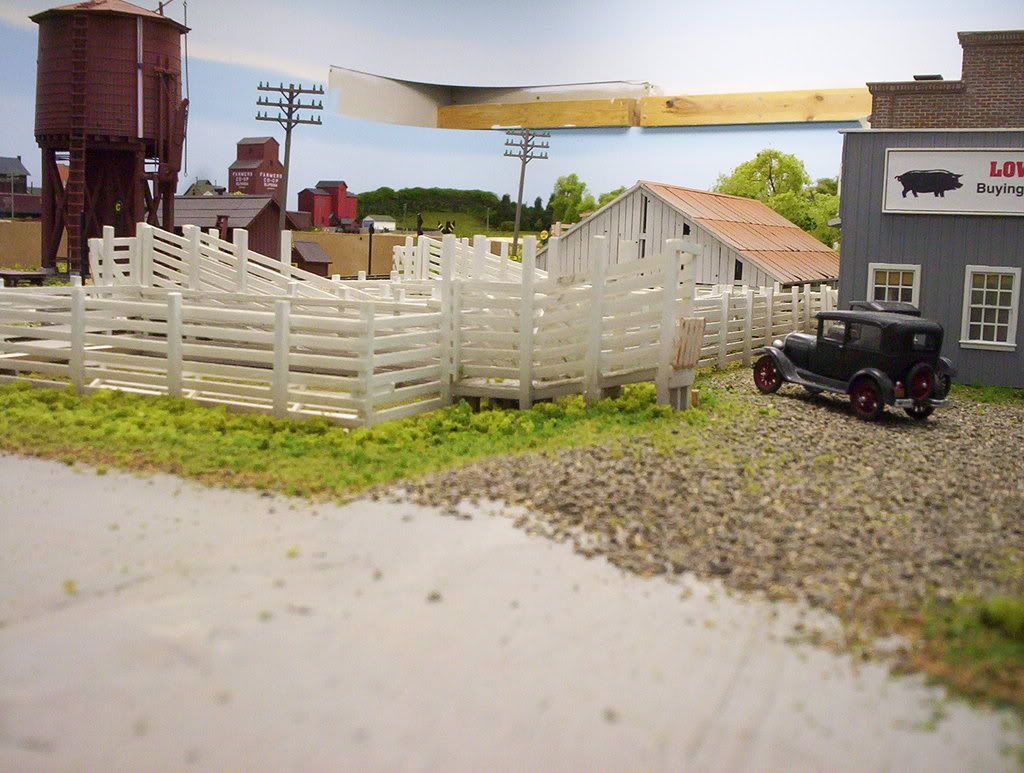
That may be true - I’ve used some high-priced DSLRs and by the time you stop-down far enough to get decent depth-of-field, you need photo floods in order to see the image. [banghead] The photo below was taken with a Kodak CX6200, a very basic point-and-shoot camera.
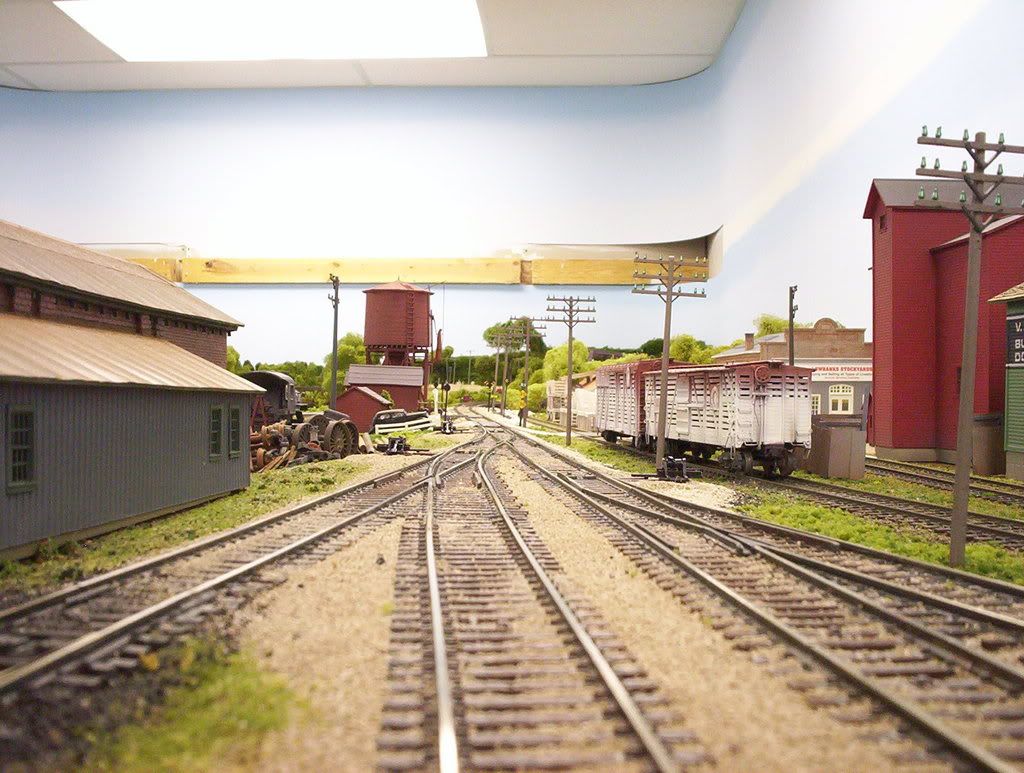
Here’s another one, also taken with the camera sitting on the layout and this time, pointed towards the aisle. The grain elevator and other structures in the distance are on the opposite side of the aisle:
Wayne
Here are the features you should look for:
- Macro setting
- Aperture selection mode (for depth of field)
- Self-timer
- Top quality lens
Most of the cameras off these features, except a quality lens. Panasonic Lumix cameras have a Leica lens, which I can recommend.
I have an older model Lumix and I am still happy with it, although it does not have a high amount of mega-pixels to boost. It´s lens is superbe, and it is also small enough to be placed nearly anywhere on the layout.
Most modern cameras give good shots however if you want great shots, go for a DSLR. Now adays you can bracket the focus and blend so you have endless depth of feild with the right equipment.
One factor in favor of the pocket cameras versus the DSLR for pics on the layout is that the form factor is much reduced. You can just get a small camera in more places now than before, while the image quality is especially good.
My suggestion would be a micro four thirds camera: interchangable lenses and all the features of an SLR without the bulk.
My personal choice is the Olympus E-M5. One brilliant feature is the optional capacity to use the tiltable back screen as the shutter release. Also one touch of the screen will prioritise your focal point, given that the depth of field is superb anyway. The E-M1 would do a great job too but it is slightly bulkier.
Micro four-thirds cameras can use other brands’ lenses, meaning I could use Sony [Zeiss lenses] or Lumix [Leica lenses] if I wanted to, but I use Olympus because they too have superb clarity.

Wayne I love that first view!
Thanks for all the suggestions. Being a former photography geek I’d have to have interchangable lenses. It sounds like the compact system cameras are a good compromise of lens choices and size. I agree that the DSLR’s are a little large. I also think it’s strange that not all of these cameras have tripod mounts. That’s a must have for me as well.
What focal lengths do you find the most useful?
I’m interested in the infinate depth of field capability with bracketed focus. I’ve tried that with exposure (HDR) but I didn’t know it could be done with focus. Is that an in camera feature or is it done with software? Which cameras have that feature?
You didn’t mention how much you had to spend on a camera, which can of course make a big difference. Now that you’ve stated you would like an interchangeable lens model, this changes things. Almost all current DSLRs are quite capable of taking great photos. The newer “mirrorless” models with interchangeable lenses are pretty great too. Not as much a selection of lenses though. And I’ve yet to see a current camera that does not have a tripod mount, maybe some do, but they would be few and far between.
As to what focal lengths are the most useful, it depends on what you want to photograph. If you want shots of individual models, almost any will do. If you’re looking for extensive depth of focus, then wide angle lenses seem to work the best.
“Focus stacking” with many images all focused at a different point is usually done with software. Helicon Focus is one that’s popular, and there are free ones out there too. I’ve th
“Focus stacking” with many images all focused at a different point is usually done with software. Helicon Focus is one that’s popular, and there are free ones out there too. I’ve thought about trying one of the offerings, but I can get all the depth I want with my wide angle lens at f/22. Railphotog
As I’m personally not a fan of focus stacking, I agree with Bob [always a wise move on things photographic!]
My micro four-thirds camera came with a wide angle 12-50mm lens, but being a 4/3, this actually equates to 24-100mm in ‘normal’ terms. Still a wideish lens, and one that does a very good job for me, anyway. Ihave no doubt that the 4/3 offerings from Sony and Panasonic would be very good too. However, to my knowledge, the Olympus is the only one with the shutter function on the touch screen. It’s hard to get any shake when using it. I always use the self timer anyway to give it time to settle.
I find a good point-n-shoot digital camera quite adequate. I started with a Kodak ZX1485 which gave good service for 5 years and then started to get flaky. I replaced it with a Canon Sx170 which has been quite satisfactory. I use a tripod and aperture priority to stop the lens down as far as it will go (f8 usually) resulting a shutter time of perhaps a full second. Too long to hand hold. I use the self timer to trigger the shutter to avoid any chance of camera shake from a fat trigger finger. I would expect the other major camera makers (Nikon, Contax) to make perfectly satisfactory cameras.
[quote user=“Railphotog”]
carl425
Thanks for all the suggestions. Being a former photography geek I’d have to have interchangable lenses. It sounds like the compact system cameras are a good compromise of lens choices and size. I agree that the DSLR’s are a little large. I also think it’s strange that not all of these cameras have tripod mounts. That’s a must have for me as well.
What focal lengths do you find the most useful?
I’m interested in the infinate depth of field capability with bracketed focus. I’ve tried that with exposure (HDR) but I didn’t know it could be done with focus. Is that an in camera feature or is it done with software? Which cameras have that feature?
You didn’t mention how much you had to spend on a camera, which can of course make a big difference. Now that you’ve stated you would like an interchangeable lens model, this changes things. Almost all current DSLRs are quite capable of taking great photos. The newer “mirrorless” models with interchangeable lenses are pretty great too. Not as much a selection of lenses though. And I’ve yet to see a current camera that does not have a tripod mount, maybe some do, but they would be few and far between.
As to what focal lengths are the most useful, it depends on what you want to photograph. If you want shots of individual models, almost any will do. If you’re looking for extensive depth of focus, then wide angle lenses seem to work the best.
Sorry. I’m thinking I should be able to get this done for $500-700. The low end of the range is better, more is OK if it can be justified. I might take this camera on a road trip now and then, but layout photography is the primary requirement. I’m not interested in paying extra for improved video capability. Any picture that I’d take with a flash I’d take with my phone so no flash is required on this camera. I don’t believe a viewfinder would be useful for this type of photography so that also is not on my must have list. All other things being equal, I like the old school rangefinder look.
While it wasn’t specifically for layout photography, when I went to Best Buy in 2011 to get my first digital camera, I got a Nikon Coolpix S3000. They had them on clearance, and for about $200, I got the camera, a couple memory cards, an extra battery, and a camera case. Not a bad deal for my first digital camera.
Of course, one of the first places I tried it out was in the basement.
Works great for closeups.

Works great for overall shots.

And it takes pretty decent video.
http://www.youtube.com/embed/hoTU5Bp4kyw
In time, whenever I get the money saved up, I’ll probably be getting a more advanced camera as well as a separate camera for shooting video. For now though, I’m happy with it.
Kevin