With Bachmann’s recent announcement of upcoming Siemens S70 LRV’s, I have started considering the possibility of incorporating a bit of modern light rail into a future free-mo layout. I have rode on the S70s on UTA’s TRAX system quite a few times and see them nearly everday in my commute, so its a prototype I am familiar with. However, while I have seen modular railroads incorporate overhead wire before, I have never really seen any explination of how to do it. I don’t need it to be functional overhead wire, but something that would be believable between module to module of were the S70’s would be running. Any tips on how to make overhead wire fit into a free-mo set up?
My layout isn’t free-mo but, I do plan to have removable catenary, ‘PRR style’ so I can take some believeable photos.

My thought is to sink some hi-strength neodium magnets into the sub roadbed and cement flat steel* onto the bases of the catenary so they can be removable or they can be bumped into without damage.
*I had ‘deconstructed’ an old transformer and saved the iron core plates. Handy for car weights and loads plus other RR uses.

I thought about threading some Berkshire Junction EZ-line onto them, they make a green color that looks like oxidized copper. Not enough to get tangled in but just enough to look convincing.
IF you were careful enough you could string the catenary wire and set the poles in sequence. Remember the “pre-strung” Rapido telephone poles? Kind of like that.

My catenary poles came from a Shapeways designer.
Good luck, Ed
How big a Free-Mo module are you building? You can probably get away with simple cosmetic catenary, or you could actually wire it easily enough to the same track bus as the track connection.
The only difficulty might be trolley connection, which might be harder to keep continuous between modules.
No idea yet, its still very much in the planning stages right now. I don’t know what the Free-Mo standards would think of live wiring the catenary to the track power, but it could be a cool thing to do considering some locomotives are built for taking overhead wiring. For simplicities sake, I think cosmetic wire would be better than functional wire.
Of course… with the Bachmann S70 I really have no idea what that product’s specs will be, not even a render yet. All I know its been announced! So no clue if it will support overhead wiring or just traditional track wiring.
It sounds to me like you are going to go with dead wire. Makes sense to me, that will allow you to focus on making it look good.
I think the easiest way would be to permanently attach the wires to catenary poles, and make the poles removable. Alternatively you could attach a magnet to the wires and attach magnets to the poles. A lot of people just leave out the wires, and add them in photoshop when they want a realistic photo.
One problem with catenary poles is they will restrict the clearance and will not allow others to run some equipment (i.e. double stacks).
I have seen portable/segmental layouts with live overhead wire. I never really studied the points of intersection between modules but it appears that if the models were traction with trolley poles some fairly finicky transition areas had to be wired up when the layout pieces were put together. However if the layouts featured catenary and locomotives or interurbans with pantographs then some simple and non-obstrusive slight overlaps of the catenary kept the pantograph in constant contact with the juice.
Dave Nelson
Ed
The Neodymium magnets should work great. I went with ⅛” x ⅜” Neodymium magnets to anchor my HO structures and that worked out very good. A magnet in each corner takes a bit of lifting pressure to remove the structure. They will definitely hold their own weight.

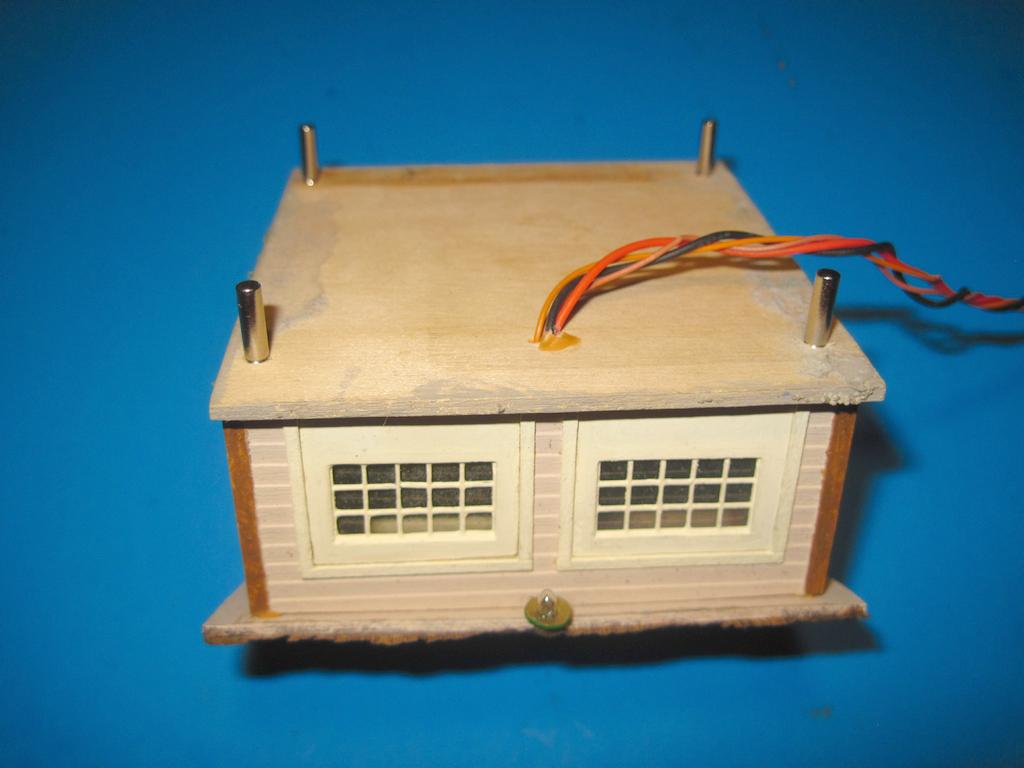
These magnets are the ones that go in the layout, they are magnetically attached to the structure magnets.
I drilled the holes in my layout filled them with glue then drop
If I am going off prototype, it wouldn’t be an issue since the only freight to use UTA TRAX is typical stuff like boxcars, hoppers and lumber loads that travel the line in the dark after hours. But… for Free-Mo I can understand that might cause some issues if a double stack train that clears the other modules reaches the catenary equipped module and is unable to clear it due to the wires. Might be a good idea to build a junction of sorts that seperates the street car tracks from the main Free-Mo loop to ensure the street cars and their wire don’t interfere with the mainline trains.
And while my module prototype is UTA TRAX in my plan right now… what’s not to say that other people might someday bring other electric trains to the layout? I for one am a sucker for nearly everything Stadler pumps out and if anyone picks up the rights to start making HO scale KISS cars I would also be buying those in a heart beat… although judging by their size it wouldn’t surprise me if they require more clearance from the wire than the Siemens LRV’s do. It might be a good idea for me to research different wiring set ups before I pick the one that fits.
I would think that a light rail set up like this would be completely seperate from any freight rail.
You could have your Free-Mo set up with a seperate R.O.W. for regular rail traffic, making sure the easement follows what other Free-Mo modulars use for freight rail.
I just don’t see a light rail intermingling with regular rail.
Mike.
Nor do I, clearance is a major issue, and so is the appearance. A modern double stack intermodal just won’t look right on street car tracks.
You (the OP) seem to get this. I think it’s best to have a separate street car track with a connection to the main if you want that. I am not sure how Freemo works with streetcars but I’m sure you can figure that out.
After going back and rereading some of this, does the TRAX use the same rail as regular rail? And regular freight traffic runs on the same track as TRAX, and vise-versa?
Milwaukee just installed this:
https://thehopmke.com/about/#hop-vehicles
It does not interact with regular rail, strickly a street thing.
I didn’t think the rail was the same.
I’d still keep your TRAX seperate from the rest, as I mentioned before.
I have seen displays at Trainfest, in Milwaukee, but I never paid attention to the overhead part, and how they seperated the modulars. I think there might have been a couple lay outs that use live wire.
When Bachmann released the Acela, I wanted one so bad, but I don’t use anything with OH wire, even if it’s just for show, and the track is powered.
Well, the prices went down, and I ended up with a set, it sits in it’s box, unused. [:|]
Yea, one of those moments.
Mike.
Hello All,
I just returned from a vacation in Europe; Germany, Belgium, France, Netherlands and U.K.
Most of our travel was by train- -either by high-speed rail; TGV or ICE, or regional trains.
What I noticed was that all the container traffic was single-stacked. This was to clear the catenary lines that powered the freight locomotives.
Many of the switchers were diesel and could move freely under the catenary.
Back to the topic…
Using magnets to hold the catenary poles sounds like the way to go.
As far as the power lines themselves I can see problems of tangling if the lines are pre-strung.
You could consider using small eye-bolts under the catenary and thread the lines each time you setup your modules.
This would avoid gaps between the modules in the lines but would take more time.
Sewing thread could be used and it is easily replaced when worn out.
Hope this helps.
Yes, TRAX is built for freight rail access. The core of the system is the former Union Pacific Provo Subdivision which still retains a small handful of active freight customers. Another branch of TRAX runs on the former DRGW Bingham Branch, which has several active customers and interchanges with the still freight only Garfield Branch at Welby.
Two railroads are contracted to run freight on the TRAX lines. Utah Railway (via its Salt Lake Southern subsidiary) and the Savage Bingham and Garfield. Both of these freight railroads share space in the Midvale Yard. At the end of the wye at Midvale is were the freight trains enter the TRAX system: https://goo.gl/maps/K9gLGvfRhUfFcste6
The second access point for freight is coming out of the TRAX Redline and onto the Garfield Branch further west at Welby: https://goo.gl/maps/1rSeo7nZC9BbeNyj8
Of course there is a key safety caveat for this operation… All freight trains run at night after TRAX has fully shut down passenger operations for the day. So no, there aren’t freight trains trying to shuffle around active light rail cars; since the freight trains aren’t given authority to enter TRAX until the last LRV’s have been stored away for the day. But once on the TRAX system, the entire operation is a freight operation until just before sunrise when the light rail trains begin running again.
So for the purposes of a modular layout, of course it makes sense to keep the light rail a seperate line from the main through route. But having at least one module that transitions from the main line and onto the light rail system is prototypical,
Trying to string catenary on a modular layout? That sounds a few steps short of insane. Catenary -poles-, I can see, but … wires?
It was hard enough keeping the wires strung up under the real trains. Broke a few pantographs in my time, but always “got the train in” (others weren’t so lucky!)…
I’ve got a Bachmann Peter Witt trolley. It has a switch on the bottom to select either the trolley pole or the wheels.
I don’t use wires, but I would hope they would put the same feature in other electric engines.
Yes, I think I have heard Atlas locos do the same. This should provide some flexibility when running electric equipment.
I have to dig out my Bachmann Acela. I think it has the same feature, to switch from over head to track.
Mike.
Here’s a site with light rail modeling info:
This is a group that sets standards for building modular traction layouts:
Hope these help!
Eric
Southern California Traction Club has a 6-module light rail layout that includes live catenary on straight sections (and single trolley wire on curves). Here’s a 2015 video of 3D-print San Diego S70 LRVs circling it: https://youtu.be/YxebGCN5Qww
yes it does have that option