Based on some of the responses to Lesson 2, I decided that it would probably be a good idea to cover the “how” of shooting in low light. It doesn’t really help anyone if I tell you to shoot at night but don’t give you some help on how exactly to do that.
While drama may increase as light levels drop, so do the problems associated with shooting. Remembering from Lesson 1 that photography is “painting with light,” low light photography means that we have less “paint” to work with. I thought about this long and hard last night, and I came up with 5 solutions to the problem of working in low light conditions. I will preface this with the idea that my shooting is based around using a DSLR. Some of these tips will work for point and shoots, but with a few exceptions, point and shoot cameras just do not do well in low light because of their small sensors. I’ll try to get an equipment article up soon that will cover some of this a little more. For right now, though, let’s just say that the darker it gets, the more you’re going to want a DSLR or a “MILC” (Mirrorless Interchangeable Lens Camera).
OK, let’s get started. The Sunny 16 rule of photography tells us that a “proper” exposure will be attained at a shutter speed of 1/ISO when shooting at f16 in perfectly sunny conditions. I’ll cover this a bit more in an upcoming lesson, but for right now let’s just pretend that we’re shooting at f16 at ISO 100, so our shutter speed may be 1/125th of a second (You can round it a little bit). I’f you’re shooting in an auto mode, your camera is worrying about all of this on it’s own, so you don’t have to worry too much about the actual numbers, just the concept for now. Let’s say our sunny sky has a few cirrus clouds, though. We’re still seeing shadows, but we’ve lost a little light. It’s about one stop darker than full sun. If we want a proper exposure now, we’re going to
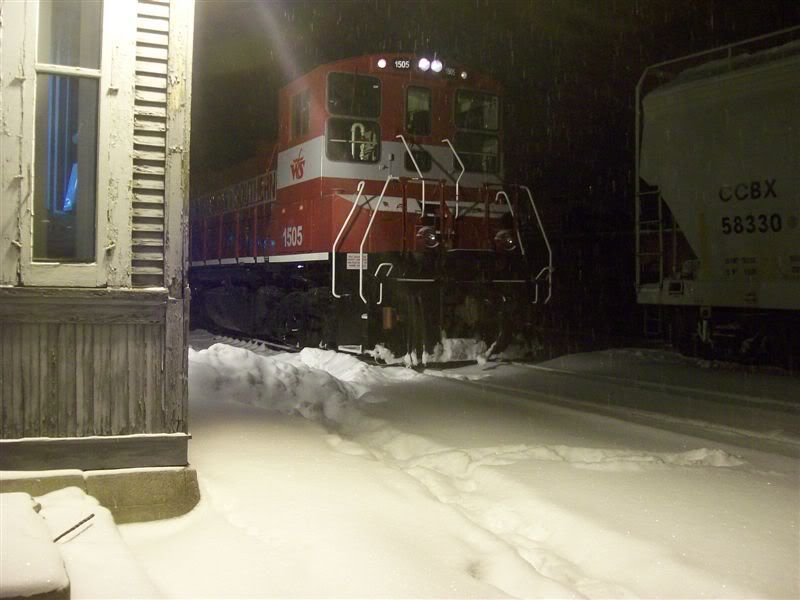
Taking some of Chris’ ideas, some point and shoot cameras have enough adjustments to get a decent night shot, without spending all the coin for a DSLR.
What I did on this shot was set the ISO as low as it would go (ISO 64), set the f-stop as high as it would go (f8), and leave the shutter open longer (16 seconds). I also set the camera on something solid. Somebody I’ll bring a tripod along…
I use similar settings when taking close-up pictures of model trains indoors. With limited light, to get some depth of field the shutter needs to be open longer.
This next shot was from a pocket-sized camera. I took a lot of pictures with it, as it was close by when the opportunity presented itself.
On this one, ISO 160, f2.69, 1/26 second shutter speed. For a stable platform, I set the camera either on a window sill or on some of the trim.
Better equipment does make things easier, but decent results can be obtained with some knowledge of what is going on.
I really appreciate your lessons. My first “real” camera was a Pentax 35mm back in the mid 70s with a hand held meter. Decent results, certainly wish I had those days over again, but am grateful for the photos taken.
Today’s equipment is a 6 year old Nikon D40 which pretty much handles my every day family and occasional train needs. I don’t push anything, pretty much point and shoot. You are motivating me to take the extra steps necessary to be a “photographer” rather than “taking pictures”.
One question…when out and about I often see rail photographers using tripods during what I would call normal light…let’s say F8 - 1/500 lighting. Why use this equipment in good light? Let’s discount a slow shutter speed…is this done primarily for framing the photograph? I have always tended to frame the photo graph without the use of a tripod.
BTW your astronomy photo is outstanding. That is another of my hobbies. What constellation or part of the sky is that? My guess is in the Sagitarius region…but just a guess.
Also, loved the photo of the mom at Denver Union Station. As always, keep the lessons coming. You are motivating me.
Three possibilities: they’re shooting video, they grew up shooting low-ISO film (where tripods were helpful), or some misguided photographer taught them that tripods are still relevant tools in daytime lighting.
ISO 400 was considered fast back in the days of film and many photographers used slower film for quality. Because it was commonly possible to get handheld blur during some daytime conditions, many photographers were taught that a tripod will always make their images better. Nowadays, their use tends to restrict composition and variety and is absolutely unnecessary during the daytime.
Of course, modern DSLRs can shoot at higher ISO than was ever thought possible in the film days, with great results. Depending on the camera (I shoot a crop-sensor 40D and a full-frame 6D) I’ll shoot at ISO 1600 or 6400 without hesitating, and if conditions warrant I’ll push the 6D to 12,800!
Re: Tripods. Sometimes they can be handy if you’re setting up a shot - maybe you want just the right picture of that special locomotive, so you get it framed up, check for distracting stuff (telephone pole sticking out of a head, anyone), and have your camera right where you want it when the time comes.
It can also be handy if you’re one of those folks who can’t seem to hold the camera still, no matter how you try, or never seem to have it level.
I have one I bought at K-Mart years ago - it’s aluminum, reasonably sturdy, and does everything I ask it too. I’ve also got one of those little ones that has bendable legs. Sometimes a fencepost or the hood of the car can provide a stable platform, but you still need to be able to make adjustments.
So, is the ISO the same as the “speed” of old films? I used Plus X and TriX (125 and 400 speeds) which obviously affected the shutter and F stops.
If so, then you are now shooting 1600 which would give incredible light gathering ability…correct? I need to get up to speed (pun intended) on all this.
Yes, ISO is a measure of the sensor’s sensitivity to light, the same as film speed, film ISO, or film ASA. There are some mathematical differences but in practice, they’re all exactly the same thing and the numbers correspond between film and digital.
Compared to the 400 speed film you used to shoot, 1600 is indeed incredible. It’s now possible to shoot handheld in dark indoor spaces where film would require additional light or a tripod.
The lead photo in this story was shot in a subway tunnel repurposed as a first responder training facility, during a bombing simulation which “knocked out” the station’s main lights. At ISO 1600 and f/2.8, my shutter speed was 1/40, handheld successfully thanks to lens stabilization technology and my own technique (which has a lot in common with marksmanship regarding breathing and trigger/shutter control). At ISO 400, that exposure time would have jumped to 1/10 and I’d have to use my knee as a tripod.
The range of usable ISO speeds depend on the camera’s sensor size and technology. Manufacturers are constantly pushing the limits upwards, so the following numbers are from a couple years ago – the latest models may go higher. Point-and-shoot cameras generally are go to 400 or so, while most DSLRs (with sensors smaller than 35mm film) are usable at 1600. Full frame cameras, with sensors the same size as 35mm film, are moving up to incredible places. My new 6D shoots
Getting back to the item about the tripod; I have seen some people who would weigh down their tripod with something like a bag of sand or a plastic bag of water, the thought being that this further helps to stop any movement. Have you ever tried this? If you did, did it work?
Film speed is a function of the size of the silver halide crystals in the film. Big crystals expose faster than small, which is why the resolution of the picture was inversely proportional to the speed of the film. If you wanted really good resolution, you shot at very low ASA/ISO’s - which often meant long exposure times.
ISO 400 is generally about as fast as you want to go with conventional film, although it can be “pushed” (specially processed) to 800. Still, you’re starting to get grainy.
The sensors now being used in DSLRs are a far different animal, which makes speeds like 12,500 possible. Barring new photosensitive chemicals, I don’t think you could make film that would shoot at that speed.
Things like water bags and sand bags if used right will definatly help as they act to dampen any vibrations that would resonate (like wind) with the typical tripod materials.
I also used a big glass insultor from a high voltage line to add mass (not for the weight) to my video tripod for more fluid movement. I thought it worked well.