If I fell in love with these (romantic mood music starts):
These three cars were used in the 1939 grain rush to a port in the PNW. A Nickel Plate employee put the word out that they were for sale at a bargain price (see end of service in 1940). Your railroad saw that as an opportunity to pick up some MOW cars, and a deal was arrived at.
They arrived on the property, and were in good and weathertight shape (had to be, to transport grain).
One car was converted into a bunk car–windows were cut in (between the upright framing posts), the sliding door was replace by a person-door, a stove was installed, and some new steps and grabs up to the door.
The other two became tool and supply cars–a small window was cut in at each end, to provide extra light (the employees thought that was a nice touch!). And also new steps and grabs at the existing door.
There was no need to repaint, so all the NKP marking stayed, except that the car number was replace by an MOW number.
Should the cars have had steel underframes, all the better. Of course the purchase year came later. But also the new owners were thrilled to get a steel underframe, as when/if the “box” failed, they could make MOW flats out of them.
And that’s how it came to be that three cars bearing NKP lettering came to live on your railroad–they found their forever home.
The Southern’s Su-series boxcars all had steel underframes and truss rods, too. A lot of the cars were scrapped (some assigned to “company service”) immediately after WWII.
There’s a photo, in the same Culotta book, showing a former Su- (acquired from the Southern by the Lancaster & Chester) in 1949. At least one of those ten cars received AB brakes, but there’s no mention of how long they lasted.
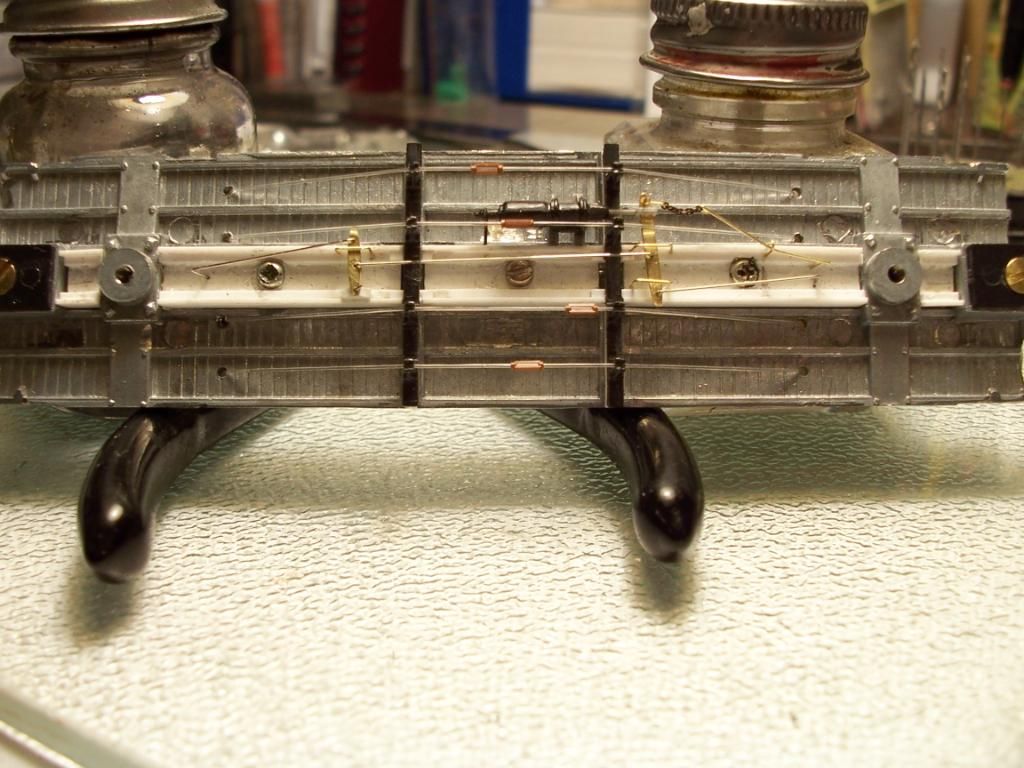
Here’s a look at the modified MDC underbody with a steel (plastic, of course) centre sill, allong with the four truss rods and K-type brakes…
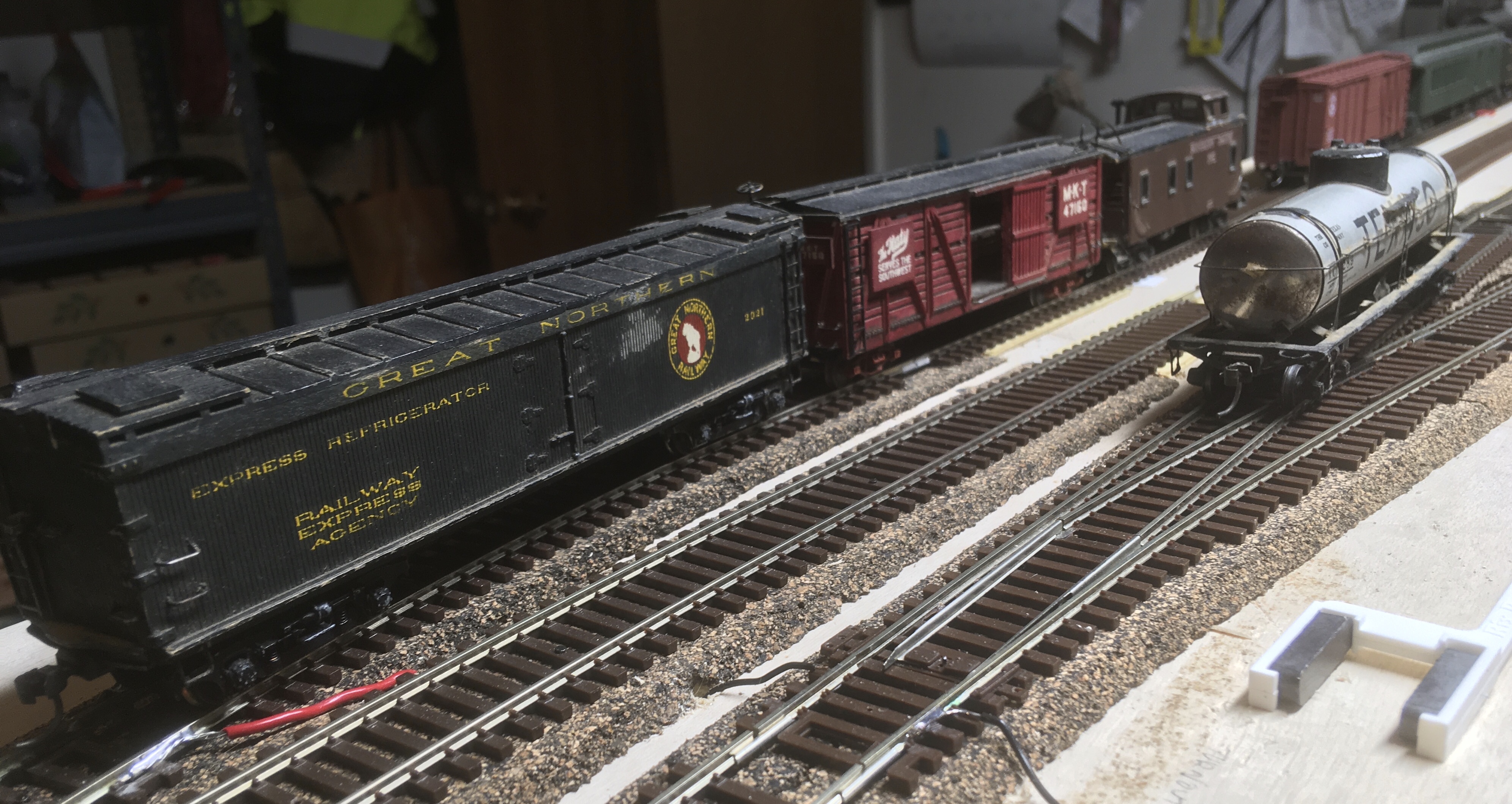
No idea what y’all are on about now, but NHTX’s little primer on Ambroid earlier got me interested, so I looked at what’s out there on eBay, and I found a GN 50’ reefer that’s the very spit of my dad’s old wooden model. So I got to wondering about my dad’s old cars, which I inherited.
I was born in 1962, and I don’t remember a time before my dad had these four cars. Mom says he didn’t have them before they married, so he must have acquired them sometime in the early or mid 1960s.
I went down to the layout to look and sure enough, the GN reefer’s trucks say Central Valley. I wonder if it’s an Ambroid model. It has that same unusual profile and looks exactly like the one on eBay.
The MKT stock car has newer trucks and maybe Delrin axles and wheels; I believe Dad repaired this model because I believe I trashed it when I was a toddler, or maybe the cat did. Still has a lot of broken slats.
The Texaco tank car is wood and metal. Someone recently told me that if it had the short running board on just one side of the dome instead of both, it would be exactly like the prototype.
The caboose, I am alarmed to discover only now, has a metal body. I doubt it’s brass, but it’s not wood, even though it models a wood caboose. The chassis and undersill are wood, and the decks and steps are metal.
These cars my brother and I did not use. We had our own, and these were Dad’s. Mostly they sat around in boxes, broken and awaiting someday repair. Besides, they had knucklers, and our kid stuff had the Tyco horns. I didn’t think about Dad’s rolling stock much until I grew up and realized they were the coolest things ever. I started putting Kadees on my cars as a teen, but shortly ther
Ed, the instructions for the GN reefer are a thing of beauty. Thanks for pointing me to HoSeeker. Lots of great stuff there, although there are a lot of frustrating dead links and nonlinks and it’s hard to search specifically for any given thing. Probably it got to be more than one person could handle. But it’s fun poking around. And it does indeed look like my dad’s caboose might have been a Roundhouse/MDC model. The drawings look right.
It would be incredibly rare to have a turntable at the end of a dead-end branchline to be used to turn a passenger car, it would only turn the steam engine. Remember, the coach or combine on the train had seats that could be rotated around 180 degrees, so the passengers would face forward no matter how the car was oriented. Whether the baggage end of the combine was forward or back wasn’t important, or even considered.
You could have the turntable there after the line had been dieselized, but my impression is that railroads got rid of turntables as soon as they weren’t needed. I suspect maintaining a turntable was more work than a couple of switches on a run-around track. Railroads tended to buy 1st gen diesels for specific purposes, like buying a couple of GP-7s or RS-3s to operate a specific branchline, or A-B-A sets of F7s to haul mainline freights. If in a crisis they had to run a steam engine after that, they’d just run it say forwards up the branch and run tender first back down. But it would only be like an emergency where the regular diesel(s) were unavailable.
My layout is also set in 1956 and the branch has a Ten Wheeler as it’s primary engine. There will be a turntable at each end. I toyed with the idea of installing a wye at the end of the branch with a flip down section for one leg of the wye but I think the turntable is a simpler solution. A doodlebug is also on the roster and that will get turned at both ends.