I have posted pictures of railroad scenes in Corpus Christi, Texas from time to time. A gentleman in Massachusetts contacts me for photos, saying he wanted to model some Corpus Christi trains and scenes in HO on a 5x9 table, with possible extension around the walls. I decided it would be fun to do an unsolicited layout design.
In the time period from 1960 into the 1990s, Corpus Christi had two main railroads. The Missouri Pacific, shown in blue (later UP) ran more or less along the south side of the Port of Corpus Christi inner channel with a fair-sized yard out on the edge of town, a smaller yard, Nueces Bay closer to town and a passenger depot at the uptown end of the line. Texas Mexican, shown in green, is about a mile or two south of the MoPac, running due west toward the Mexican border at Laredo.
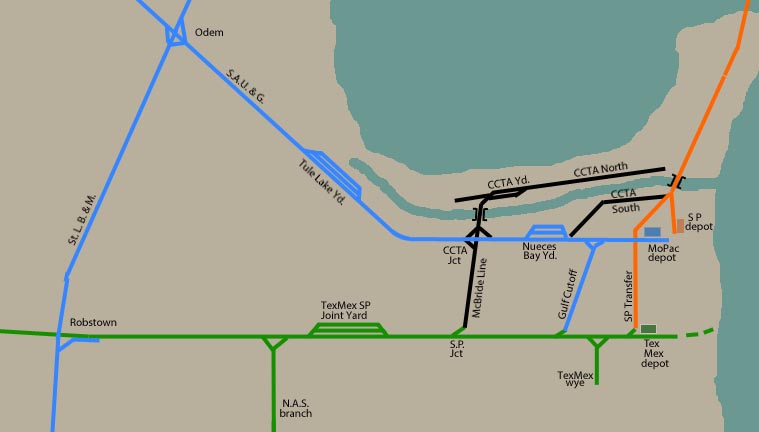
Southern Pacific once had its own line into Corpus Christi from the north, shown in orange, until 1959 when a high level highway bridge replaced a bascule drawbridge that carried rail and auto traffic across the port entrance. SP then came into Corpus Christi via trackage rights over the MoPac and ran its trains to a new expanded yard, built jointly by SP and the TexMex on the TexMex west of the city. All three railroads, MP, SP and TM, took turns operating and maintaining Terminal Association tracks serving the Port. (shown in black).
On a 5x9 table in HO?
I chose to use one side of the table, the top side in this drawing, to represent scenes and operations along the MoPac line, and the other side of the table, at the bottom of the drawing, for scenes and features along the TexMex.
The bottom portion of this trackplan for a 5x9 HO layout represents tracks and scenes along the Texas Mexican Railway in Corpus Christi.
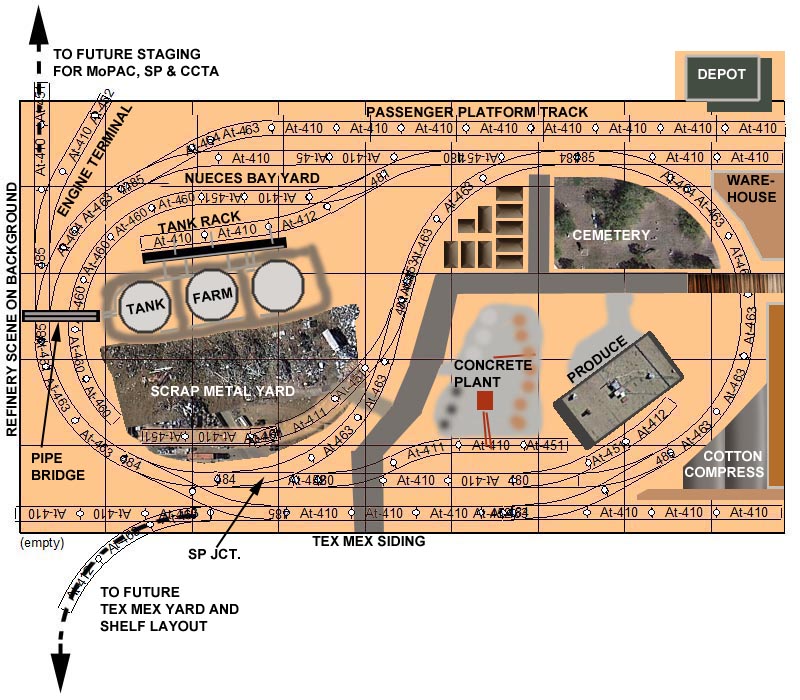
At the bottom right of the trackplan is a much-cut-down representation of a corner of the Gulf Cotton Compress, “notched” to provide right of way for the end curve. The compress was/is a complex about three blocks long along the east-west Tex Mex tracks and extending some four blocks north. (It still exists but seems somewhat inactive.) Some of the buildings are quonsets, much like the Rix kits but larger.
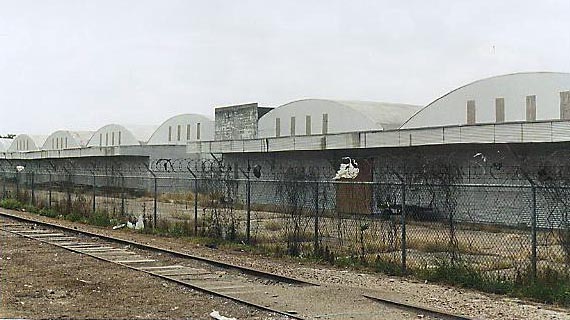
The Rix kits are 24 scale feet across, 33 scale feet long, 12 feet high, which seems to represent the most common WWII quonset, which was 24 feet across by 48 feet long. It was called “20x48” because that was considered the usable interior space. The quonsets at Gulf compress appear to be based on the larger “Quonset warehouse” version, which had units 40 feet across, 100 feet long and 20 feet high. The quonset design might be hard to cut off to accommodate a track curve.
Most of the buildings at Gulf Compress are concrete framed, which would be easier to build with an angled or curved back. Note the sloping tracks on the sliding doors. The doors can be held open with a fusible low-temperature-melting metal connection. In case of a major fire, the low-temp “fuse” melts and the door slides closed by gravity, without needing human attention or electrical sensors, motors, etc. T
Hi leighant,
i do love the information you presented about Corpus Christi. The pics of some scenes are awesome, so I can understand you are very interested in building scenes of the railroads (once) running in town.
What is missing are more detailed trackplans, like “spins” of the area. However I do not like the model trackplan you provided. I will try to explain the reasons behind it.
Just having a track and calling it Corpus Christi Mopac Terminal is not my style. Trying to be closer to the prototypical trackplan is my game. This start by studying the room-space. When like in another thread some modeler has a 9x5 pingpong table, he could also turn the parts to have a 10x4,5 table.
Looking more closely into the room might reveal other options. Those huge tables need room for access along 3 sides, so the real space occupied is much larger. The 10x4,5 table need at least a 10x7 space, not counting the aisles along the two outer sides.
Suddenly far more options are available. Important choices like scale, radii and must-have scenery items are to be considered as well. These choices might have consequences for the kind of equipment that can be operated. I did like pic of the passenger terminal with its three tracks in front of it, keeping the feeling that LDE might require more length in HO than available on a 9x5. It might also be a waste of the precious little space available looking at operational possibilities.
The absence of staging can be resolved by a cassette or removable addition like on this year’s project layout. The need of a reversing loop is not made clear at all.
IMHO in the proces leading to your plan many steps are skipped. It are just those steps, often neglected by many who are going to the drawing board to soon, which are making trackplaning interesting.
The above should not be confused with trying to get grip on the size of the space. In my design, which is not really an effort to model CC, th
I agree with much of what Paulus Jas says. I usually prefer starting with an analysis of the space and the prototype objective “before going to the drawing board.” Most of my planning for my own railroad is based on a linear shelf style around the walls.
However in this case, I was interested in suggesting an approach for a modeler who has said he wants to model Corpus Christi passenger trains in HO starting on a 5x9 foot table, and later running off with a shelf layout to model the Tex Mex line from Corpus Christi to Laredo. I do not know the gentleman’s room size. I would imagine the space to need to be at least the 5x9 table, which I would place with a 5 foot end against a wall… then three feet aisles around three sides of the layout, and a foot-and-a-half or two for a shelf around the walls. Equals a room about 14 feet by 14 feet.
My objective in drawing up a plan for the gentleman interested in a CC layout was to show how SOME of the scenes and OPERATIONS of an actual location could be at least approximated on a table layout (though table is not my usual preference). I decided to post it on the trains.com layouts and layout building forum as a partial reaction to “Decent Design for a HO Double Reversing 5 x 9.”
Paulus wrote: “These concerns might lead to skipping passenger trains…” but that was a main objective of the layout builder. His parents rode on “the last Missouri Pacific passenger train out of Corpus Christi,” an event which just happened to be featured in the local newspaper this past week.
 <
<