On “covered wagon” B units was there much emphasis on having the control stand end facing to the rear of an A-B type configuration? I assume the control stand is at the “F” end of a B unit? Thank you Rob
I don’t recall anybody ever caring which way a B unit was turned. IIRC on the F7B units the controls were located on the side at one of the porthole windows, but there may have been other arrangements.
In the earliest days of those locos, ABA or ABBA sets were seldom uncoupled and railroads often had their own preference about orientation. Some who used them in passenger service prefered the A and B unit boilers near each in each set, etc.
As time marched on and units where mixed and matched more, it was seldom a concern.
Sheldon
The first F units were the FTs. These units wheelbase was asymetrical - on an A unit, the rear trucks were back very near the back of the engine, while the front had an overhang. B units had the same design, so on one end there was a noticeable overhang. FTs were originally designed and built to be an A-B set with a drawbar between the two units. In effect they were back-to-back so the overhang of the B unit was towards the back (i.e. towards the cars it was pulling). This overhang end on the B-units was where the steam generator for passenger cars was located (in the area where the cab would have been in an A unit) so having it to the rear worked out well.
Some railroads wanted separate B units and EMD rigged up a way to add couplers to both ends of the FT B units. Often you can spot these units because they have an extra fifth window, located by where the control stand was in the B unit, so a hostler could move the B unit by itself. Otherwise the B units didn’t have their own controls.
Starting with the F2 in 1945-46, F units were symmetrical in wheel base and A and B units all had couplers on both ends (or at least had it as an option - I’m sure a railroad could still use drawbars if they chose to). I don’t know how many B units built from the F2 on had hostler controls, but AFAIK there was no outside indication of them (like the fifth window in an FT-B unit) and I don’t think most railroads paid much attention to the orientation of the B units as far as the front or back. But of course there may have been situations where railroads did have a preference, perhaps because of the location of the steam generator for example.
The “control stand” in a B unit were hostler controls. It was not a full set of controls that one could operate a train. It was only enought to move the engine or the engines coupled to it. The ones I’ve seen only had a brake valve for the engine brakes, not the train line brakes.
It’s my understanding that the B units always have some sort of hostler control somewhere. On the Fs, I believe it was somewhere just inside the door. Poor visibility for someone using it, but it’s there for emergencies.
There was this one coal mine railroad (the name escapes me at the moment) that had only a single F7B or F9B for power. They cut a window into the end of the unit so the engineer could see out while operating the hostler control.
Poor visibility for someone using it, but it’s there for emergencies.
Actually it was there for operation around a engine terminal or shop area and not really for “emergencies”.
As far as poor visibility the holster just stuck his head out the porthole while moving the B unit.
Funniest thing I ever seen while working on the PRR was a B unit being moved with a man’s head sticking out the porthole.I can still see that picture in my mind and still get a chuckle out of it.
That railroad that had a rebuilt B unit as power was the Haysi down in Virginia.
FT “A” -“B” units also only had one battery bank per pair.
Thanks all for interesting info. Back one night in the 70’s I happened to be at the Oakland WP roundhouse. A FB unit moved out of the roundhouse onto the turntable, then I noticed a Hostler standing at the vestibule door of the loco; an odd sight. Have fun Rob
All WP F3 and F7s had the hostlers independent brake stand (operated B trucks only) and a simple electric controller on the right side of the units at the porthole (is the only one that hinged out to open and easy to spot on most models). The F designated the front end of the unit, was a FRA reg. Did not matter with freight which direction it was pointed in consist( directional control were adjacent to the brake stand for direction in consist and switched accordingly), however all passenger B units ran the boiler to the back of the unit, no exceptions. I do not remember a single time the boiler was in front.
As Stix pointed out, boilers in FT B-units were in the “front”–that is, where a cab would have been if there were a cab. I’m looking at a GN locomotive diagram of GN’s FT AB set #250 and #251, and it shows the boiler thusly located. I’d love to see a roof shot of such an installation. There might be one.
Ed
(1) Sorry Sir, but I would like to point out that I was not referring to FT units at all.
My post was referring to Western Pacific F3s and F7s of which I worked on, the control stand was at the middle window of the right side of the unit, which is the only hinged window on the right hand side an we only ran the steam generator to the back of the locomotives with no exceptions. FTs were not in passenger service at WP, only F3s &7s.
WPs FTs had a draw bar between the A and B units making it unnecessary to have any control stand. I remember the water tank. Being all the top fans were all mechanically driven with 6 multiple V belts on one sheave and 90 degree angle shaft box driven from both ends of the power plant, I seriously doubt there was room for the steam generator as these WP FT units were some of the first diesel power freight locomotives and only intended to prove themselves for freight service, thereby replacing steam powered locomotives.
However all railroads had its own requirements and of course modification’s creating various configurations of any locomotive built. Perhaps other roads had different locations for the brake stand and ran the boiler to the front, This is the main reason the 3 inch letter “F” designated the front of the engine, due to locomotive’s getting on foreign railroads for compatibility issues in consists
John
According to Western Pacific Diesel Years by Joseph A. Strapac:
The WP FT’s had a steam boiler in the rear of the booster units for use when they were assigned to passenger trains. Passenger moves were rare . Eventually the boilers were inactivated and the water tanks converted to carry oil.
Perhaps you should write more clearly, then. We were speaking of the general case, not of WP F3’s and F7’s to exclusion of all other possibilities. So, when you use the phrase “all passenger B units”, it should have been referring to the general case unless you were planning on making no useful contribution at all.
Ed
Perhaps you should write more clearly, then. We were speaking of the general case, not of WP F3’s and F7’s to exclusion of all other possibilities. So, when you use the phrase “all passenger B units”, it should have been referring to the general case unless you were planning on making no useful contribution at all
Hmmmmm very interesting, reread my comments and and perhaps you will understand for what it is
My reply was from actually from the years experience working on the locomotives in question and not at that time a hobby, just trying to inject from a hands on perspective, most units I think were cookie cutter during that time period. The position of the brake stand on Rio Grande, So Pacific B units were also the same, and my reply followed the origingal the question and yes all were at the opening window to the side, not at front!!! and I have worked on other railroads F units, they were pretty much the same.
however if you have any other comments concerning your rivits, , please just go to the side bar under conversations, Have a great day…John
Regarding an drawbarred AB set of FT’s, it would seem likely that the rear of the B unit would be where the cab would normally be.
Ed
The hostler controls on F7B’s was optional equipment. Not all units had them and was not at the middle porthole on all. Rather was located at the end porthole nearest the electrical cabinet which was also closer to the air brake equipment ( less wire and pipe). On the vast majority of EMD B units the main generator and electrical cabinet end is considered front, so the hostler control is at the first porthole on the right side of the carbody. When one cuts the air in there are two cut out cocks to open. One is for the independent (engine) brake valve and the other is for brake pipe. Brake pipe is supposed to be charged before moving a B unit with the feed valve set to the correct pressure. There is no brake pipe air brake valve at the hostlers station except for an emergency valve (an emergency application gives a higher brake cylinder pressure and turns on the sanders for a quicker stop). Hostler control station has a valve for the bell, horn and sander control plus electrical control for fuel pump, generator field, engine run control. Although I never saw one some road probably had headlight controls too. Most roads used the walk to end of unit and use switch on wall to turn on/off headlight.
Dick Haave
However, FT A-B sets ran “back to back”. The overhang on the A unit was where the cab was, facing forward. B-units had the overhang in back, and the steam generators were where the cab would have been, so it was in the back of the A-B sets. As originally designed, there wasn’t room for couplers between the A and B units where their short ends met, only on the part with the long overhang. In this diagram from the Northern Pacific Ry. Historica Assn’s website, you can see the overhang and the small stack for the steam generator near the rear of the B unit…

Wow. Did not know about the NP ones.
It appears that Santa Fe had at least one set of boiler equipped FT’s: #167. Perhaps a real Santa Fe guy can tell us more.
Ed
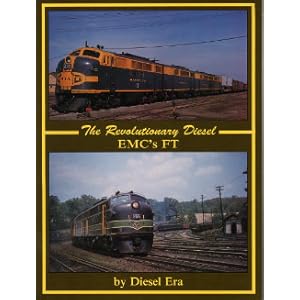
Diesel Era did a good book on the FT’s, covering each railroad that owned FTs and the original FT 103 demonstrator A-B-B-A set that toured the US in 1939-40.
http://www.amazon.com/The-Revolutionary-Diesel-EMCs-FT/dp/1881411028