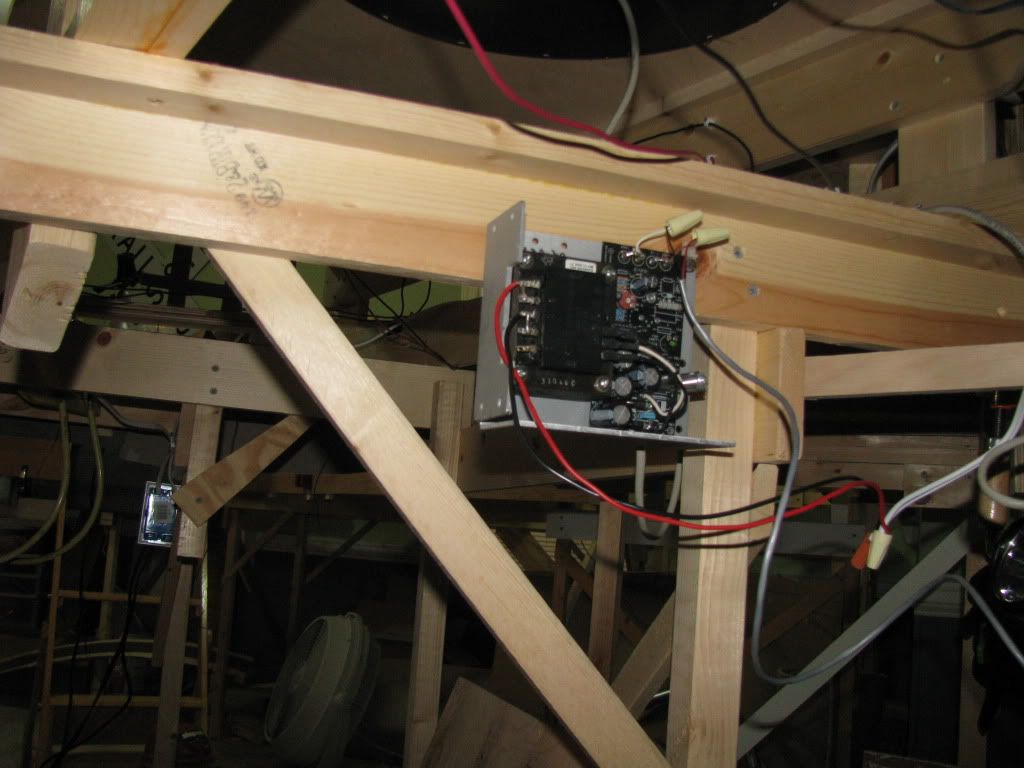
I’m getting ready to build an n gauge layout. I bought the Kalmbach publication on benchwork (2nd ed.) and perused through it. One question that came to mind was bracing, seemingly necessary, would be a major pain, especially during the construction of the layout. I’m thinking about doing the wiring, switch motors, dcc board installations, et al. I can imagine constantly bumping into the bracing. I guess it’s another good reason to build table higher, like 40"+.
Could the bracing be left off until construction is complete?
Would you build a house without bracing then add it after it was done? I hope not; same thing with the layout. When building something, the bracing will help it hold its’ shape; if it’s new, you can make sure everything is straight, level and square and the bracing will help it hold its’ shape. If you wait until later, the benchwork may warp or sag during construction, then adding the bracing will ensure the sag is permanent…not a great idea. I know it might be a pain to work around the bracing, but if the benchwork is stiff and square from the beginning, it will be easier to lay track that is level and smooth…something that is important for derailment-free running. I’m not familiar with that particular book or what kind of bracing you’re referring to (bracing of the layout surface or the legs?). Without knowing your exact situation (experience, scale, size, layout space conditions, etc), you might get away with not bracing until later, but more often than not, I’ve heard temporary solutions usually turn into permanent solutions; do it right the first time and you’ll only do it once. Moving the bracing a few inches or modifying the trackplan so turnouts, etc aren’t directly over the braces is your best bet. I’ve had to drill a few holes at an angle to avoid bracing, and even cut some bracing away to clear turnout linkage (be sure to strengthen the bracing you’ve cut away somehow…metal stiffeners, double the thickness of the brace (aka ‘sistering’) or add more braces as close to the weak spot as possible. If the bracing is for the legs, it will prevent wobbling, which will make working on the layout easier and prevent vibrations from loosening or damaging previous work. I’m not saying you absolutely have to add bracing, but if a ‘professional’ wrote about it in a book, it’s probably a good idea to do it.
Would you build a house without bracing then add it after it was done? I hope not; same thing with the layout. When building something, the bracing will help it hold its’ shape; if it’s new, you can make sure everything is straight, level and square and the bracing will help it hold its’ shape. If you wait until later, the benchwork may warp or sag during construction, then adding the bracing will ensure the sag is permanent…not a great idea. I know it might be a pain to work around the bracing, but if the benchwork is stiff and square from the beginning, it will be easier to lay track that is level and smooth…something that is important for derailment-free running. I’m not familiar with that particular book or what kind of bracing you’re referring to (bracing of the layout surface or the legs?). Without knowing your exact situation (experience, scale, size, layout space conditions, etc), you might get away with not bracing until later, but more often than not, I’ve heard temporary solutions usually turn into permanent solutions; do it right the first time and you’ll only do it once. Moving the bracing a few inches or modifying the trackplan so turnouts, etc aren’t directly over the braces is your best bet. I’ve had to drill a few holes at an angle to avoid bracing, and even cut some bracing away to clear turnout linkage (be sure to strengthen the bracing you’ve cut away somehow…metal stiffeners, double the thickness of the brace (aka ‘sistering’) or add more braces as close to the weak spot as possible. If the bracing is for the legs, it will prevent wobbling, which will make working on the layout easier and prevent vibrations from loosening or damaging previous work. I’m not saying you absolutely have to add bracing, but if a ‘professional’ wrote about it in a book, it’s probably a good idea to do it.
Let’s assume that your layout is roughly rectangular. Long braces reaching down to near the bottom of the legs can work fine three sides. Then use plywood gussets or shorter bracing on the fourth side to allow easy access. This will leave the layout well-braced, but still easy to get under – provided you’re under 50.[:P]
As for crossbracing the leg assemblies themselves…this is needed with L-girder construction to tie your two L-girders into everything for supporting the layout. The leg assemblies only need bracing down from those L-girders on the other two sides. I usually run long braces down on one of the other two sides and leave the fourth side with bracing like described above that makes for easy access.
If my description isn’t clear, think of a standard wood picnic table. It’s got two leg assemblies that are braced and strong, tied together with the bench seats and table top, which have stiffening braces down to the legs assemblies.
Far out! I’ve made it! I’ve been recognized by Google! [(-D] [wow]
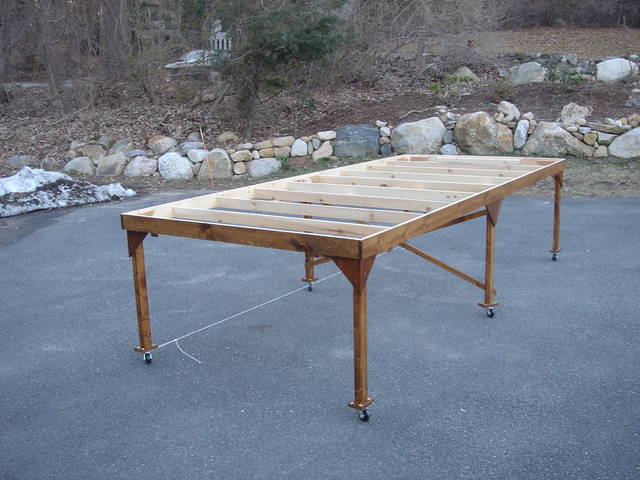
The “plywood gusset” picture above is my benchwork for Phase 1 of my layout. It’s been in service for quite a few years now. The corner legs have 2-sided gussets, and are quite stable. The legs themselves are 2x3s. The center legs, which only have one-dimensional gussets, are not as stable. I had to apply cross-bracing there. If I were to do it again, I would have put another rafter in the center, aligned with those legs so I could add gussets at 90 degrees and avoid the cross braces.
On the topic of height, the surface of my layout sits mostly at 38 1/2 inches above the floor. Since it’s made of 2-inch foam, that puts the underside at 36 1/2 inches. This is fine for working on the top, and even a bit of an advantage when reaching to the back of the layout, but it is very uncomfortable when doing wiring beneath the layout. A few inches higher would be much better.
The problem with making stilt-legged layouts HIGHER so that the gusset/sway-braces won’t get in the way is that you negate the intended benefit imparted by the addition of the gussets/sway-braces. The problem with bumping into benchwork, or merely leaning against it, is that you cause leverage against the very foot of each stilt-type leg because they want to remain friction-bound in place. All that leverage applies against the joint under the framing, usually in a corner. If you want your bracing to be effective, it must come at the very least half-way down stilt-type legs, unless the legs are 2X4’s…which I would never use. But my point is, as you lengthen the stilts to raise the gussets out of the way, you are also raising the leverage against the joints under the layout. You defeat yourself!
I build my around the walls layout in 30 inch by 8 foot modules. I initially build the module on sawhorses in the middle of the room. I can then tip the module on it’s back or side to do the majority of the wiring and switch motor installations.
I terminate all the wiring on a board that is hinged at the top and swings down at the front of the module. Things like Loco-net and the Track Bus will be connected on that board.
I then install it in the layout. Very little activity is then required under the layout.
My entire layout consists of the 2’ x 4’ domino system as described more than once in MR and MRP by David Barrow. The legs are 2x2 pine. With the Barrow system you have a basic box frame, in my case made of 1x4 pine, and vertical pieces of wood that support yet another box frame on which the plywood top sits. I am tall and the overall height is on the upper range for layouts. The legs go to the lower box frame, not the upper one.
Any one of these domino pieces is wobbly unless supported by some sort of truss or gusset. I found I did not have to make an “X” truss on both sides for good stability, just one truss per side and per end was enough. On some dominos, due to the poor quality of the pine these days, for spacing purposes I put side braces on the ends near the bottom of the legs that hold the legs the right distance apart.
What I found is that the dominos need the trusses or gussets while they stand alone, but once one of them is bolted to the wall and the other dominos are bolted to that domino, much of the wobbly nature goes away. Thus I am able to remove the trusses from a few dominos here and there which does make working underneath far easier.
I built similar tables for my wife’s workshop but there I followed a Jim Hediger article about making L shaped legs out of plywood that is screwed together. Those legs are less wobbly than the pine 2x2s - but also the tables are not as tall as my benchwork.
Probably about two weeks ahead of you as I have just started construction of benchwork. I am using a mixture of reclaimed and new lumber to build L girder tablework loosely following MR practices. Since my old basement floor is so uneven, I installed leveling bolts in each leg of the benchwork so I can bi-directionally level the table top (should be an interesting exercise). As soon as I hooked the first lateral brace to the legs it became apparent that diagonal bracing would be necessary. I am headed to the basement to do the diaganols this afternoon, Benchtop height will be 44 inches to allow for plenty of head room under the bench as I have degenerative disc disease in my neck and need plenty of room to prevent frequent head bumping. I’d leave a picture but can’t figure out how to insert a photo image with this posting program. Maybe someone can clue me into inserting photos into posts.
If you’re like the rest of us (well, like me anyway), when you planned out your layout space you did not leave space to store all the lumber and other supplies that will be used to build the layout. I’m working on my benchwork and I can guarantee you that without sufficient bracing (IMO sufficient = more than reccomended in the book you referenced) I’d have had a crumbled pile of busted up lumber all over the floor. All that stuff that I plan to use, but didn’t plan to store, has tripped me up uncountable times. Most of the time I leaned on the benchwork to catch my balance.
If you can’t fall on it without it colapsing, it’s not strong enough.
As others have recommended, don’t postpone the bracing. Attached is a photo of the duck-under location in my Sievers benchwork. All members are 1x4s of #2 pine (almost the quality of #1 grade). The legs are 48" high to top of frame plus about 1" for the added levelers. They are typically spaced at 3’ on center. The benchwork is an assembly of sections that are typically 2’ wide by various lengths not exceeding 4’. All members are screwed together; individual sections are bolted together and legs bolted to the perimeter frame. No glue. The benchwork is solid as the proverbial rock-no wobbles. Note the horizontal braces near the bottom of the legs.
Dante
P.S. That is foam pipe insulation wrapped around the 1x4s that are the perimeter frame and the braces. They are for duck-under navigation protection! Definitely not structural!
As was mentioned earlier, the lower the brace is attached to the leg, the sturdier the framework. I used 1x2 for most of my bracing (photo 1) and sometimes just scraps of 1/2" plywood, but I also fastened the legs to the floor with braces I made to work after the levelers were adjusted (2nd photo). You would be amazed at how solid the benchwork is with proper placement of bracing (even 1/4" ply will work for small corner braces).
That depends what you mean by bracing if you mean that which holds the top level, flat and square then my answere would be a definate no.
if you mean what holds the legs square and true as an alternative gussets can be made these are less of a pain and will still do the job.
my layout legs are held in place with 3mm thick alluminium gussetts and this is a less anoying way for me to do the job.
you can also make the bracing removeable the risk however is that too much of it will be removed to do the wiring job.
and that the parts go back in the wrong places with not to good a conciquences for the layout and it the case of too much removed not good for the person working underneath…


 [/URL]