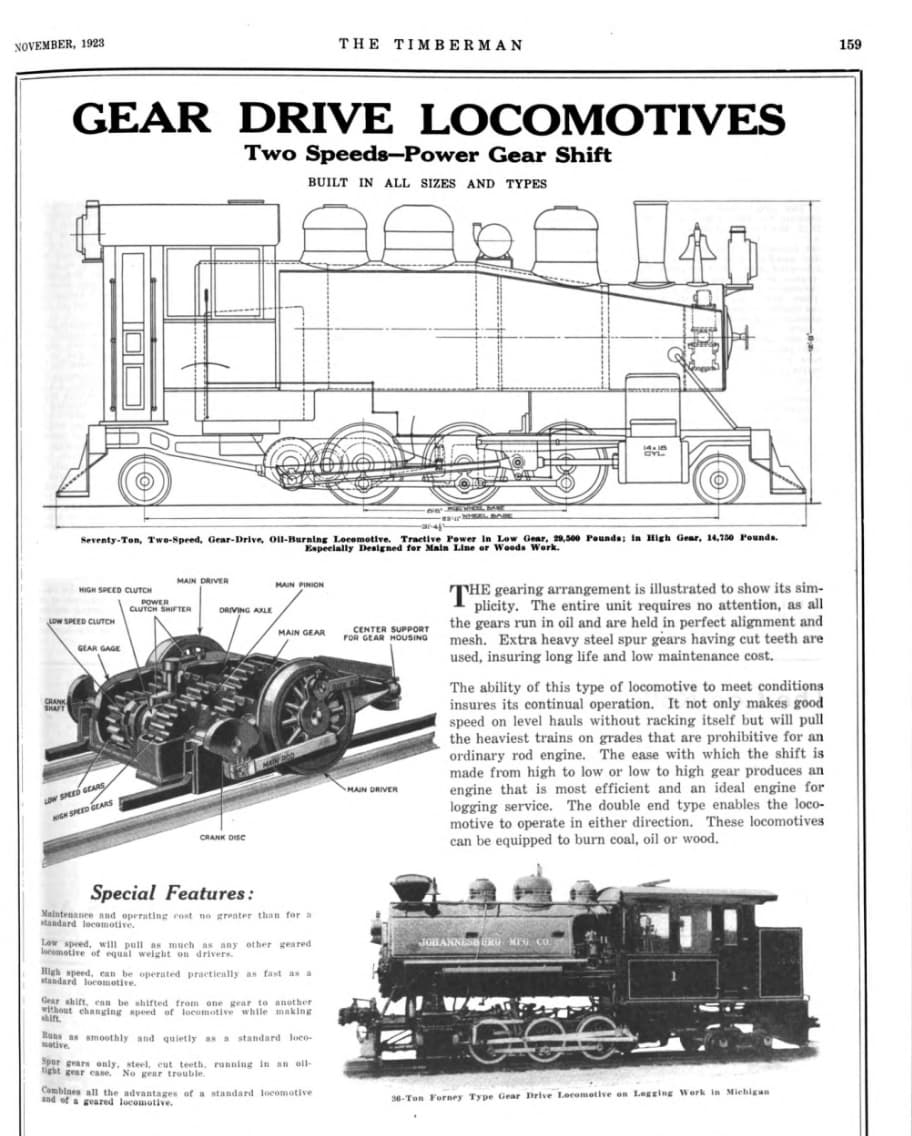
Hello everyone I recently came across a drawing of a 2-6-2 2-speed geared tank engine by Davenport Locomotive Works. There’s very little information on the internet regarding Davenport geared locomotives and even less about this rather strange design. What sets this design apart from your regular Davenport geared locomotive is the fact that this design had a 2-speed gearbox which allowed you select one of two gears. With low gearing the engine down and providing the extra torque required for slogging up a steep gradient with a heavy load and high driving the wheels directly for a higher top speed in line with traditional locomotives. Essentially combining the advantages of a logging locomotive with that of a traditional one. With some backtracking I was able to find the origin of the drawing in the November 1923 issue of ‘The Timberbman’. My question is wether the locomotive illustrated in ‘The Timberbman’ was actually built? And if Davenport utilized this 2-speed gearbox on other geared locomotive designs? So far the only reliable source I’ve been able to find online about Davenport geared locomotives says that they produced a model with 2-speed gearbox in late 1923. Could this be the aforementioned 2-6-2 design? The link below is to the November 1923 issue of ‘The Timberban’ illustrating the design. Any help or insight would be much appreciated.
(https://babel.hathitrust.org/cgi/pt?id=umn.31951d00216746p&seq=135&q1=davenport&start=1)
This is 2:1 ratio change based on the indicated ratio of tractive effirt stated. All the gears run in constant mesh regardless of ‘selection’, which is one of the historical things found valuable ‘over the years’ in designing multispeed mechanical transmissions for locomotives. There are two opposed clutches, mounted on a ‘spool’ sliding on what is presumably a splined cross-shaft between the quartered jackshaft cranks. My guess is that these are dog clutches rather than Maybach claw clutches, as the description is that the shift can be made between speeds with the locomotive running. I cannot make out the details of the power shift, but it is probably either air or steam cylinder acting on a transversely-pivoted lever. It ought to work as well as a contemporary booster in generating torque.
As noted, the entire gear arrangement works inside a sealed gearcase and there is no friction clutch material to wear. If I were designing this, there would be some ‘resilient’ shock absorbance between the actual dogs of the clutches and the spool or driven gears, to soften the shock of engagement similar to the action of quill drive.
As an aside, the Westinghouse patent for change-speed gearing for direct-drive steam-turbine locomotives, which would have been used on the 4-8-4 follow-on to the PRR S2 that would likely have been given PRR class R2, worked very little like this; it used a planetary transmission, also with all gears in constant mesh, that gave two forward and one reverse from one impulse/reaction turbine.
1 Like
Ah I see, my apologies for the technical mistake. I thought that if you were to use a dog clutch on a geared design it would require for the locomotive to be completely stationary prior to selecting your desired gear, like some locomotives built by Sentinel.
Not a technical mistake – a choice.
The Maybach claw clutch is a dog clutch with slight negative rake, so that it becomes self-engaging and stable (the faces lock together and would require significant power to move them out of engagement if even moderate torque is being transmitted). A straight dog clutch has straight engaging faces, so there is a bang as the clutch engages (with the desirability of ‘flexible-gear’ style compliance) and relatively little difficulty in disengaging.
The clutch could also be made with small positive rake, to get some of the automatic disengaging action of the booster when powered engagement is cut out. That would facilitate the locomotive drifting or running downhill without the usual need for snifting valves or drifting throttle, perhaps saving water.
I don’t see it as being much competition for Willamette ‘Pacific Coast Shays’ of course – you have the adhesion of more driver pairs with far better chassis flexibility and shorter rigid wheelbase, and no inherent augment from quartered rods as observed on Bethlehem auxiliary locomotives…
1 Like