I want to measure the amp draw of several Athearn (and others, all currently DC) locos. I have a short test track set up. Do connect a DC amp meter on one of the track leads, between the power and the track? I was going to try and figure out how to use a multimeter to do this, I think using a meter on my test track would be easier.
Thanks,
Mike.
Your multi-meter should be connected in series on one of the leads as you describe. However, check to see how many amps of current the meter can handle. An Athearn locomotive can draw a full amp(1000ma) under full load with no problem. I have a pair of meters in front of me:
- GMT-12A - It will handle 250ma(1/4 amp) - This is an old analog meter.
- DM-301 - It will handle up to 10 amps of DC current.
Make sure you have the polarity set up correct as some old meters will not block reverse polarity(like the GMT-12A) and you can burn them up.
Most decoders can handle 1 amp continuous and a peak of 1.5-2.0 amps for a short time. I converted an old Athearn ‘Blue Box’ engine years ago. After some clean up and motor brush adjustment, I got it to pull only about 600ma under full load.
The current Athearn ‘RTR’ line of engines usually pull about 500ma from measuring the several I have(SD40-2).
Jim
LION has built-in volt and ammeters on his big 15 amp regulated power supply. I cannot detect much movement it that ammeter, but LION also has an 5 amp ammeter on the interlocking panel, and that easily reads 1 to 1.5 amps during most of my operations, which includes up to locomotive equivalents running at one time. Two more trains to put on the layout and I’ll have 12 locomotives running all at once from this one power supply. You can see why I went with such a big supply, but apparently it was never all that necessary.
LION will put a switch in front of the meeter so that he can switch it to reading the auxiliary power supplies as well. Him wonders how much power all of the other stuff is drawing.
LIONS do not understand mufti-meeters with their knobs, buttons, batteries and plugs. He tends to burn the up or out or whatever. Mount a meeter on a panel, no problem.
ROAR
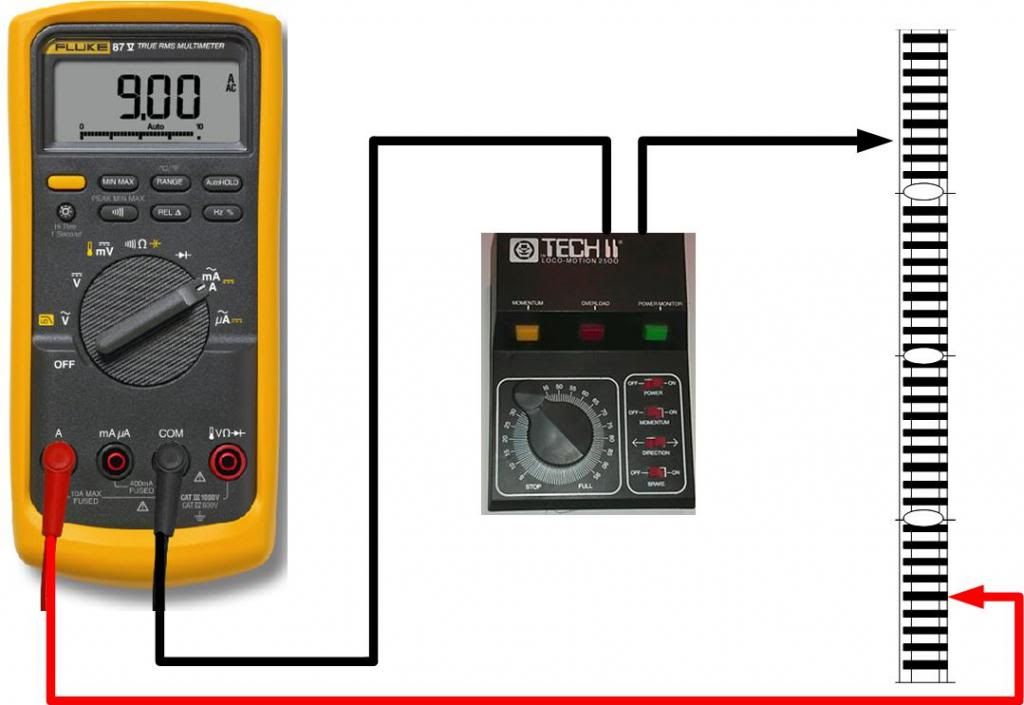
One useful current measurement is done by holding the engine , with no downward force, and applying full voltage from the power pack. This is known as slipping, since the wheels are spinning.
It will be the highest amperage value the engine can draw under normal conditions. An alternative is to run the engine against a bumping post.
This is where a good meter with Min/Max/Avg setting is useful. The meter will automatically record the highest amperage value and store it for you.
Another value is stall current. This is done by applying full voltage with the wheels locked and should only be done for a few seconds. Stall current is the absolute maximum amperage the motor can draw.
The only time this value would be present is when a fault occurs in the loco, such as a jammed drive shaft or gearbox. Motor burnout is imminent when stalled so the value of the test is debatable. I usually do not perform a stall test.
Thanks guys for all the great info, and links. No matter which way I do this, I need to get a new DMM any way, as the old one I have won’t handle the current.

Mike.
Putting a resistor in series with the load and then measuring the voltage across the resistor will measure amperage. This is called a Shunt. Unfortunately I’ve not done the calculations for such an arrangement since Junior High, so I would have to look them up. Probably much easier now with the internet than it was back then with the good old card catalog.
Harbor freight regularly has multimeters on sale for $2.99. They work great for model railroading applications.
Thanks Jim. I picked a new DMM, hooked it up just like this Only my MM has 3 jacks, so used the “10ADC” jack, as per the MM instructions. I’ve going through all my BB Athearns, picking out the better running locos for future decoder installs. All the BB locos run at 0.70 to 0.72 at full throttle. A GP 9, that I had added a whole lot of weight to, for switching, ran at 0.78 to 0.80 A new RTR, DCC Ready, ran at 0.65 to 0.68
Just thought I’d pass that on, and thanks again. Nothing like a picture to explain things!
Mike.
Very nice. I have one of those meters for backup but mainly use my cheap meters which show the same results.
A photo is worth a thousand words.
Rich
Your welcome Mike.
I am glad everything worked out for you. Enjoy the new meter.
