I would like to get a new dc walkaround throttle suitable for n gauge
Well, they are not made anymore, but you can still find them NOS or gently used.
This is what I use, The CREST/Aristo Craft 10 Channel Train Engineer. Wireless radio throttle with full voltage pulse width modulated speed control. Not the best photo, but here you go.


Sheldon
3 Likes
I have used simple walk around throttles housed in a Radio Shack project box, and connected to the layout with a curly 4 wire telephone cord (back when telephones had cords). Put a new, easy to use 4 pole connector at the layout. This is not suitable for heavy current draws, but will work at 1 amp or less.
You can put in a more complex throttle than I did very easily. Ken’s Hobby Electronics Page ([KEN'S HOBBY ELECTRONICS PAGE]) offers ready-built and kits for a PWM DC walk-around throttle that has momentum and zero point adjustment.
There are home build circuits for throttles with memory that allow you to plug and unplug your throttle while the train is running, but those were always too risky for me. My layouts were/are always small enough that the curly telephone cord would reach where I wanted to be.
Fred W
1 Like
Fred I’ve used Ken’s products and he does make a quality product in my opinion Both the throttles and the 751D switch controller
Mike
1 Like
Sheldon isn’t this kinda the same thing I’m not sure but seems to be and they have in stock items
https://www.revoelectronics.com/
Mike
1 Like
Yes, it was developed by the same people. It is a newer, more sophisticated version. I actually had one of those when it first came out, but decided there was no reason for me to change.
The new company is made of of some of the same people who developed it at Aristo Craft right before the owners closed the company. Product availability has been off and on with the new company. But, they are still around.
The new version is more heavily geared to G Gauge with onboard receivers , but does work like my system as well.
Sheldon
1 Like
Sheldon I remember reading about your layout years ago and your use of the Train engineer throttles seems to me you had a few of them at the time I think they were about the only one with wireless for DC I used DC only till I dismantled my layout it was in a 28 x 40 ft area I built my own throttles and then went to Ken’s I used Ethernet plugs for mine since the train would keep running when i unplugged the throttle
I did see they say 25 years in production by them
Thanks Mike
2 Likes
I have not tried it yet - I plan to get one for my DC test layout but I’ve had other priorities lately - but Kato has what they call their Smart Controller. You connect to it through Bluetooth with a smartphone or tablet and control the train with your device. It even integrates with their Sound Box to give your device control over sounds if you are so inclined.
Kato Smart Controller
Less than $100 on Amazon

1 Like
the systems from Digitrax, NCE and TCS work for all gauges.
CSX_Robert, great to see you once again. We have missed your electronics advice. Thanks for this informative post on the Kato Smart Controller.
Rich
He asked about DC throttles? For N gauge. Sounds like his locos are DC and he is not interested in installing decoders. I know I would not be interested in the prospect of installing N scale decoders.
Admittedly the price of decoders is way down from 25 years ago, but the price of 100 decoders and the prospect of installing them was just one item on a list reasons I decided to stay with DC.
Sheldon
My late brother-in-law had a huge DC layout in his basement. The prospect of going DCC and installing a large number of decoders was daunting. He was an NYC guy. He started buying BLI NYC steamers that could be run on a DC layout as a partial solution to the problem.
Rich
About 27 years ago when I finished restoring the old house, I started planning a layout for the second floor room of my detached garage, a space about 1000 sq ft. It had the same theme as the current layout, but it was a double deck affair with no helix, progressive levels and too much hidden track for the grade changes. I had 3/4 of the benchwork and a1/3 of the track in when I decided I did not like it and completely abandoned the idea of a multi deck layout.
Anyway, at that time I seriously considered DCC. Learned about it, operated on layouts of friends who had it, helped others convert to it.
I was not sold. So I began the full development of the system I use now. One of my friends had me install my DC Advanced Cab Control on his layout. He too felt installing decoders in a large fleet of older steam locos, mostly smaller ones, many brass, was going to be a big job. He was very happy with my control system when it was complete.
When availability of a desired loco leaves me no choice than to purchase one with DCC installed, I simply remove the decoder and rewire as necessary. Or in many cases years ago, simply unplug the decoder and install an 8 pin jumper plug.
Locomotives with dual mode DCC decoders will not run on my throttles. The waveform output of my throttles is full voltage pulse width modulated DC - it set decoders crazy. They either sit still and hum, or they have two speeds - full throttle and off.
The wave form on my rails is very similar to the waveform from a DCC decoder to the motor. So my loco performance is similar - very good speed control.
I had about 100 locos then, now about 140, even at $20-$30 for a motion only decoder, that money will by a lot of $4 relays - way more relays in fact than my system requires - most of which I acquired for under $2 a relay…
Sheldon
OK DC.
the problem with a walk-around throttle is that it needs a device physically connected to the layout driving the track voltage allowing a pluged in trottle to un-pluged and pluged back in again without losing track power, or a wireless handheld, or simply unplug, drop track power and plug in again.
another aspect of walk around control is are the turnouts remotely controlled and where are the controls. At the club using Digitrax DCC, the hand controller can toggle remote turnouts.
First, there are, and have been for many decades, DC tethered hand held throttles that remember the current speed while you move the throttle tether from one jack to the next.
https://www.classixaudio.com/821.HTM
DC walk around users often put turnout controls right where the turnouts are, either on small local panels, or individually on the layout facia. BUT, many modelers I know, DCC or DC, build walk around layouts with all turnouts manually controlled. Like PECO turnouts or new Walthers turnouts that need no switch stand or motor.
Having operated trains on several DCC layouts with DCC controlled turnouts, that is the most cumbersome task ever invented to control a model train layout - at least on a Digitrax throttle - 5 buttons to push for one turnout/route? That are so small I can hardly read them or get my chubby fingers on them? Any system is better than that - just my view.
And again, there are a few wireless DC throttles out there. Mine work great. They may be out of production, but they are rugged, and can be found “NOS” for under $200, sometimes around $100. I have a dozen, none of them has quit working yet in 25 years.
The OP has given us no indication of how large or small this layout might be. I would avoid assumptions about turnout control “issues” absent of some idea of the size or complexity of the layout.
So there are at least three practical options for walk around control in DC. All considerably simpler and less expensive than a DCC system and decoder installs in N scale locos - of an unknown quantity.
Again, we have no idea of the OP’s other operational needs or wants.
Sheldon
1 Like
Thanks for those kind words! I’ve been away from model railroading for a while, just had other priorities, but I’m getting back into it.
I know this is a few months old, but I don’t know if you have found a solutino to your DC throttle search. I developed my own wireless all-DC throttle system, and you can read about it here:
The “early adopter” phase is over, since I’ve sold a few. If you are interested, send me a message.
Cheers,
Max
1 Like
Your throttle looks interesting.
I am a user of the Aristo Craft/Crest 10 Channel Train Engineer and I am very happy with them.
I looked at your link, but did not have time to sift thru all that info.
So here are my questions and comments based on a quick read:
So did I understand that you have 10 discrete channels?
What waveform is the output? PWM or pure DC?
I like the push buttons on the Aristo throttle.
The range seems pretty good.
I use a progressive cab control system activated by pushbuttons, your throttle would work well with that approach as well.
Sheldon
Sheldon,
Thanks for writing. In answer to your questions.
Yes, my system can use up to 10 different channels. The entire thing is
done with a 433 MHz (or 315 MHz) analog broadcast frequency. The data messages are sent with simple “OOK” (on/off keying) style pulses. Each command begins with a preamble and ends with a CRC so that there can be no bad messages acted upon by the receiver. At worst, if there is interference, the message would be corrupted, interpreted as junk by the receiver and ignored. I put the channel number in the message itself. So all receivers in the area will receive all messages, but a receiver set on, say, channel 5, would simply ignore any messages it gets that don’t have channel 5 in the message header. Because all the logical channels share the same frequency, it is possible that with a lot of transmitters in close proximity, all sending at the same moment, they can interfere with each other. To get around that, I send all messages multiple times, randomly spaced, to make it almost impossible for at least one copy to not get through. I have tested this by setting my transmitters in a special mode, where they just go nuts, randomly sending messages constantly, at random intervals. I set up 4 of those in a small room doing this, while I ran a train with a 5th one, just to make sure that my messages would get through reliably, despite all the interference. And it works really really well. In a real world situation, you could never have 5 (or 9) other operators all pounding away with messages like that. In addition, remember that I said I could use 433 MHz or 315 MHz. So a really robuse system with a LOT of channels in use (like the maximum 10) could have 5 build to run on 315 and 5 on 433, so that any given one would only ever have to compete with up to 4 others on the same frequency.
Range: I tested it out to 50 feet, through two interior home walls. and it works without a single miss. ( I set up the the transmitter inside, then walked outside to my backyard, and went all the way to the back of my property). Without any obstructions (just line of sight), I’m sure it could go further.
The receiver goes under the layout, and connects to the throttle module, which is a fairly traditional transistor based linear current amplifier. It uses smooth DC with half-wave 60 Hz pulses superimposed on it. The pulses come on as soon as the throttles comes off “zero”, and the ramp up in amplitude as the throttle goes up. Then, at about 8v, they gradually diminish, so that by 11v, they are all gone and it is smooth DC. I specifically did NOT use PWM, because PWM can really mess up DCC decoders, and I built this for DC users, who may also want to run a DCC-equipped engine in DC mode from time to time. 60 Hz pulses are very good to keep a DC motor turning at very low speed, with no noise and no heat.
The speed control is a knob. I find it interesting that you say you liked the pushbuttons on the Aristocraft. When I designed mine, every single person I asked said they would always prefer a knob to pushbuttons (speed up/down), and it took quite a bit of work to make a system that used a knob. Personally, I prefer a knob.
Are you using the Aristocraft for N guage? The original poster wanted something for N. I thought the Aristocraft system was designed to have the receiver carried on-board in the loco, so it was intended for large scale trains like O or G. Although, I supposed you could mount the receivers under the layout, and just connect them to layout blocks. Is that how you are using it with your cab control system?
Thank you again. If you have more questions, or know anybody who might be interested in this system, feel free to contact me. I originally built this thing as a simple transistor throttle way back in the 1970s for my own layout. Then, I decided to completely update it with some circuit modifications for better performance, and as I kept redesigning it, I ended up adding the wireless capability to it and decided to make it public in case anybody else could use one, since DC throttles don’t really exist anymore except for MRC and a few cottage makers.
– Max
The Aristo 10 Channel Train Engineer system came in different versions for different applications. It was marketed as multi scale but was very popular in large scale, as that was Aristo’s primary market with their other products.
Large scale users often used it with the receivers onboard the train or loco but many did also use it like your system with trackside based receivers.
I use it for HO in a configuration similar to your throttle.
The most common version was a base station much like yours, using a separate power supply that can be as big as 10 amps at a max of 24 volts.
The system works on 27MHz and has 10 selectable frequencies each having 10 available channel addresses.
The 10 frequencies do not interfere with each other at all, the 10 channels will block other channels on the same frequency.
I use 10 of these, each on a different frequency to have 10 throttles on my layout.
Here are few pictures of the equipment, not the best pictures…
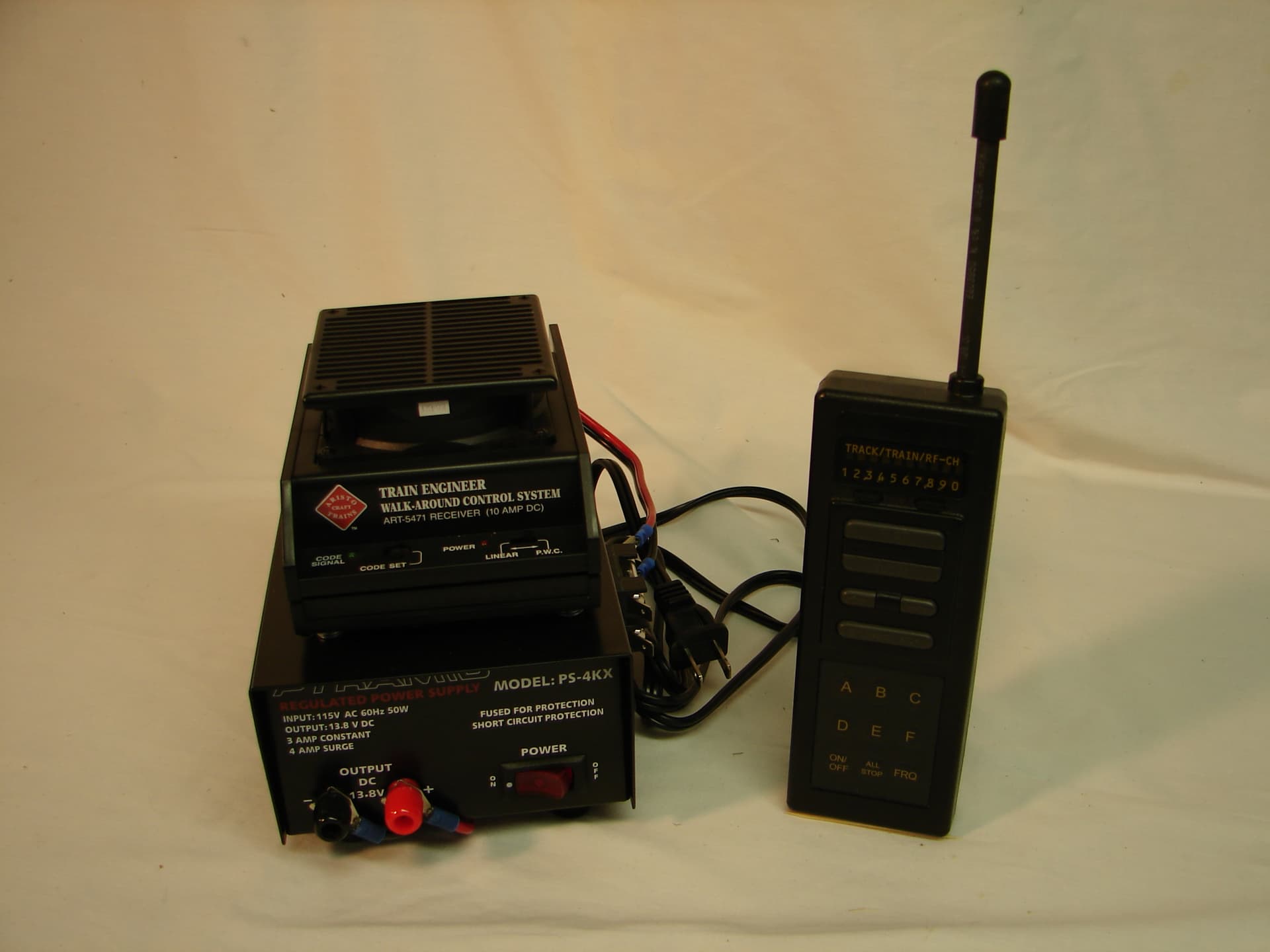
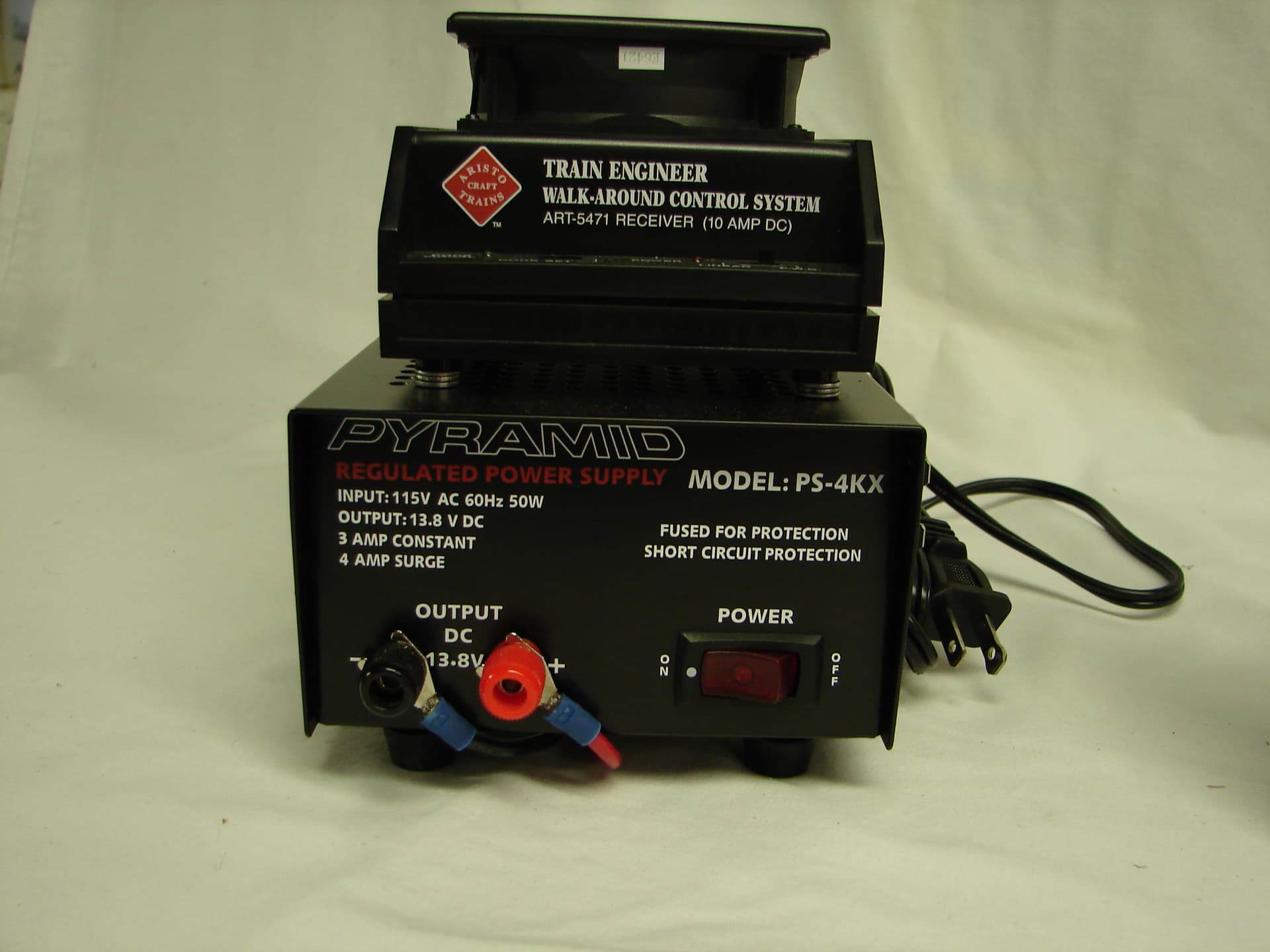
I use 3 amp, 13.8 volt regulated power supplies, one for each throttle.
The base station is selectable between a 25kMz full voltage pulse width modulated output or a filtered linear output.
My base stations are equipped with optional cooling fans.
Yes, my blocks are controlled with a progressive system of lighted push buttons that allows walk around control. A block can be assigned to a throttle at either end of the block or from the dispatchers panel.
Interlockings are not treated as blocks that require selection. Selecting the route and the blocks on either side of the interlocking automatically routes the power thru the interlocking.
I don’t use onboard sound, I do not have decoder equipped locos. You are correct, dual mode decoders will not run on PWM.
I have never tested a dual mode decoder on the linear mode of the of my system - but on PWM I have never seen a dual mode DCC loco work.
I never cared because I don’t want onboard sound.
The PWM speed control is very good and similar to most DCC decoders.
Sheldon