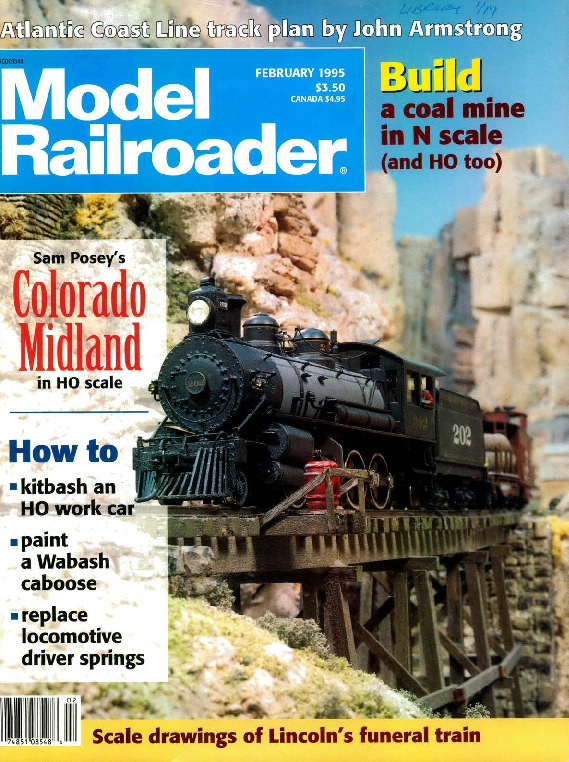
Model Railroader
February 1995
188 pages
Editor: Andy Sperando
Managing Editor: Jim Kelly
I’m chugging along trying to get caught up so let’s get to it. Were only pausing at one stop in between the front cover and the first feature as there were many pages of new product announcements and product reviews. Squeezed in between those is Workshop. The first topic was a brief set of instructions for modeling HTB trucks on an SP GP40X. The direction is more generalities than instructional. The upshot is a nice black and white photo of SP’s GP40X #7230. I don’t model the SP, but those intake shields and flared radiators make for a visually interesting loco. I may need some foreign power on my rails.
Sam Posey’s “My Colorado Midland” is first up. It is a 16 x 50 HO scale layout inspired by the Colorado Midland in the early 1900’s. And inspiration is the perfect word to describe this layout. Mr. Posey outlines his inspirations: “I soon discovered the master of this western genre had been John Allen, and Linn Westcott’s book “Model Railroading with John Allen” is a source of continual inspiration. Allen’s work showed me that a layout , and the photos of it, can be very expressive. The other big inspiration came from the Colorado Midland itself.” Later in the article he states, “Two excellent books I keep at hand for both inspiration and common-sense advice are Dave Frary’s “How to Build Realistic Model Railroad Scenery” and Malcolm Furlow’s “HO Narrow Gauge Railroad You Can Model.” John Allen, Dave Frary, and Malcolm Furlow. You can see inspiration from this trio in his layout. The bottom of his deepest ravine is 16-inches off the floor, track level is at 36-inces, and the tallest mountain is at 78-inches. The mountains make his HO scale seem more like Z scale. Inspiration. Yes, indeed.
Basic Model Railroading is back again and the topic is 2 pages about Kadee HO couplers. To be honest, I didn’t read this one. As discussed in previous Decades discussion, this is just feels over the top in its “basicness.” The number of pages in any given issue is limited. I would rather use those precious pages for something a bit more inspiration and/or challenging.
Next is an article with a little more meat on the bones. Bill Pearce writes how David Haines built Morley Mine in N and HO scales. The structure is based on a prototype coal mine near the town of Morley in the Raton Pass area. The article covers all of the construction but it just feels like there could have been a bit more meat than was present. At least it was a scratchbuilding article with scale drawings and provides more substance than the preceding article.
John Armstrong, yes that John Armstrong, contributes a track plan for Atlantic Coast Line’s Perry Cutoff. The setting is a flat and straight route from Thomasville, GA to Dunellon, FL where it meets up with the Tampa/St. Pete route. It is a double-deck HO scale layout designed to fit in an 11’ 6” x 21’ 6” attic. Since it was designed for an attic and it is also double-deck, the design calls for a sit and stand operating arrangement. It could have used a bit more prototype information and more than one photo, but I still enjoy dissecting John Armstrong’s designs.
Do you need a way to raise and lower your crossing gates? Then the next article is for you. The authors builds an adjustable platform to mount a Tortoise switch machine that will raise and lower the crossing gate. The author also installs a resistor in series with the motor to reduce the 12 volts DC to 7 volts to slow down the raise and lower motion from 3 seconds to 5 seconds. The article is a solid 2-pager.
Trackside photos weighs in at 6 pages and there are some great photos and modeling in this issue. The money shot for me is a photo Lou Sassi took of the Fairfield Model Railroad Club layout of a Housatonic Ry. RS-1 crossing a river on a truss bridge surrounded by fall scenery. Another really good photo involved a triple exposed photo that inserted an image of real buildings into the background (today we would do that with Photoshop), but regardless of method it is a tasty model railroading morsel.
Wayne Wesolowski gives us photos, drawings, and information for Lincoln’s funeral train. He also has a photo of his 1” scale of the funeral car. The history of the car is interesting. It was built in 1864 but had never been used until Lincoln’s funeral. The car is unusual in that it had 16 wheels to give it a smooth ride and the overall design was described as opulent. After the funeral, the car was sold to UP who used it in service for 8 years. It was then sold to the Colorado Central who stripped it down and made it into a work car. It ended up back with UP who then sold it to an entrepreneur who made it into a commercial exhibit with limited success. Thomas Lowry, President of Soo Line, recognized the importance of the car and purchased and restored it. In 1911, a grass fire destroyed 10 blocks of residences including the where the car was being stored in an unnamed Minnesota community.
Let’s make a work car/idler car/boom car out of a single-sheathed boxcar with an end cut out. That is what Alan Mende did based on a Maryland & Pennsylvania car. The basis for the model is a Walthers car that can still be found at train shows, but I would think any single sheathed car could be the starting point. The article provides options to make the car more or less detailed based on your modeling preferences. I think I may have to put one of these on my never-ending, never-shrinking, perpetual to-do list. If I get bored, it’s my own fault.
The Model of the Month goes to Harry Jacobs for an exquisite model of the Santa Fe station in Flagstaff, AZ. I’ve been there a few times and this model nails it. I don’t even know if “nails it” describes it appropriately. It is that good. Oh, and the walls are made out of matboard covered with embossed brick paper and the roofing is strips of construction paper the builder scribed with pencil lines to simulate individual shingles. The modern doors are clear styrene framed with silver tape to simulate the aluminum trim (that right there is what I call a good ideer…and I’m going to use it). The windows were drawn oversize and reduced to scale on a copier. To me, this is exhibit #1 on how the hobby does not have to be expensive: matboard, brick paper, construction paper, copy paper, silver tape, clear styrene, a few pieces of stripwood, and roof vents made from dowels. Talk about an economical scratchbuild… Also, it is exhibit #2 on reading articles on things that may not initially be of interest to you. I’m not modeling the Santa Fe in Arizona so “bah-humbug as this has nothing to do with what I model.” For me, my mind is now racing thinking about that tape over clear styrene for the doors. I’ve been stuck in my plastic ways and doing this sort of thing with styrene strip and then painting and gluing it to clear styrene. Heck, the tape idea is quicker, cleaner, and still gives you some dimension to the frame. And this leads me to exhibit #3 regarding re-visiting “old” material. This little one page feature with a short write-up now has me re-thinking previous strategies and techniques. You know, when I turned the page to this model, I had no idea it would turn into a paragraph of this length. So thank you, Mr. Jacobs and MR for the inspiration, and sorry if the length annoyed you.
Do you have a steam loco that has a too-stiff suspension that causes drivers to lose contact with the rail? The next article may help. Jeff Johnston describes how he replaces and fine tunes the driver springs on a brass locomotive. I don’t need this one, but it may solve a problem for someone out there in forum-land.
The next layout feature is about the O scale (two-rail) Detroit Union Railroad built and maintained by the Detroit Model Railroad Club. This layout was designed in the early 1970s after a move to an old movie theater the club purchased and rehabbed. It is 30 x 100 and they hold multiple open houses during the year. The club was founded in 1934 as a spin-off of the Detroit Society of Model Engineers and this layout is their 6th. As a side note, the layout will be on the layout tours for the NMRA National Convention being held in Novi, MI July 14th-19th, 2025.
I usually don’t revisit Symposium on Electronics but I did with this issue. There were a couple of photo-cell circuits that briefly caught my eye. The remainder of the info was a correction from a previous issue, using auxiliary contacts, and another type of occupancy detector.
Tony Koester ponders the significance or the lack thereof of being a model railroader. He asks the question: “Will we suddenly realize that while others were discovering top quarks or rebuilding the nation’s healthcare system or its physical infrastructure, we’ve been trying to get a model steam engine’s lead truck to stay on the track or put scale-thickness grab irons on a miniature boxcar?" Ultimately, Mr. Koester concludes that our hobby is a creative endeavor not unlike any other creative activity. All that great problem solving and innovation during our day job doesn’t prevent us from exerting that same mental energy to our hobby. He surmises that “what we do as model railroaders can be as worthy and significant as we chose to make it.” I will take it a step further that the significance lies within the hobby and also because of the hobby. I build models, help others build their layout, volunteer for the NMRA, and write these re-visits as activities within the hobby. Of at least the same significance, or possibly even more, it what I’ve gained because of the hobby. Because of this hobby I’ve created enduring decades-long friendships. Because of my interest in trains I’ve arranged four cross-country sleeper car trips with both family and friends. The lasting memories are significant and priceless to me and it created lasting a priceless memories for those who tagged along. Over the course of the years, half of my fellow travelers have passed on, including my dad. Those who still are held in these earthly bounds, to this day, still recount the adventures. I can still see etched into my memories the smile of one of my modeling friends who was on the trip, who has since passed on, when he saw Yosemite Valley. I met him within the hobby but my greatest and most cherished memories of him are because of the hobby. I think this is the whole purpose of “Trains of Thought.” My mind went down a different path, but Mr. Koester made me think, and all that thinking resulted in some good thoughts…and a little smoke from the gears turning.
Paint shop hit a home run for me (but I know it won’t for everyone). Mark Vaughan writes about Wabash’s red, white, and blue cabooses from the 1960’s. He also provides other references to other articles about how to model their streamlined cupola caboose. Pardon me while I oogle over the pictures. Coming in a close second place is a photo and paint scheme info for GM&O and Alton E-unit paint schemes. Nipping at the heals in a close third place is information regarding yellow and gray GP38-2s and GP40s. While I have my preferred roads, I’ve learned over the years that I pretty much just like trains with just about any road name on them. A least I try (try being the operative word) to keep my actual purchases within a lane and just admire the others. Like I said, I try.
That is a wrap for 1995. 2005 looms over the horizon. As I don’t write these Decades re-visits in one sitting, I have time to ponder during it composition. I was halfway through this issue and ready to declare that it wasn’t one of the stronger issues I’ve revisited. But as I wrote the second half my initial conclusion began to shift. The Flagstaff Depot Model of the Month Award, in its simplicity, sparked ideas for me on how to proceed with multiple projects and details, large and small, that I’ve been beating around inside my brain for a while. Then with reading Trains of Thought and where it led my own thoughts regarding my involvement in the hobby and how it has impacted my life outside the hobby was a rewarding mental exercise. Sometimes the inspiration comes from the words printed on the page and other times it is because of the words on the page.
Jeff