The other day, I was running my new U36B (I’ll explain later) on my test track and I was thinking about how unrealistic the reverse unit is. Think about it–do real railroaders need to cycle through positions on their locomotives? Of course not!
But there are a number of advantages to the reverse unit. I’m not going to go into detail on all of them, but suffice it to say that I think that the three-position reverse unit should not disappear (electronic or electromechanical–whichever you prefer). But that leaves us with the same problem–how to get more realistic operation. I think that many modelers (including me) often focus on improving the trains but not the infrastructure that powers them–track, wiring, transformers, etc. So, what I’m saying is, instead of changing the trains themselves, why not improve the control system on the layout end?
How it would work: First, let us presume that a train is rolling along in forwards. Then the throttle is notched down to 0, and the system turns power off for about 1/2 of a second and then goes to 18 volts. This switches the train into neutral. Next, let’s presume that it gets notched up again. When this happens, the transformer automatically pulses power to 0v, 18v, 0v, 18v, 0v, and then returns to the voltage dialed in by the throttle. This cycles the reverse unit to reverse, neutral, and then forwards, and the operator can then continue running his train in that direction. Now let’s say that he wants to go into reverse. He stops the train, the system puts it into neutral, and he then moves the direction toggle on his controller from “forwards” to “reverse”. When he throttles it up again, the train will have power pulsed at 0v, and then control is turned over to the throttle. This will take the train out of neutral and put it into forwards. Now, what happens if he tries to reverse the train while it is in motion? That could confuse the system, depending upon how it is designed. Luckily, there’s a solution for that too: the reversing lever will be interlocked to the throttle so that, when the throttle is turned up (and the train is therefore in motion), it cannot be moved out of its position. From the perspective of the operator, this would be like running DC trains with the suitable power pack, where it only reverses when the direction switch on the power pack is changed. Viewing the train, it will jitter slightly before going in the proper direction–which my 249 sort of does (the motor takes less voltage than the reverse unit and thus starts in the wrong direction for a second).
Some additional features that would be nice: a switch for controlling 2-position or 3-position reverse units, a potentiometer to control the “pulse” voltage (so that, for example, you could have it pulse closer to 12v–which would have some advantages for the operation of locomotives with lower control voltages for the reverse units.
Now, of course, how it could be done? That I’m working on. There’s a couple of directions that I could go with this, that I’m still figuring out. For now, though, it’s just a nice idea.
Well friend, you could also wire your motor field thru a rectifier and run the train on DC, which would give you the distant control you desire.
For your DC source, just use a few 6v car batteries, or a few cells of a 32v farm lighting battery. And don’t forget the Marn-o-stat for control!
I could, but, as I mentioned earlier, there are several advantages of the reverse unit: no changing polarity in the tracks, constant train lighting when stopped, etc.
Also, it would be easier just to rectify the voltage from a regular transformer and add a DPDT reversing switch than to use batteries. Or, for that matter, I could use a cheap-cheap HO power pack–that’s what I did for my mine train.
Mark, if you have a new U36B, does it not have a can motor and an electronic reverse unit? Is the U36B conventional or command control? When I run my Legacy U36 in conventional it always powers up in neutral. That powered stopped position allows access to all the TowerComm dialogs. When I run my ERR TMCC engines conventional they power up in FWD. Both engines reset to the default direction after about 6 seconds of no track voltage.
The retrofit Dallee 400 reverse units can be set to power up in either Neutral or FWD. They reset to that default position in about three seconds of no track power. I have these in non-command control engines I want to run with a conventional transformer.
Gilbert made postwar transformers that do most of what you want. They are the 15B, 16B, 17B, 19B and 30B transformers with the Dead Man’s Handle. They only work with old style 3-pole open frame motors. When the handle is rotated to stop, the track voltage stays at about 4V. This is low enough to stop the engine but high enough to prevent the reverse unit from cycling. To reduce the track voltage to zero the handle must be lifted up. Unfortunately, engines with can motors usually will not stop at 4V.
Sorry. I meant “new to me”. It’s a 1970s Lionel model. However, I do have some new conventional locos with can motors. That little revelation did just solve a completely different problem, though, so thank you greatly!
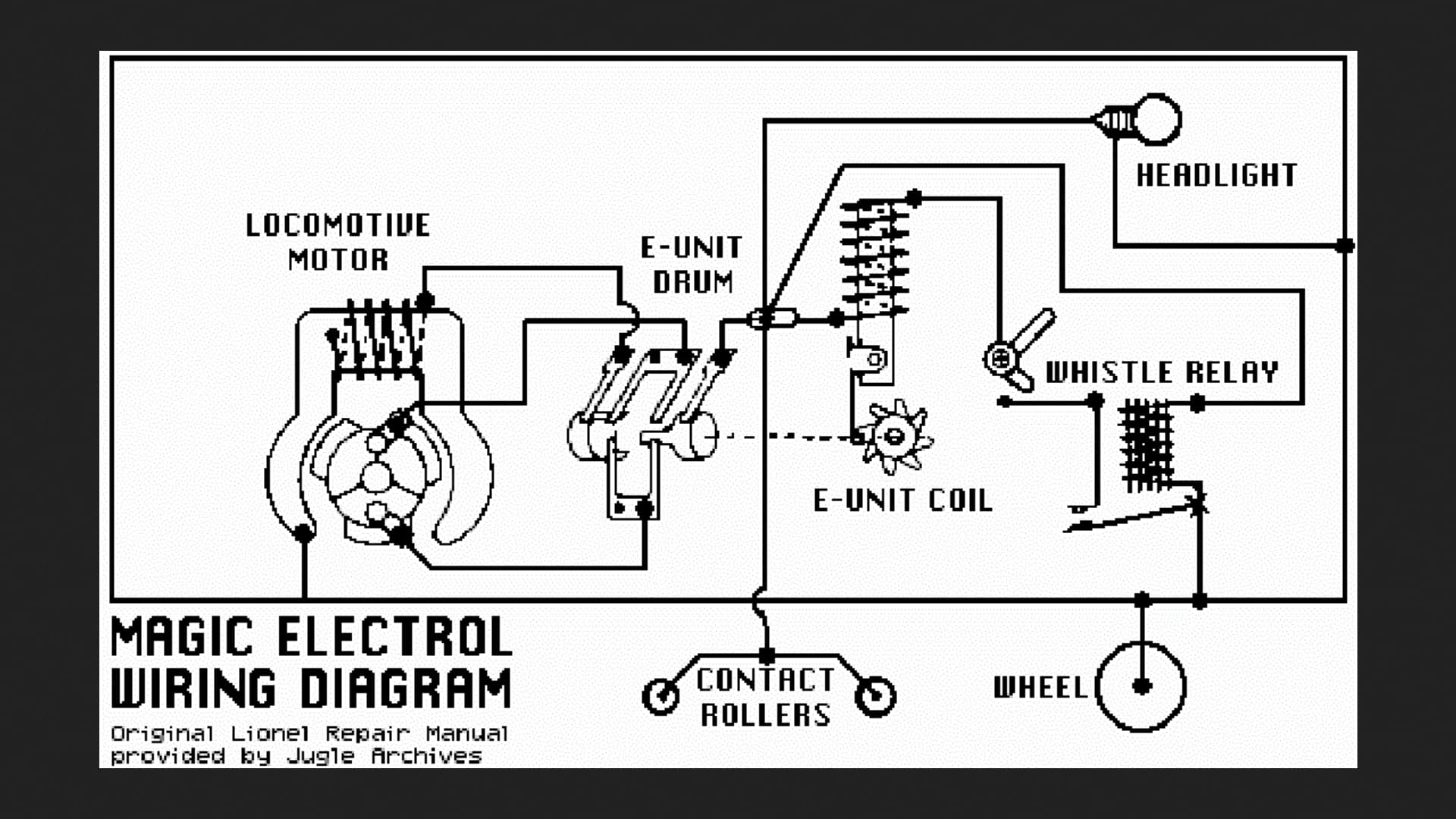
That is true, but it is unsuitable for the locomotives that already exist unless they are getting modified–and then it’s a moot point.
QSI use to offer controls like this by raising/lowering the voltage and using the whistle and bell buttons. In some products actually from QSI, you could even get independent control of locomotives on the same track(something that was left out of MTH’s ProtoSound 1 boards from QSI).
At the end of the day, all of this lost out to command control, which really does have these sort of advantages even for a single locomotives operated on a track by itself. Full voltage is always present so lighting stays constant(more or less), locomotives move in the direction you want them to when you want them to without having to cycle through positions(and can remain stopped but powered on indefinitely) and a whole bunch of other things.
I really think that the market is going to be thin for something like this now especially considering that Lionel is putting Lionchief+(which is RF and Bluetooth) in even their most basic sets now, the $200 Menards sets come with their own RF controller, and systems like Blunami with bluetooth control are now common in all scales…
I agree–hence the reason that I was moreso kicking around this specific idea as just a project, not for the market.
I don’t know where you people are looking for components, but these guys seem to have solved the parts list compellingly enough:
There have been better ways to generate a complex waveform through large output transformers since the days of tube hifi.
Was someone trying to drive a motor load with a diac?
I certainly agree with your comments on where the new O gauge train products are and what is coming soon. Lionel has done a good job with the Base 3 and the Cab 3 app to integrate all their command control systems from a user perspective. The newer Bluetooth engines have a range greater than the size of most houses, the older versions seemed to be about 20’ max, less with obstructions.
There are still new conventional O gauge engines that require transformer control, and many operators who want to run their trains that way. Most have old Lionel transformers and are happy with them.
In S gauge, the market is both smaller and much more fragmented. Around 40% run Gilbert and Lionel AF conventional engines with AC track power. The three most popular transformers are the 8B, 30B and the Lionel ZW. Around 20% use DC track power. These operators are a mix of S scale and S high rail. Remember that every Gilbert S gauge engine and all Lionel AF conventional engines run with DC track power. 20% are using DCC to operate their trains, these are almost all S scale operators. The final 20% use Legacy, these are all highrail.
That’s a good price on a 20A autotransformer. I would not plug my ZW-L’s into it. Its not isolated so the Legacy signal might pass through it, but it would be too easy to lower the voltage below the ZW-L’s design point and then damage the electronics. One could plug a simple postwar transformer into it, and use the autotransformer to control the primary voltage rather than use the transformer control to lower the secondary voltage. Problem may be the old postwar transformers would be way outside their design range with just 25V on the primary.
Not to mention the QSI products had many shortcomings that Lionel’s TMCC didn’t have.
My point is that the actual Variac components used in that unit would be considerably cheaper than their ‘assembled, packaged, marketed’ price.
Perhaps there are ‘corners cut’ on the actual variable-transformer construction; you might have to disassemble, inspect, and reverse-engineer what’s in there to see if it’s suitable. But a little research into where they got their key parts might be useful for this project.
Right, looking for the sourcing of the components could be helpful. I was surprised by the low price and went down that tangent.