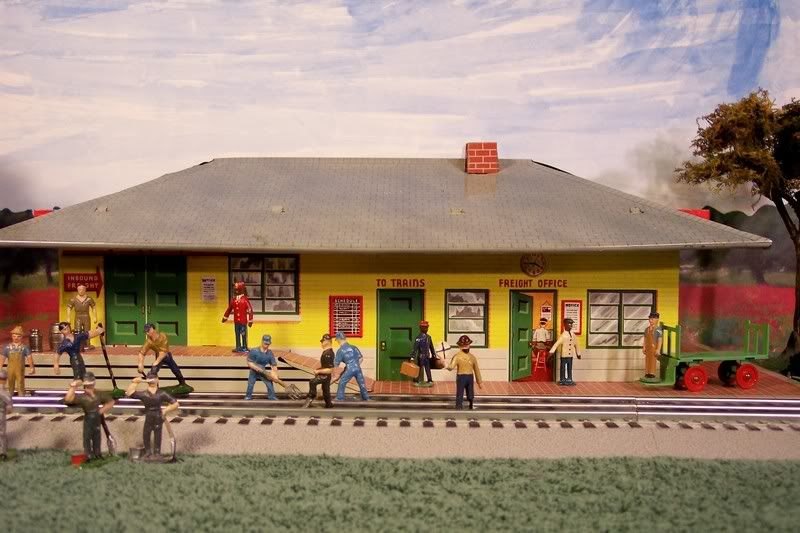
I confess it – I’ve been a Lionel snob since I was three years old. That’s when Santa brought me my 2026 set, and I’ve owned and enjoyed Lionel products ever since. I was aware of Marx, of course, but in my callow youth, I’d always dismissed it as “cheap crap.” And if you’re looking for scale fidelity, I guess that’s not too hard to understand.
But I’ve been perusing Marx trains on the net lately, and began learning enough to at least catch my interest. Maybe it’s because I bought my first Lionel tinplate (a 259E and freight cars) last year (and they were a huge hit at Christmas time), but I’ve recently started looking at Marx in a bit of a new light.
At a recent train show, there was little to catch my eye as far as my Lionel interests go, either scale, postwar or tinplate. But there were a few Marx items that did catch my eye. In particular, there was a #999 2-4-2 locomotive and tender, lying forlornly on one dealer’s table, attracting no buyers. I knew from my web browsing that the 999 was considered one of the better Marx locomotives. It was in great condition, and the price was a mere $19.99. Conditioned as I am by Lionel prices, I thought at first that I’d read the tag wrong, but there was no misplaced decimal point. It really was $19.99.
Still obdurately undecided, I walked around the hall a few more times. Apart from a few postwar accessories, I’d never looked for anything Marx before, but now that I was sensitized to its presence, I started uncovering more. There was a set of three NYC streamlined passenger cars (more on that later), some freight cars with very weird-looking couplers ( know now that they were Marx “one-way” couplers) and a lot of track. None of the prewar streamliners I would have expected to see.
After a great deal of struggle with my Inner Lionel, I decided to take the plunge. I went back to
That spoon-shaped pick-up on the bottom of the caboose looks like an add-on to me, but then I’m no Marx expert. I do have a Marx 4-4-0 that’s 56 years old and still runs very well, and yes, those Marx couplers are funky lookin’ but they DO work.
Maybe there’s something to be said for being a Marxist.
My first love is American Flyer, but I strayed. My daughter bought me a Marx Tin Plate Set at a flea market I guess six years ago. It was a very simple set in good condition for $75.
I set it up and the loco came to life after being stored for who knows how long. After a test loop I took it apart for a clean and lube and was surprised at the simplicity and robust construction. We ran this set under the tree that year for hours and never skipped a beat, and that was with 7 year olds at the throttle.
Since that time I’v bought several Marx sets, the 666 and the 999 and the 333 being my favorites. I’ll get a Marx set and donate it to a school auction fundraiser because a really nice Marx set can be bought for around ~$100, be ready to run after a lube and will run for years with out much more than a drop of oil. I know the folks who have bought the sets we’ve donated over the years and they set them up at Christmas and they are still running good as new.
The Marx trains may not look as realistic as American Flyer or Lionel, but I enjoy the toy look and feel and they were made to play with and last.
Several people have came to me asking about getting into toy trains and I steer them to Marx for the affordability availability durability reliability and ease of maintenance. Since they are three rail at some point many go on to Lionel, but by that time they are hooked on toy trains!
I have grown to love the Marx as much as my American Flyer. When I build my next layout, it will have both two and three rail to run my growing Marx fleet.
you’re done for…Marx has gotton under your skin. I had a Marx set when I was a kid. It was a plastic PC steamer. I knew it wasn’t the same as Dad’s and my Uncle’s Lionels, and it dissappeared. Now I really like the Marx tinplate, and more of the plastic.
The reissued caboose was a little fancier. As mentioned above that is a home made pick-up and light. Not an original idea I have seen that type of P/U added to Lionel cabooses as well.
Perhaps this is a good place for a reminder that a lamp’s rated voltage alone is not a reliable guide to how much heat it puts out. For example, the G-3.5 bayonet-base number-1445 is often described as an 18-volt lamp; but it has a 14.4-volt rating also and draws 135 milliamperes at that voltage, 12.5 percent more than the 120 milliamperes that the 14.4-volt number-53 draws, and therefore 12.5 percent more power–at any voltage. Their screw-base counterparts, 1447 and 52, are even more different, at 35 percent more current and power.
I picked up an unboxed 666 set with Southern Pacific tender and caboose, Santa Fe stock car, cities service tank car and transformer for 20 bucks on Ebay. These are the tilt coupler cars with “F” trucks that are very very close in size and detail to the so-called Lionel scout type cars which I love.
Marx offers a little something for everyone, whether it is the 3/16" scale cars, 4 wheel 6" tin, 8 wheel 6" tin, 7" tin, 4 wheel plastic or 8 wheel plastic cars. You can collect prewar or postwar Marx, not to mention the buildings and accessories! Last but not least, Marx offered what is arguably the most commonly available line of O gauge windup locomotives, and with the demise of Hafner (Wyandotte) and Unique in the 50’s, Marx still continued to sell windups through the end of production in 1975, and litho tin 6" cars through 1972. Yes, there is a lot to like about Marx. “One of the many Marx toys, have you all of them?” James
Thanks to all who advised me that the caboose lighting hardware was not original. I looked more closely at it, and discovered that not only was it not original, it wasn’t exactly done by a brain surgeon, either. I removed the whole mess, and I’ll post a photo of the excised bits tomorrow. I’ve updated my original posting to reflect this. I’ll know better next time.
Yeah, I’ve dealt with tin tabs before, and these were no worse than most. I must say, though, that I don’t think I’ve ever seen so many tabs on such a relatively simple construct. Marx designers must have been trained on Chinese box puzzles.
I’ve always been a bit reluctant to deal with eBay, for various reasons. But there are no train stores in my area, and the local train show is only twice a year. So I may be forced to go that route if I want to get any more Marx equipment.
I too have recently begun to take a closer look at Marx - although mostly at this point on the accessory side. One can find, at least relative to their analogous Lionel counterparts, some decent deals on Da Bay for them. This thread gives me the inspiration to dig a little deeper in the weeks and months to come.
Okay, as promised, here is what I found inside my Marx NYC caboose when I took it apart. Enameled copper wire, hardware-store nuts and bolts…and a series Christmas tree bulb from which someone had thoughtfully scraped most of the paint. The third-rail contact appears to have been cut from a tin can:
Obviously I have a lot to learn about Marx trains! But the learning is part of the fun.
JTrains: I know what you mean about Marx accessories; I’ve been using them with my Lionel trains for years. My scale Lionel layout has a Marx Bubbling Water Tower (to whose top I added a flashing light), a Marx plastic Water tower and a Marx two-bulb Yard Light. It’s only very recently that I’ve begun looking into the Marx trains themselves.
That home-made caboose illumination, yikes! That bare copper wire gave me the willies! No reason not to illuminate the caboose but I’d put some proper insulated wire back in the thing.
Oh, and Arkady you mentioned Zinc Rot in your post, or what’s commonly referred to as “zinc pest.” If you’ve got vintage post-war Lionels as I do and it hasn’t happened to them yet it’s not likely to. I don’t lose any sleep over it. As a matter of fact if anyone’s got pre-war die cast locomotives and they’re still intact I wouldn’t worry about them either, they’d have rotted away a long time ago.
I confess it – I’ve been a Lionel snob since I was three years old. That’s when Santa brought me my 2026 set, and I’ve owned and enjoyed Lionel products ever since. I was aware of Marx, of course, but in my callow youth, I’d always dismissed it as “cheap crap.” And if you’re looking for scale fidelity, I guess that’s not too hard to understand.
But I’ve been perusing Marx trains on the net lately, and began learning enough to at least catch my interest. Maybe it’s because I bought my first Lionel tinplate (a 259E and freight cars) last year (and they were a huge hit at Christmas time), but I’ve recently started looking at Marx in a bit of a new light.
At a recent train show, there was little to catch my eye as far as my Lionel interests go, either scale, postwar or tinplate. But there were a few Marx items that did catch my eye. In particular, there was a #999 2-4-2 locomotive and tender, lying forlornly on one dealer’s table, attracting no buyers. I knew from my web browsing that the 999 was considered one of the better Marx locomotives. It was in great condition, and the price was a mere $19.99. Conditioned as I am by Lionel prices, I thought at first that I’d read the tag wrong, but there was no misplaced decimal point. It really was $19.99.
Still obdurately undecided, I walked around the hall a few more times. Apart from a few postwar accessories, I’d never looked for anything Marx before, but now that I was sensitized to its presence, I started uncovering more. There was a set of three NYC streamlined passenger cars (more on that later), some freight cars with very weird-looking couplers ( know now that they were Marx “one-way” couplers) and a lot of track. None of the prewar streamliners I would have expected to see.
After a great deal of struggle with my Inner Lionel, I decided t