How far away would coal generally be sent by rail? For example, from appalachian coal country in the eastern US, would coal be shipped all the way to the west coast? or even the south or midwest? And would they be generally the originating eastern railroads cars?
EDIT: Specifically looking for info from the past. In the late 50s to late 60s eras.
I model Centralia, IL in 1955. Centralia was a major terminal for the coal operations in the Southern Illinois and Western Kentucky coal fields.
I have a copy of an Illinois Central publication, Organization and Trafffic of the Illinois Central System published in 1938. I’m going to start with that because coal was the primary source of energy in this country until natural gas and heating oil started making big inroads in the 1960s. The book contains an entire chapter on coal traffic. In the 1930s through the 60s the IC served 56 mines in Alabama, Illinois, Indiana and West Kentucky. They also served 36 other mines jointly with other railroads. In 1937 these mines had the capability to produce 3497 car loads per day. In 1937 the IC handled 15,209,084 tons of coal which was 33% of the total freight tonnage that year. They made $16,623,669 on the coal traffic which was 17.7% of total freight revenue. So where did the IC haul this coal? I’ll quote from the book:
[quote] Marketing of coal. The higher grade coals are preferred in the domestic trade. This coal is hauled by truck or wagon from retail yards to which it moves in railroad cars. Industrial firms always endeavoring to keep their power cost at a minimum, equip their plants with stokers that will enable them to burn efficiently the low grade coals which are usually cheaper then the higher grade, and they attempt also to utilize coal moving on short rates.
In this way, a condition is created whereby there is a market not only for the high grade coals, but for the low grade as well. There is a certain balance to the situation which obviates the necessity of everybody tryong to use only the high grade coals.
Coals produced in Illinois and West Kentucky are not of as good a quality as those produced in Eastern Kentucky and West Virginia; regardless of this fact there is a competition between these different fuels
Western states got their coal from mines in Utah and Colorado. However most electrical power plants in the west burn oil or natural gas since the west coast has lots of oil and natural gas but no coal of it’s own. Western railroads used oil burning locomotives instead of coal.
The first unit trains of coal were created to bring coal from mines in Utah and Colorado to Kaiser steel mill in California. It was 1600 miles round trip.
Here is some really interesting informantion about the trains and the coal mines. 1942-1981
There is a giant modern coal burning power plant which produces electricity for Las Vegas that uses coal from Utah. Most people think that Hoover dam provides the power for Las vegas but nowadays it can only light up one neighborhood, not the whole city. The coal burning powerplant is being replaced by a solar powerplant and natural gas burning plants.
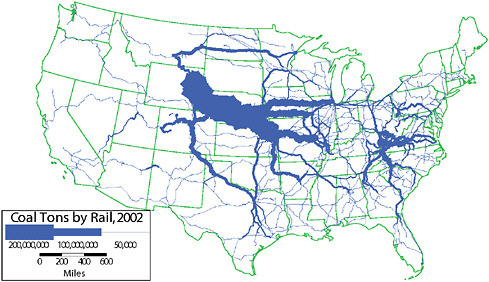
There are coal-fired plants in Florida and Georgia that burn Powder River Basin (Wyoming) coal today. 2000 miles there, 2000 miles back. Plant Scherer (Atlanta) alone burns 30,000 tons a day. That’s three one-mile long 100-car coal drags each and every day, rain or shine.
I’ve never heard of coal being shipped by rail, I’ve heard of it being shipped via freight cars that ride on rails! [(-D] just kidding with you…
A good resource for coal railroad modeling is Kalmbachs “The model railroaders guide to coal railroading” by Tony Koester and if you’re modeling mountains Kalmbachs “the model railroaders guide to mountain railroading” by Tony Koester is also a good help…
The coal fired power plants here mostly burn Powder River Basin coal despite the fact that we sit on some of the largest coal deposits on the planet. I think maybe one or two of the mines in Southern Illinois are still operating.
A BNSF coal train from the Powder River basin started running past my house daily at the first of the year. At first I thought that the trains that served a powerplant in Southern Illinois that ran on the old CB&Q line from Beardstown to Centralia had been re-routed for some reason. Some checking revealed that it’s a train that used to run from Wyoming to Newton IL on the UP. For some reason it’s coming down the BNSF to Centralia, then going back North 50 miles to Effingham and then on to Newton. Any way you look at it, the new route is 100 miles longer.
There is a mine at Hillsboro IL (in Central llinois) that built a private rail line 10 miles to the powerplant at Coffeen, IL. That coal goes right from the mine to the powerplant and doesn’t run on a class 1 railroad at all.
When the Homer City (NE of Pittsburgh) plant was built in the '60s, it was smack dab at the mouth of the coal mine. I think the mine has receded about 10 miles since then, but coal is still hauled in on rubber-tired trucks.
Actually there is is some coal in California. $7 of the 58 Counties have coal deposits. Coal was discovered at Corral Hollow Canyon (12 miles south of Livermore) in 1855, a mine opened in 1868. In 1897 the town of Tesla was established and the area b.ecame the leading coal mining area in California. The Tesla mines closed in 1911.
The Southern Pacific had a large coal dock in Santa Monica where coal was unloaded from ships to fuel SP locomotives. It ceased operation when the railroad converted to oil. First oil burners in 1895.
I don’t know off hand and for a fact, but here’s something to keep in mind: not all coal is the same, and I don’t just mean bituminous and anthracite. There likely would be buyers looking for coal from, say, Western PA down in Tennessee or something, if they were looking for specific products.
Thanks for all the info guys, That was enlightening. I would also assume in most cases the string of cars would more likely than not belong to the originating railroad with an occasional group of privately owned cars by really big customers?
Generally, private owner coal cars weren’t common until unit coal trains came along - trains that aren’t switched, they’re run from the mine to say a power plant and back again over and over without being uncoupled or switched etc. Although unit coal trains started in the 1960s, they weren’t really common until the 1980s, when you’d see say a train of bathtub gons all owned by a power company running as a unit.
As was noted before, private owner cars are going to depend on the era you model.
Hopper cars in a given train may or may not belong to the railroad that served the mine the coal came from. There were several mines in Southern Illinois that were served by 4 different railroads. The IC, CB&Q, C&EI and Missouri Pacific. These mines operated with reciprical switching agreements with the railroads taking turns switching the mine for a year at a time. So you would see hoppers from all of those railroads being hauled to where they were interchanged back to home rails.
You could also find hoppers belonging to roads that didn’t serve the mine. I have a lot of photos from the 1930s through 1960 which show B&O and L&N hoppers at the mines.
And don’t forget gondolas. There was a lot of coal hauled in gondolas. This was especially true out west. The CB&Q used a lot of USRA clone compostie gondolas in the coal fields here well into the 1960s.
867 miles is average length of haul for coal according to the Association of American Railroads.
"Due in part to the high consumption of low- sulfur Western coal by utilities throughout the country, the average length of haul for rail coal movements has trended upward over the years, reaching 867 miles in 2014 — an all-time high. "
In much of New England, bituminous coal arrived at ports in ships, often sailing schooners to a very late date. Power plants were built on the water and coal unloaded into piles directly from the ship, then conveyed into the plant itself.
When coal was shipped inland from a port on the B&M, just as an example, it would mostly travel in B&M or other local railroad cars – not very far, in other words.
Anthracite, I would bet, would come in PRR and NYC cars.
BTW at one time, the port of Duluth / Superior received large amounts of Eastern US coal via Great Lakes lake boats. From there, the coal would go by rail to the Twin Cities or to other places in the Upper Midwest. Today, it’s the other way around, as a lot of Powder River coal goes there to be loaded onto lake boats going east.