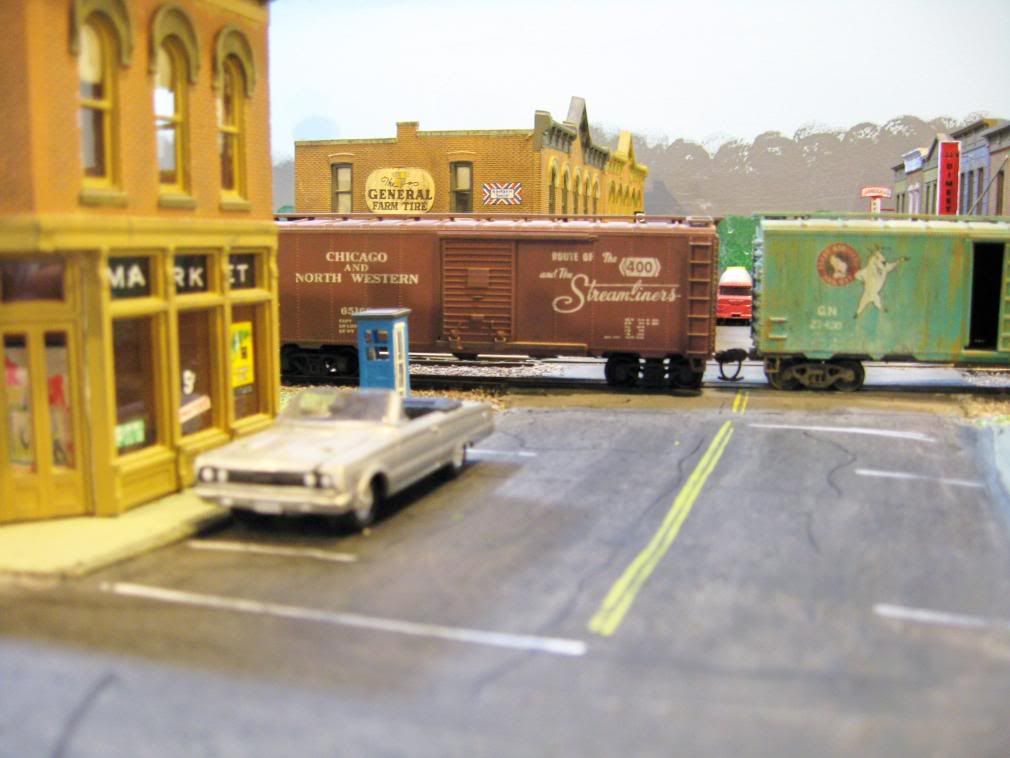
It’s not nearly a pointless question. I think it’s a distinction with a great impact on this hobby. It is natural that a lot of modelers should want a photogenic railroad, and in fact these are the ones who probably get published most often - photography is still the main way we communicate our images to others, whether on paper on electrons. At the same time, this is a three-dimensional art form, and even a performance art form, so we aren’t exactly like the builders of movie sets. There really is no way to satisfy both viewpoints completely, because the camera and the eye just don’t see things the same way.
Some elements work well for a camera, but not the eye. A good example is the typical two-sided scene-divider backdrop. A camera is fixed and predictable. You can aim the shot in such a way to block out the backdrop edges, and make it the background of a realistic scene. Eyes are neither fixed nor predictable. The eyes of an observer viewing the same scene will jump from target to target, drift along, take in everything within view. It’s hard to miss the edges of the backdrop and not see it as a Big Card Standing There.
Other elements work well when seen, badly when photographed. A typical old-time club layout, with lots of dense track, and heavily scenicked chunks connected by relatively narrow “bridges” is unlikely to look good in a photo. A camera takes in what it’s pointed at. The eye, though, can be distracted - an operator following his train doesn’t necessarily notice the extraneous tracks, or the sudden dropoff of the world. He’s concentrating on his train.
My wholly unsystematic observations suggest that, over the years, we have come to focus on those things which photograph well, even if they don’t necessarily work out well when seen in person…but is this really what we want?
I was thinking the exact same thing last night while conducting a photography shooting session on the layout. When I designed this layout photogenic elements or placement was not in the equation. Now I find that a lot of cropping will need to happen with some of the images to keep them focused on the subject.
And for me this seems to be more of an issue with wide-angle shots as opposed to the close-ups.
I’m still playing around with my new digital SLR, having used a “point and shoot” for the past 4-5 years it is going to take some time to get back in the hang of using manual settings.
My upcoming layout is being built with photography in mind. In fact all my scale model I build have that end in mind during construction.
I think the layouts that have the most impact on people are those that are what I would call “phootgenic”. This means more scenery than structures and visually impacting scenes. It also means less “spaghetti” trackwork and a simplistic approach. Of course building a layout like this doesn’t mean you have to sacrifice operations. I think you can get enough satifying operations from a layout that is built to be photographed.
The last thing on my mind is taking pictures. I build for myself. I guess that means I build for the eye, but for my eye. If others enjoy how it looks, great! If not…[B)] [(-D]
It seems to me that quite a few modelers have been able come up with a layout that satisfies both the eye and photograph and have been doing so for many years. Hayden and Frary, Malcom Furlow, John Olsen, Allen McClelland, John Allen etc al… built their railroads with photography in mind. With the ability for anyone to take and publish digital pictures of their layout I think that some elements of design for photography were inevitable even on the smallest layout.
Trying to duplicate the type of scenic effects of a layout like the V&O in a relatively small space is going to require view blocks and other techniques that may no be as pleasing to the eye for some people. I actually prefer the visual effect of a divider type backdrop compared to the visual effects of many of the spaghetti bowl layouts of the past.
I build for the eye, but since I take a lot of pictures, I’m aware of the difference. My layout is a table, so I can’t use a permanent background, and it’s in the family room which no one really wants painted light blue with a few puffy clouds. So, I make do with a thin piece of foam board that goes behind the layout when I’m taking pictures.
Most of the time, though, I’d have to agree with the original premise. The pictures I take can be tightly controlled, to block out anything that doesn’t fit the theme. After all, there’s still a sizeable chunk of pink foam visible, and I wouldn’t want that in anything other than a “work in progress” photo. I find that I’m often happier with the pictures than I am with the real look of the layout.
Then, sometimes I look at a photo and see something I really don’t like. I have to head back to the train room and fix it.
I’m not really referring to les chemins de spaghetti, though.
Take my own layout. My trackage is slightly convoluted, but is no temple of reformed pastafarianism. I also have two town - areas roughly diagonal from each other that aren’t supposed to be so close.
Conventional wisdom would suggest a diagonal backdrop board, crossing part of the table, or a ridge high enough to block all view. This would photograph well from either side, and the background could be as urban or rural as paint or print could make it. “Hey, they built a Hotel Gotham in Wattsburg! [C):-)]”
In practice, though, there would always be times, while running the railroad,
I definitely try and build for the camera. If I’m painting or building something and I’m not sure if I like it, I’ll grab the camera and take some shots and view it on the computer. I can find mistakes much easier in a photo than the real thing. I find I can focus better that way without having the surroundings as a distraction. Being able to view photos instantly has really helped my modeling.
If a piece of rolling stock looks good enough to my less-than-perfect eyeballs at a distance of 100 scale meters (roughly four feet) I consider it satisfactory. Once I start building scenery and structures, I expect to follow the same standard. Except for ‘right up front’ modeling, any detail not readily visible at the length of a New York City block will be roughed in, or simply omitted.
I don’t doubt that the flaws and shortcomings of models built to that standard will jump right out of a photograph, but I really don’t care. I have a LOT of respect for craftspeople who can build models able to withstand close-up photographic scrutiny - but trying to equal their efforts is rather low on my list of priorities. Maybe my opinion will change once the broad-stroke work of building a rather large model empire is mostly completed, but that won’t be happening soon.
Chuck (modeling Central Japan in September, 1964 - in essence, not in excruciating detail)
The camera can pick up things that thge eye alone can’t pick out. Something that looks like a minor error to the eye can look like a major mistake in a photo.
I think the pendulum is at one end of the spectrum right now and that is detail that most people can’t see. I remember pictures in one of the magazines years ago from the NMRA convention where a modeler had included a casket in the baggage section of a car and got points deducted because it didn’t have a body in it. I connect engine consists with drawbars and no one has ever noticed them but they can tell you the stripes are too wide by .0003" on a PRR engine. I put a highly detailed high priced rolling stock on the railroad and watch parts fly off just from rolling down the track. People want engines and cars with more detail than the prototype and then complain it won’t go around 18" radius curves in HO. I got news. It won’t in real life either. Get a life. Everybody thinks they can make their railroad and get pictures of it published in the magazines. Good luck. Let me give you a hint, “it isn’t what you do. It is who you know”. I got to the point with a magazine that out of consideration for our host will stay nameless but witnessed a major wreck take place and took pictures while it was happening. Called up the office asked to speak to the person in charge of the photo section and asked if they were interested, exact response quotation was ,“Thanks we already have them”. That opened my eyes. Now I have an attitude of if I ever build a layout and get called if it can be photographed for an upcoming publication the answer will be, “not in this life”. I also have an attitude if someone I don’t know starts criticizing anything I point to the door and tell them to leave. My house, my railroad, my rolling stock. if I want your opinion I will ask for it. Now I please me. I don’t need guilt trips, aggravation, anger or frustration from fools so I don’t accept it. It used to be
But does this matter? If photography is the goal, it obviously does…but can’t you just as easily say that the major photo error isn’t a problem, because the eye misses it?
What of something that works better on film? Take the typical polyball hillside. On film, it looks good, very realistic, as a backdrop for equipment. But in real life, looking at a scene like that, the eye tends to breeze right over it…lots of green, nothing to see.
This is very useful when trying to make something Not Be Obvious like a big pillar or the table edge, or a divider ridge, but not so much when the intent is to make a scene that is interesting even when there’s not a train in sight.
I think we have really become used to thinking of the photo as the ultimate test, but really, this is not solely a photo art form, but a live art form too, meant to be personally viewed.
Photography wasn’t a consideration at all while I was building my current (second ever) layout. It took far too much energy as it was with all the learning I had to do to keep asking myself as I went along how this would look at such and such an angle. It turns out that the resulting layout, at its current state of development, produces gratifying images for my equipment and skills in both modelling and photography, but a cursory glance at WPF each weekend encourages me to keep looking ahead. For example, I need quite a few more trees, and more detailing so that scenes come alive.
All in due course. Same for beginning to think in terms of decent photography.
I agree(sortof) with Jeffery. As an example the scene below looks great in my basement and pretty good in the picture. BUT, when you click to enlarge I can see the booboos.And they aren’t lack of detaials, more along the lines of foundations, etc.
Terry, I think you’re selling yourself short. I think the scene you’ve posted is very effective - it has the “look” of typical small-town USA. I like it!
I tend towards building for the eyes, rather than the camera, although I do make allowance for photography by leaving some scenic features loose, so they can be removed to allow the camera to placed on the layout.
As I told Grandman back when he was first learning to use a camera and photograph his layout, “… the two edged sword of good pictures, the flaws in the models start becoming more apparent. Did you notice your cement station platform isn’t totally on the ground?”
While I don’t design a layout or a scene for the specific purpose of taking pictures, I certainly want my work to look good in a photo.
I would think the great majority of people build for the eye, without giving much thought to photography. However the percentages of modelers on a forum like this may be much different.
Frankly, I think the differences in approach are minimal:
More detail is always better. If it can be seen in a photo, it can probably be seen (but perhaps not noticed) by the naked eye .
Almost any MR looks better with a backdrop, whether in photos or real life. The exception to this rule is backdrops painted by people who think they are artists, but aren’t.
My personal rule of thumb is to avoid putting anything on the layout that causes people to ask questions like, “Uncle Harry, why is that board sticking up in the middle of your layout?” While it will photograph well, it tends to look really stupid in person. There are many other ways to disquise/hide the dreaded oval, and imo all of them are better than the centerboard.
A final obvious difference is that a MR build for photography only wouldn’t have to run. That wouldn’t suit me in the least.
If a photo makes a minor flaw look like a major mistake then I’d have to say the camera is the major mistake. I take pictures of the things I wish to recreate in scale, not the other way around. [:)]
Maybe someday I’ll care if my layout is photogenic and then maybe I’ll care about seeing my layout in MRR…I sincerely hope not. That’s not why I became interested and it’s still not why I do it. I’d rather take terrible pictures of my family having fun working on the layout and running trains. [;)]
I first started taking pictures of my layout simply to document construction and progress. As areas became more finished, I started using the camera to help improve a scene. Lately, I have been building certain areas specifically to look good in pictures.
During all of these phases, my main objective has been to run the trains. Everything else is secondary. I am continually amazed by the quality of the newer engines in the area of performance and detail. Having said that, it is so much more fun to run the trains through a somewhat realistic setting rather than simply shifting cars back an forth on a bare table top.
I guess for me the answer to the original question is “both.”