I have 2 crossovers on the mainline , points facing each other. One crossover goes from mainline 1 to 2, other crossover goes from mainline 2 to yard lead. I was thinking of replacing mainline 2 crossover to a double slip switch to shorten up distance of all the crossovers. Can double slip switch have mainline speeds or is it only low speed use?
What is the # of your cross over switches?
In general, the divergence angle, usually denoted by the turnout number, indicates relative speed through a turnout or cross over. Walthers made a #6 double slip switch which would be the equivelent of a crossover made from 2 #6 switches. Ideally, in the model world, you would want a #8 crossover for moderate mainline speeds.
I would guess double slip switches would be for low speed operation.
Double slips, where they are used A LOT, in Europe, are all negotiated at speeds less than 30 mph, so not high speed at all. It is unusual to find them outside of switching areas, near yard throats, and such. You’ll find them at places where trains shunt, cross over, and are finding a main line for a straight shot to their next destination. If you ever watch ‘cab view’ videos on YouTube, you’ll soon see what I mean.
Crossovers, on the other hand, are found everywhere they’re needed, even out on the high iron. Those frog numbers would be north of #20 if you want them to only have to bleed speed down to 50 mph or so. Makes for one very lllooooooonnng appliance.
I have three #6 DS’s that look like they would only be found in a yard, and that is where I have mine. They work just fine, and would do well with properly gauged wheelsets on our layouts pretty much anywhere, even with high velocities through them. So, you have to think on this and decide if you’d rather have one out on the main. It’s quite unlikely, not impossible, and I won’t say it hasn’t happened anywhere, maybe even 20 times here and there, but it isn’t something one would bank on seeing.
In the real world, double slip switches are never used out on the main for a couple reasons … first is that they are very expensive to build and maintain. They are only used where space is at a premium which is normally slow speed areas such as yards or industrial areas.
Mark.
That is how I reached yards on my prior layout until I eventually shifted to a double slip arrangement. I did not do this to increase the speed of trains over the crossover. Rather, I did it to straight the route into the yard, eliminating the S-curve effect which was causing derailments.
On my new layout, I use a configuration of 4 double slips and four turnouts to access each and every one of my four mainlines from either direction. I never run trains through this complex at top speed, but the straight line routes do permit higher speeds than otherwise could be handled without derailments.
Rich
I agree. In my prior reply to the OP, I mentioned the use of double slips on the mainline on my layout. But, let me be quick to point out that this double slip complex occurs in the area where there is a yard on either side of the 4-track mainline, requiring access from the mainline tracks.
Rich
Thank you for all the replies. I’ll keep it the way it is so no slowing down on the mainline.
I’m not sure what you mean by “no slowing down on the mainline”.
If you were to install a double slip turnout on your layout to replace the crossover and the turnout into the yard, there would be no slowdown on the mainline. Moreover, the installation of the double slip would provide a straight line into the yard as opposed to your current S-curve, thereby reducing the possibility of derailments.
The only movement that is not warranted by the replacement of the crossover and yard turnout with a double slip would be a high speed movement across the double slip into the yard or from one mainline track to the other.
That said, the installation of the double slip would provide an opportunity for greater speed when making movements, as previously described, than recommended with your current crossover and yard turnout arrangement.
My recommendation is that you replace the crossover and yard turnout with a double slip.
Rich
Rich, I meant the speed limit of going through the slip switch. I see your point as now there’s a speed limit of mainline to yard. So it would be slow speed slip to yard or slip to mainline 1 but normal mainline 2 through route.
Take a look at my crude diagram of a crossover (top drawing) versus a double slip (bottom drawing). That red circle pinpoints the S-curve.
The diagram illustrates why mainline running (straight through) can be done at top speed under either configuration. A run across the outer mainline through the double slip into the yard can be done at mid speed, but only at slow speed using a crossover and turnout into the yard. A run from one mainline to the other mainline throught the double slip should be done at slow speed.
Rich

All model railroad turnouts are not protypical because we don’t have space for them. No model railroad turnout looks correct anyway.
The issue then becomes a pragmatic operational question.
S bends are problematic, ironically for the same reason: lack of sufficient space.
Eliminating unnecessary S bends is more important to actual operations than preserving any supposed realism from the appearance of the crossing.
I’d use slip turnouts for pragmatic reasons wherever my space requirements would make those an operational improvement.
They also look really cool, don’t you know?
There is one instance that I’ve seen where double slips were used on main line tracks. It’s on the Pentrex video/DVD Conrail Hot Spots West. It was on Conrail’s St. Louis line in, I believe, Illinois where it crossed a CSX route and the crossing was actually a pair of double slips controlled by a tower operator. While the tower is probably now gone, I’m not sure if the double slips are still there or not.
Kevin
Kevin, what was the speed limit there? Unless it’s a 100+ foot long turnout, it would require slowing to maybe 40 mph or whatever the engineers say would be the upper limit for safety, particularly where passengers walking aisleways is involved.
Kevin: Were those actually double slip switches at the crossing, or simply moveable point frogs? When the crossing angle gets shallow, fixed frogs can no longer be relied on to keep the wheels continuing straight across.
In models the switches are much sharper and a double slip switch only moves the outer switch points. The middle crossing location has fixed frogs as well as the outer ends. In real life such as the No.9 DSs at Toronto’s Union Station, the central crossing location has moveable points instead of a frog.
John
I know of three places around me that had double slip switches on the main track.
This one is on the NYC main track #2 going through Collinwood, east of Cleveland, Ohio.
 Collinwood_Yards by Edmund, on Flickr
At the east end of this yard there is a single slip on both the main tracks:
 CP171_BRtower by Edmund, on Flickr
Unless the switches were set for a diverging (reverse) position there was no particular speed restriction on these. Track speed.
Also on the Erie main line in Warren (Leavittsburg) Ohio there were two double slips where the second sub to Cleveland branched off the Erie main.
http://www.twinplanets.com/rr/slides/R_EL_OH.LE__71.03.28.07_R.html
A double slip on the main is unusual but not rare.
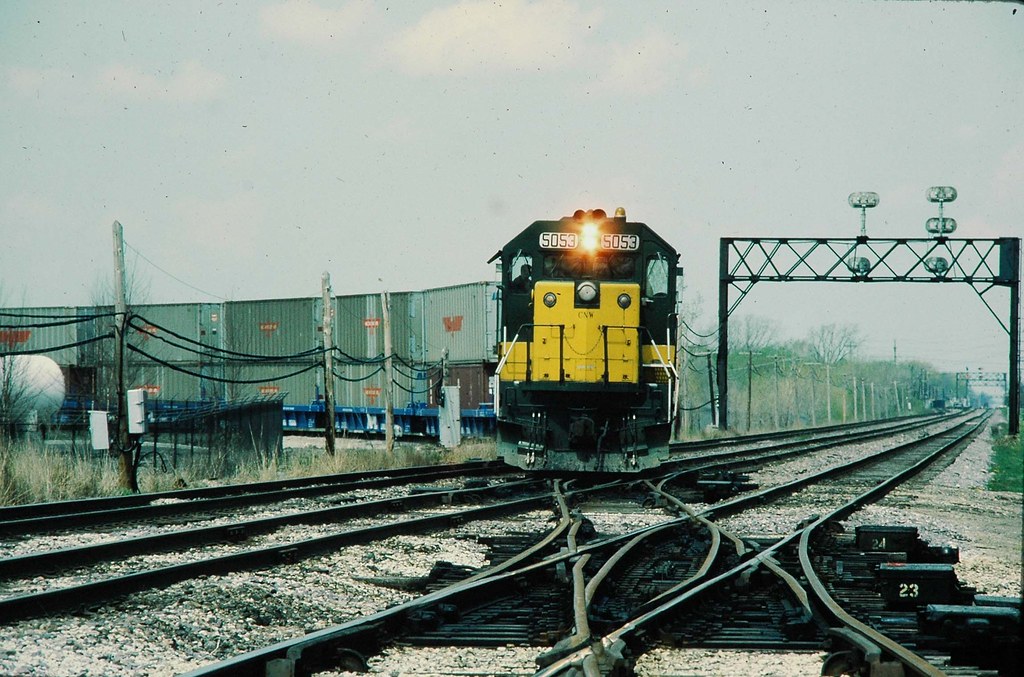 CNW GP-50's Des Plaines IL by Mark LLanuza, on Flickr
Good Luck, Ed
Ed is certainly correct.
My buddy and I got to Leavittsburg, unfortunately too late to photograph the trackwork, but we could see where the turnouts had been located. I imagine they could have been negotiated at a reasonable speed. In the photos provided, it looks like the track alignment would indeed have allowed mainline speeds at least at the Leavittsburg location.
John
Just east of here, until 1966, there was the gauntlet track going through Warren to contend with as well. Surely an operating bottleneck.
 Erie_Warren_Gauntlet by Edmund, on Flickr
 ERIE_Warren_7 by Edmund, on Flickr
Regards, Ed
To justify any feature on a model railroad you only need one protypical example.
Assuming you are looking for or needing justification.
Looks like slip turnouts were used fairly often.
Job done then.
I’ve got a nice Shinohara single slip I bought just because it looked good. Now I’m trying to find a convincing way to require using it…