I was advised that there was a yard sale last week and that there would be a number of HO model railroad items there. All of the items had been bought i over five or six years and then building a layout was of no interest. Went to RC cars and trains.
I came across a half dozen Atlas Double Switches at a yard sale and have a question.
I was very surprised to see that there was a few train sets (five or six left ) all made by Athearn, a lot of Heljan building kits which were certainly priced to sell at $5 each.
These were a bit too European for my liking, although If I did not have the roundhouse I certainly would have bought the two stall train shed.
Quite a few premade tunnels and trees, I forgot how awful those things looked.
And the slip switches, they are in Atlas boxes and yet three are marked Shinohara, that certainly answered who made them.
Forgot to mention the switches were $10 each. in case anyone wondered.
Anyway, I have been planning to redo my main switching yard and these double slip switches certainly make layout out the yard very easy.
My question, why do I not see more layout using double slip switches?
Back in the 80’s, Atlas imported some track items made by Cassidio in Italy. It was labeled ‘Customline Supreme’. If the switches are labeled ‘Shinohara’, they are just in the wrong box.
Most prototype freight yards do not use slip switches - I can thing of one I have seen over the years. However, passenger terminals have used lots of slip switches. I think I have seen a higher percentage of them on model layouts over the years…
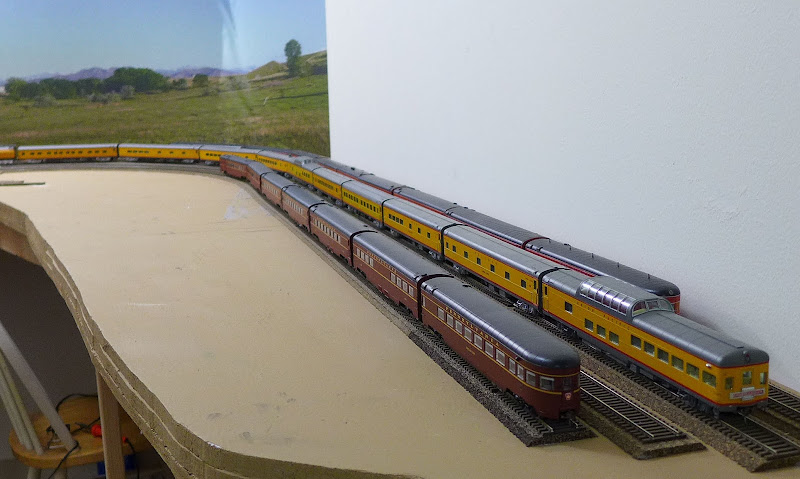
I’m going to use double slips here in my passenger staging. You see the four tracks here. I haven’t installed them yet, but plan to really soon. I’m going to use 4 of the Peco double slips, and they are expensive.
I really like double slip switches, because they are binary, so many possibilities…
I have many all in odd numbers, but do not let that stop you…
You can place one on a Dual Mainline to a side line & the other Mainline with one other turnout.
They are very compact, & make really neat looking trackwork, look at any Walthers ads…
Don, the real railroads avoid slip switches like the plague. Their most common use was/is in crowded, busy passenger terminal yards. They are very high maintenance, so they are generally only found in locations like that where a track crew is always available and working.
Then can be helpful on our selectively compressed model layouts, but the smart track planner avoids them unless they really solve a problem or save a lot of space - just lke in real life.
And just like real life, keep them within easy access.
Well they are definitely doing their job, as a space saver.
I can easily increase the amount of tracks from 4 to 6 with in the old yard area.
Amazingly the tracks are closer together but there is just enough room for the cars not to scrap each other. The yard area is easily reached at the front of the layout.
I have a few, basically at locations where yard leads join my double track mainline, they do save space.
A well known club that use to belong to years ago has a double crossover with one of the turnouts also being a double slip connecting the main freight yard with a double track main - scratch built of course, by the master craftsman who taught me to hand lay track 40 years ago when I was just 16 - talk about saving space!
Infrequently used by the prototype. With the demise of massive passenger throats, most of the need went away. So did the double slips.
Supposedly difficult to hand lay and wire.
Note that I said, “Supposedly.” Actually, hand-laying and wiring a double slip is dead simple, even in analog DC. Granted that it’s more complex than a simple turnout. It’s less complex than a double crossover, and no one seems to have a problem with one of those.
In my modeling I will be laying double slips in two places of diametrically opposite characteristics. One, which follows the track layout of Higashi-Shiojiri on the Chu-o Hon Sen, will employ one, as part of the arrangement that crams a station/passing point onto a shelf between a bridge and a tunnel mouth. The other is the Down end of my main station, Tomikawa - double track main splitting to four platform tracks and a freight arrival-departure track, including a steam loco escape pocket and a motor pocket in minimum length. Using double slips, I can cram all that into just over one meter of first main track length. Without them that one throat would take up the entire length of the passenger station area.
Chuck (Modeling Central Japan in September, 1964 - with double slips where necessary)
Here is a Double Slip Switch, with a Turnout, representing a Dual Track Mainline & a Siding exit. The use of the Double Slip does not make a dangerous ‘S’ curve effect, but is a smooth & efficient curve from either main track. The only ‘S Curve’ situation is transitioning from one Mainline to the other, which would be had with conventional Turnouts anyway. This smoother transition, & the space savings over individual turnouts, promote it’s use in my environment.
I have a double slip turnout on my double main line. It cuts across the inner main line track from the outer main line track, leading to a spur track where I park a bunch of diesels waiting to be called into action.
As others have said, double slips were somewhat common in passenger stations where space was at a premium. At Dearborn Station in Chicago, there were five double slips within a few yards of one another.
On the layout, the double slip does not present any particular wiring problems, but controlling the double slip movements takes some practice. Trains can come and go through the double slip in 8 different movements, four in each direction. It takes two switch machines (e.g., Tortoises) to complete a movement, and it is easy to mis-route a loco if you are not careful or are forgetful.
That is the common use for them, I have the same thing, where yards enter/leave my double track mainline. And as part of the same interlocking I always have a crossover in the other direction as well.
The only reasonably well-known and documentedmainline use(outside a terminal track arrangement) of double slip turnouts in the United States was at Leavittsburg, Ohio, where a double track Erie/E-L mainline crossed a single track B&O mainline.
Those double slip turnouts were removed during the 1970’s. However, as recently as 1991, it was still possible to discern where they had been located on the ground. My friend and I went looking for them, but he forgot the Morning Sun E-L books clearly stated that they had been removed…a partly wasted road trip on our part.
If there were other mainline uses of double slip turnouts, I’m not aware of where they were located.
In the model world, double slip turnouts have generally been considered to be a maintenance and derailment headache. Personally, I would prefer Peco’s over Shinohara.
Same here my Walthers Shinohara slips work fine. Personally I have no use for PECO with their sharp angle, 12 degree = #4, and the their sprung throw bars. Half the stuff I own will not go through a #4 anything, and most of the rest should not go through a number 4 just based on looks.
I had tried these switches after I first got them by mounting them on a piece of ceiling tile. I have used caboose hand throws on these and I am happy to report that the slips work very well.
Using my little tank engine to switch around my various rail cars I can report no derailments or other problems. I used the Dow adhesive lightly and the bond between the panel and the switches and track is great a few hours switching resulted in no observable movement
As I mention the yards now have more lines of track, overall appearance of yard it more attactive and the rail lines do seem straighter.
This is completly untrue. A slip switch is a type of “wye” or equalateral turnout. This means the frog angle is split between the diverging rails. therefor a 4 is equal to a #8, a 5 is like a 10, etc. This is why a lot of mainline turnouts are of the wye type when they fit the layout.
I know they were used on more than a B&O-Erie crossing in Ohio. When I was a section hand on the Milwaukee, there were two located at Chestnut St in St. Paul where the Milw and Omaha Road split. I had to dig frozen track heaters out of the ice there on a minus 36 degree day back in 1969.