Of what materials are DPM kits made? Styrene, or resin, or plaster, or what. I am particularly interested in the frieght depot and Schultz’s garage as seen on M.B. Kleins web site.
I get mixed opinions when I search these forums.
Of what materials are DPM kits made? Styrene, or resin, or plaster, or what. I am particularly interested in the frieght depot and Schultz’s garage as seen on M.B. Kleins web site.
I get mixed opinions when I search these forums.
DPM kits and modular building parts are all styrene. Lacquer thinner makes a good cement for assembly.
 [swg]
[swg]
Wayne
This is the freight depot I got from them:
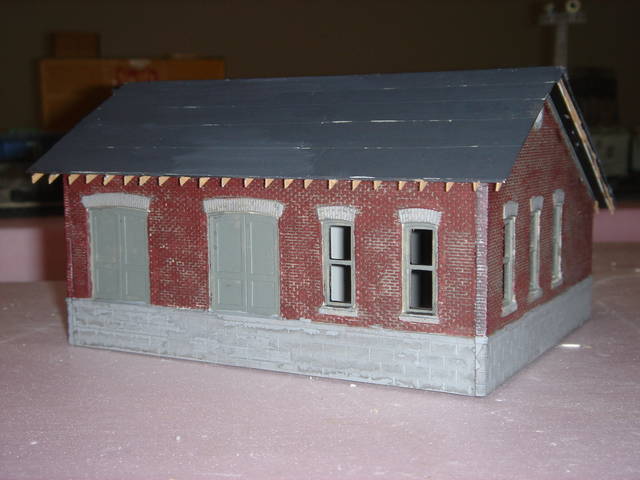
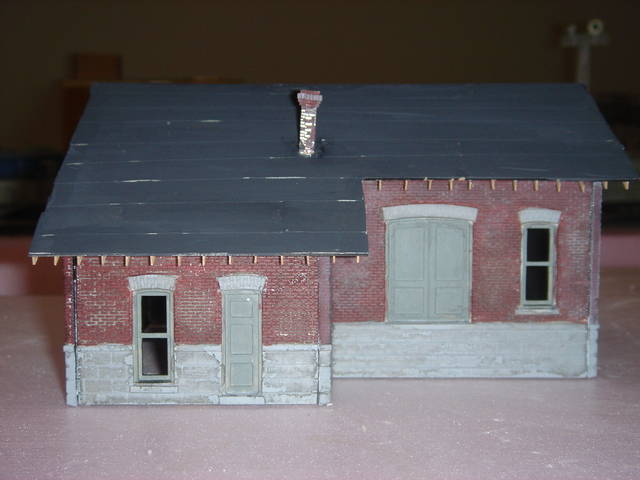
This was early in my kitbuilding life. At this point, I’m thinking about re-painting the model, or at least touching it up a bit. However, the flash lighting makes it looks worse than it really is. (It was also early in my model photography life.)
This is a plastic kit, as the good Doctor said. It’s more complex than most DPM’s I’ve built. The roof rafters sticking out are all individual pieces which must be glued in place. The roof supplied is just a couple of pieces of white styrene. I did mine with masking tape and painted it black to simulate a tar-paper roof. Since then, I’ve discovered that masking tape doesn’t stick to styrene forever, and I will have to do major work to get the roof in good shape, too.
That’s okay, MB. You should see the inside corner of that same freight depot I put together. Not exactly perpendicular [(-D]. (I think it was my 2nd kit?)
Yea, the rafters were a real challange to individually cut and add on.
Tom
Mister B, if you want three-dimensional tarpaper, ordinary writing paper, applied with contact cement, works well. “Prepping” the styrene with a coat of lacquer thinner before applying the contact cement will give an even better bond.
You can also use .005" sheet styrene - even though it’s too thick, the effect is not too bad: [swg]
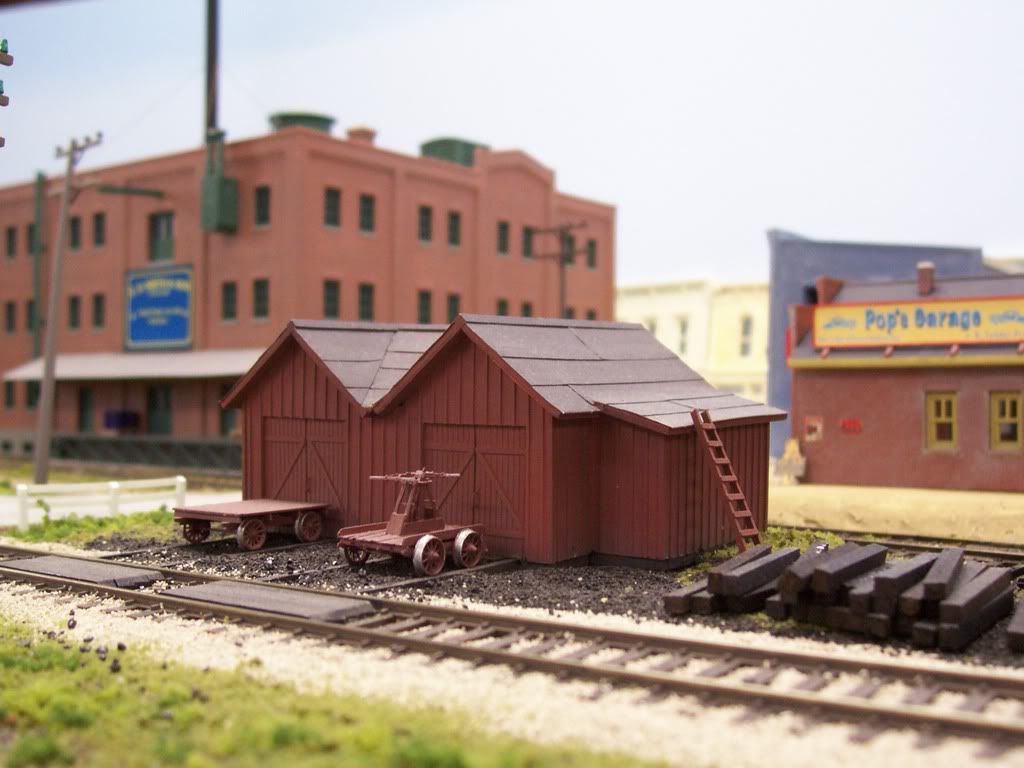
Most of the time, though, I use my airbrush to get a simulated tarpaper effect:

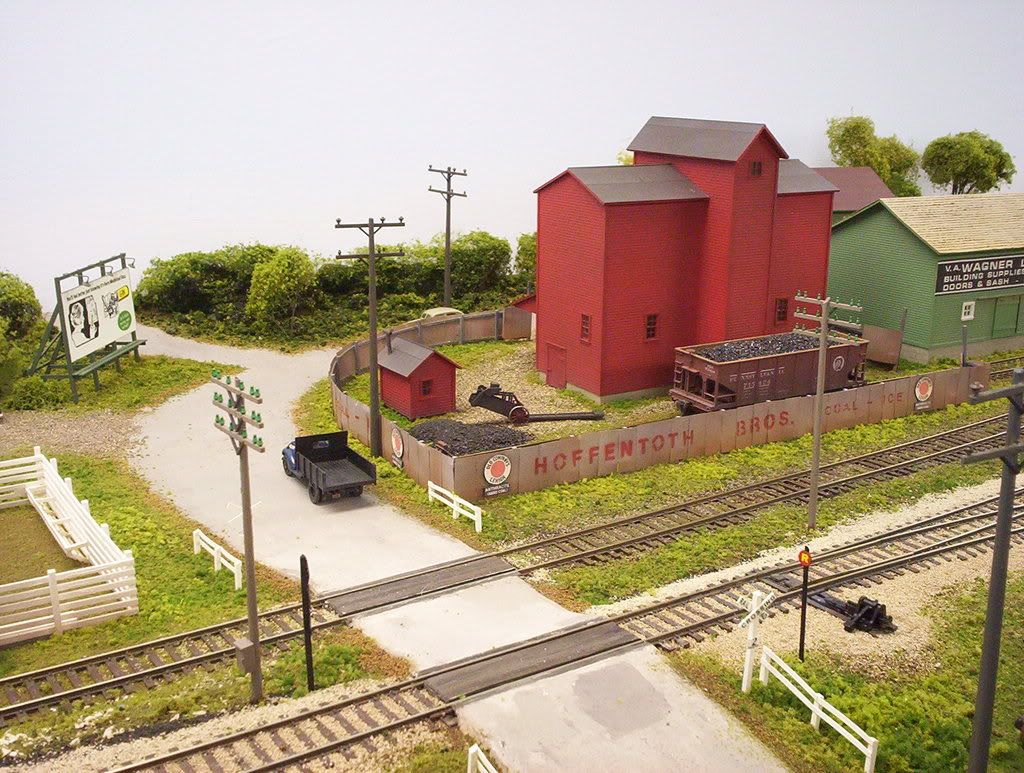
After painting the roof in the colour of your choice, apply appropriately-sized strips of masking tape in a pattern simulating the effect of tarpaper. Leave about 6" scale between the sheets where they would normally overlap, both horizontally and vertically. Then, using your airbrush and a colour darker than the base colour of the roof (I like to use a similar, but darker colour, but grey, brown, black, or even green can look surprisingly effective), spray the entire roof area. Direct the spray towards what will be the top of the roof and don’t spray to cover the entire exposed area. Next, remove the bottom row of masking tape, and using the same colour, make a very light and quick pass over the newly exposed area, again spraying “up”. Remove the next row of tape and repeat, until the entire roof is exposed. This is to simulate the run-off of dirt and colour that builds-up towards the eaves, and it also softens the joint lines.
Wayne