I just learned of a new fiber optic lighting system called Dwarvin and am wondering if anyone’s had experience using it. If so, what’s your assessment of it?
Here’s the website’s link: https://dwarvin.com/
Thanks!
I just learned of a new fiber optic lighting system called Dwarvin and am wondering if anyone’s had experience using it. If so, what’s your assessment of it?
Here’s the website’s link: https://dwarvin.com/
Thanks!
I’ve been working with fiber for about 12 yrs and while I like their light driver box that’s about it for me. You would either have to buy fiber fixtures such as lamp post or make them.
Just sticking a fiber up through a hole won’t give good light dispersion so that would require coming up with a way to distribute the light.
Working with lighting isn’t a 10 minute job if you do it right. I also like individual lighting control that would require to many light drivers.
Might work for some but not a serious model railroader.
Mel
My Model Railroad
http://melvineperry.blogspot.com/
Mel,
I’m a newbie to fiber optics. Just what’s needed in the way of equipment to use fiber optic cable for streetlights, building interiors and the like? And where is it available?
Thanks!
I buy all my fiber cable off eBay by diameter. I stock .075mm for vehicle taillights and big rig clearance lights, .15mm for small lights, 1mm for slightly larger light sources and 2mm for larger lights, 2mm is the largest I use.
A typical use for 2mm is the taillights in my streamline observation cars.
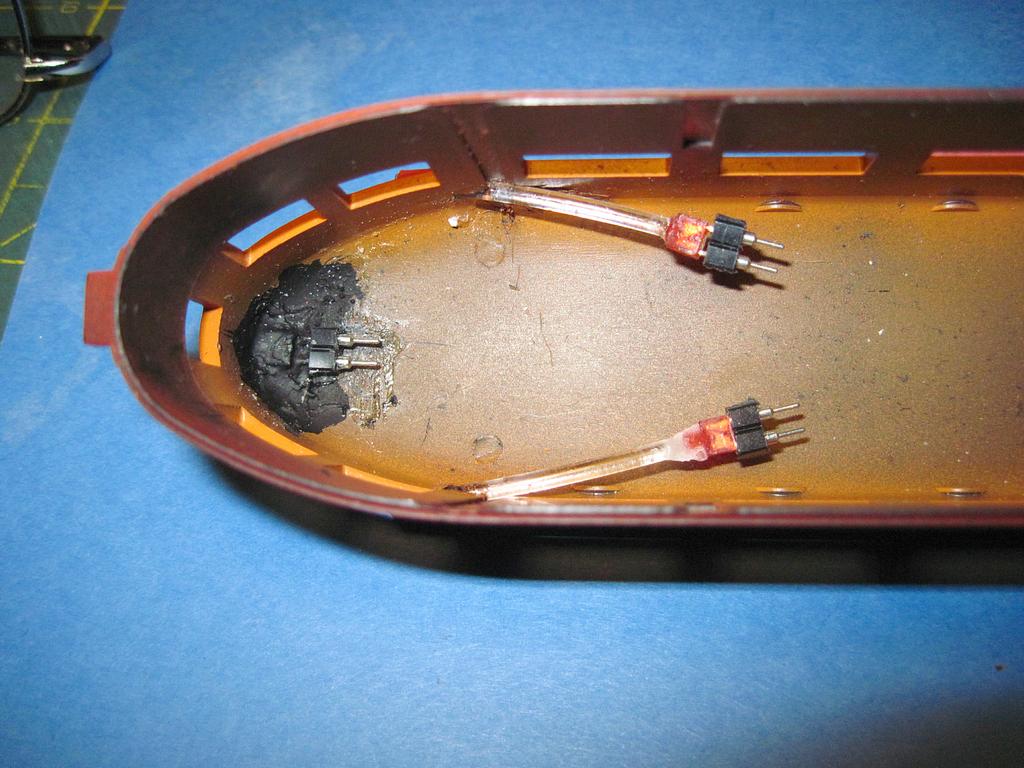
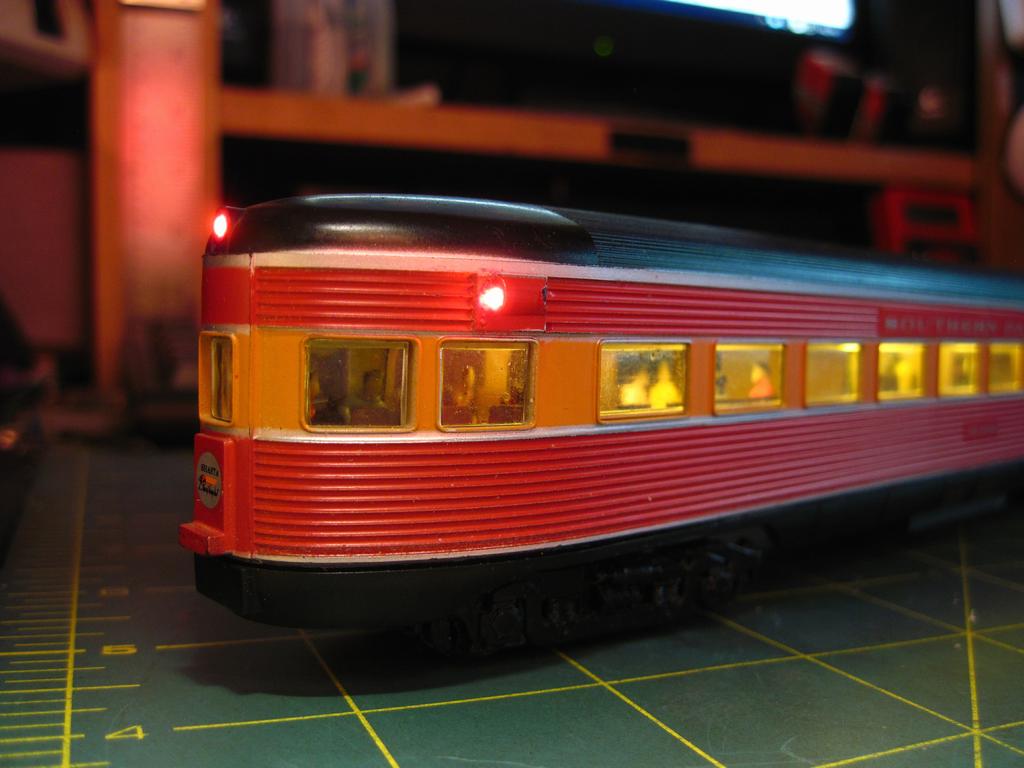
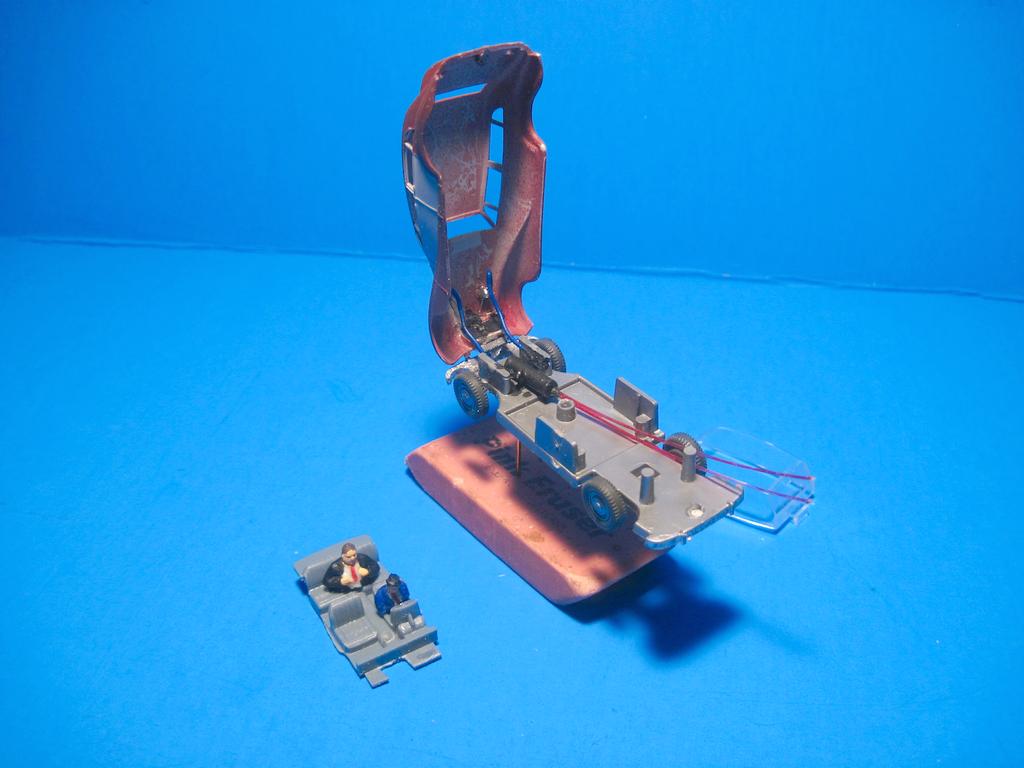
I use .03”/.075mm for taillight such as this 1951 Rolls Royce Phantom.
If you have access to the archive, or have a good collection of back issues, there have been some good articles in MR over the years on working with fiber optics, especially for things like car lights and street lights. Including some good information on getting the light to disperse nicely.
With today’s mico-LEDs, and the fact they you can buy them now from several suppliers with the hard part already done - namely solding wires to them, which requires a fine tipped soldering iron, good vision AND a good magnifier, and very steady hands - it seems to be the mechanical complexity of snaking fiber optics through everything is a lot less appealing, or needed. Back when those articles were published, a grain of rice bulb was maybe as small as it got, and those are far too large for HO or N scale autos. Fiber optics was the only way to go. In the case of a car, you now can use micro LEDs, and have 2 wires form the car to under the layout to supply power, instead of 4 fibers. If you’ve seen the amazing (but not cheap) modern fire apparatus with full lighting - micro LEDs are great. All those flashing lights and so forth, and it’s only 2 wires to supply power, everything is contained within the vehicle.
For a while, fiber optics were everywhere - my pool has fiber optic lights - it’s a really stupid idea. OK, instead of one underwater light, I have 4, and they change color. But they are nowhere near as bright as one ordinary pool light would be. There’s a box on my patio that contains a high intensity projector bulb and a color wheel and the fibers are bundled and installed underground over to the pool. It has 2 switches, so I can stop the color wheel on one particular color, although because there are 4 bundles of fiber optics, it’s hard to get all 4 showing the exact same color.
It may have its place, but I’d rather install small LEDs and jus thook up some wires instead of trying to feed fiber optics all around, driven from a central
Mel,
Thanks for the photos, et al.
Rerarding your edit: Without the use of Dwarvin’s lamplighter power box, what’s your power source for lighting non-powered items like streetlights and building interiors? Seems you’re going to have to spend some bucks on something, perhaps approaching the price of the Dwarvin box. And I’m not sufficiently knowledgeable to make one on my own.
Randy,
No such stock of back issues or access to the MR archives (don’t want it either).
The Dwarvin system does not use LEDs since the fiber optic cables themselves light up like the full moon when connected to the lamplighter power box. That’s the way I’d like to go to avoid using more LEDs and for a more realistic look.
Given that - and without purchasing the lamplighter box - what alternative power sources could one use? And I’m not knowledgeable enough to make one myself.
Not at all. Miniature 12 volt Grain of Wheat bulbs (2 to 5mm) are about $10 per 100 on eBay. The 1mm micro bulbs are beginning to get scarce and the price is going up. About $20 per 100 now.
The bulbs mounted in a Styrene tube ready to go is less than 25¢ each and I power all of them with two $5 DC to DC converters (two voltages, 8½ volts and 1.4 volts). I power my entire layout accessories from a 12 volt 30 amp switching power supply $20.
I power my entire layout lighting for less than $40, that’s over 300 lights. I doubt I have more than $125 tied up with all of my lighting and other accessories.
I have recently gone to using Arduino Random Lighting for my structures, something you couldn’t
Mel,
Thanks for the mini education!
I see a number of DC-DC convertors and switching power supply units on Amazon. Can you please tell me the names and models of the ones you use so I can do a comparison?
I buy most of my supplies off eBay and they generally don’t have brand names.
I bought a 12 volt 30 amp switching power for my layout, probably much larger than you need. My goodies on my layout have goodies so I need plenty of power.
The DC to DC converters I use are 8 amp ambient cooling and 12 amp with a fan. That also may be over sized for you.
Here are a couple of eBay search links.
DC to DC Converter
EDIT:
I corrected the link above.
<
Kerry
A lot of the guys on the Forum are using low current converters (2 amp) like the one in the link below. They have a built in meter for setting the voltage
I bought cheapo panel meters for the 8 amp version.
This is my bench power supply for testing my electronics.
Many thanks, Mel. I’ll check out those links.
Hi Mel and the other folks who responded regarding the use of Fiber Optics.
8 years ago I had no experience with fiber optics other than I am a physicist with a good knowledge of optics. I moved my layout and decided no more wiring for me, so I looked into making my own light source to use fiber optics after people told me it couldn’t be done! The result was 4yrs of research and playing around in between everything else I was doing, to come up with the Lamplighter box, which was initially only for my own use. My grandson joined me and we decided to commercialize the system, hence the Dwarvin company (my grandson loves Tolkein).
The key is getting the light efficiently into the fiber, from there on it’s clear sailing. We now have 100’s of customers using the product, some of whom make their own street lights. I noticed a comment about diffusing the light inside a building - I typically put a single fiber into a building and use parchment paper on the windows and you get a soft even glow. I also paint the ends to the fibers to give me the color I want.
The system is certainly not cheap, but if you buy any of my products you will note they are not cheaply made either. My background is in medical products and I use the same approach in the Dwarvin business as I’d use in medical when it comes to product design and even testing. We have had zero failure rate for the Lamplighter boxes, which I am grateful for.
I loved seeing some of the photos of lighting cars in this forum - this is a fun application that a number of my customers have done.
Great to see the dialogue on this subject. See you at Amherst?? Michael
Michael
You have a very nice looking product and I’m sure it works great but between retirement income and a couple of bad knees I’ll have to make do with the old school method. I like the look of incandescent bulbs operating at 70% voltage, to me it looks much more realistic to the 1950s lights than LEDs.
If I was modeling the more current times the LEDs would fit in OK.
I do use more fiber as time goes by and the 1mm micro bulbs are getting more expensive and harder to find.
An HO scale vehicle with the micro bulb headlights looks like the real thing in photos. LEDs just don’t cut the mustard for realism of the 50s.
I figure the 3mm to 5mm bulbs will be around longer than me, I’m older than dirt and stuck in the old way of doing things.
I do like your product a lot and for the younger crowd it will workout very good. Your streetlights are the best I’ve scene and your LED driver would handle a group of fibers.