I’ve been planning to make a freelance rail line called the Lake Superior and Eastern, a fictional Class 1 line starting from Duluth and heading through Chicago and into my fictional city (The railroad’s main hub) and branching out onto many different lines, with some of them being shared trackage with other railroads. But since i’ve always liked electric locomotives, I want to incorporate electrification into my system. Since the USA never really adopted electrification like in Europe and Asia, they never really produced many electric locomotives, let alone electric freight locomotives. The E60s are an obvious choice, but are there any more electrics that would add a little more variety to my railroad’s electric roster. My layout is set in the modern day if that helps at all.
I think I would try to “Americanize” a modern European electric locomotive for this project.
-Kevin
The immediate question is whether the electrification dates from a particular era; the secondary one is whether you want to stick with historical prototype. I’m presuming this is heavy mainline service, not converted interurban-motor or tunnel type power (both of which would be options for you of course)
Personally I have no hesitation at all in telling you what to do: dust off the Conrail ‘dual-mode lite’ plans and modify some contemporary freight units with the switchgear, rectifier detail and pans. Most sensible options would be overhead wire based, ranging from rudimentary structure for initial helper districts (where the diesel constant hp is being boosted, so the whole of the horsepower doesn’t have to come off the wire) or for urban use where the prime mover might be idled or off for air-quality or safety reasons, right up to high-speed ‘European’ constant-tension.
The use of this system to produce rectified DC to the link bus of an AC-motor unit is obvious, and it is the obvious choice for a ‘new’ electrification effort (with constant-tension cat). A good excuse for running SD90s, I think, as their extra length easily accommodates the ‘stuff’ needed and at one time your road could have picked them up for about $100,000 apiece needing only some frame welding to be good locomotives…
I don’t have a clear photo of my E-33s but I think they make a nice looking (I like the E44 better but there isn’t a decent model of one other than brass) freight motor.
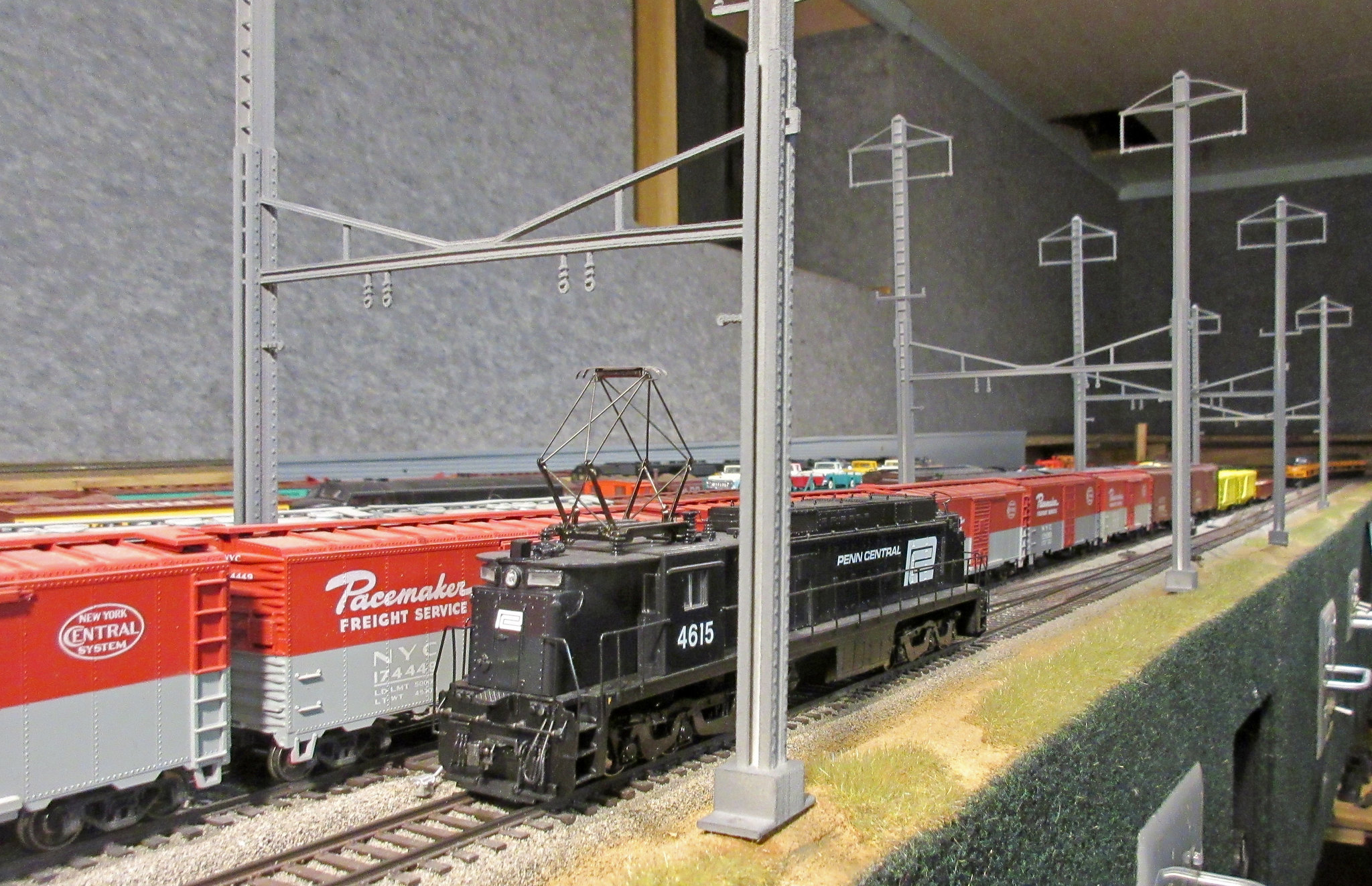 IMG_5577_fix by Edmund, on Flickr
The E-33 was built as EL-Cs for the electrified Virginian, went briefly to the N&W then sold to Penn Central.
Alternately, there’s the Amtrak Swedish Meatball AEM-7 which you could, concievably, regear for freight.
 AEM_911-901_2k by Edmund, on Flickr
At least the E-33 and AEM-7 models can be found fairly reasonably from Bachmann and Atlas respectively.
Other ideas:
GE made a few varieties of electric locomotives, one comes to mind was for the Muskingam Electric Railroad E-50C:
https://www.railpictures.net/photo/705492/
EMD was in the game then, too:
 EMD GM6C by Dave Witty, on Flickr
The EMD GF6C built for BC Rail also come to mind as a fairly modern electric freight hauler:
https://en.wikipedia.org/wiki/GMD_GF6C
Good Luck, Ed
There are a few others out there depending on your time period. The GG1 did pull freight and so did the P5a. BLI makes the P5a and BLI among a number of others make the GG1. MTH made a Little Joe but it only pulls about a few cars and is one of the weakest pullers.
Eric
If you want modern-era, you’re going to have to adapt some European locomotives (that’s what Amtrak keeps doing) Roco makes very nice models, but they can be pricey. Märklin is also pricey, and you need to confirm the models are DC two-rail, not AC three-rail. Europeans have developed eras or epochs to describe when the full-sized trains run. I’m not sure where we are currently, but the higher the number, the more recent.
For American freight motors, the last GG1 ran in the early 1980s, the last P5a in the early 1960s.
Eric
Hello All,
Guess what!?!
You’re in luck…
…“a fictional Class 1 line”…
That means you can do anything you want!!!
Electrification in Europe is the mainstay- -both prototypical and for the modern modeler.
I suspect IF a modern private American corporation was seeking an electrified line, it would not “reinvent the wheel”. It would outsource to a proven system from overseas.
You might have to re-paint the European stock to fit your situation.
Do you want to power the locomotives from the track, the catenary or either?
In the June 2020 issue of Model Railroader magazine; pg. 28-29, shows a W-1 electric locomotive along with the pair of Y-1s, on pg. 37.
This particular modeler chose to only model the poles and not the wires for the catenary, drawing power from the rails.
Catenary in European modeling is abundant.
Every hobby shop I visited had display cases full of live and dummy types of overhead wiring.
The bottom line is if you want to run electrical power and any other form of motive power; steam or diesel, it’s OK!
Hope this helps.
The japanese actually have an electric steam locomotive. Runs off the ctenary. The one i saw was a small 0-4-0 Similar to the LGB stanz loco.
you could take an E8 or 9. Say it was rebuilt with a modern power plant leaving space where the second engine was. In that space sits the switch gear for the pantograph Of which you could cut in a flat spot on the roof to mount it
you could take CP rail cowl units like the sd50F’s. And say they had the diesel pulled and electrical installed.
You might be interested in Broadway Limited Imports’ announcement on their Facebook page. They will be selling PRR P5a boxcab electrics. They have PRR paint schemes of course. Also, they have 3 fantasy schemes for NYC, GN, and MILW. They look good in the photos.
Thank you for all your suggestions, I will take them into consideration. I plan on “Americanizing” a Japanese EF66 Locomotive. The railroad could have picked up some while JR Freight was cutting a portion of the EF66 fleet. They could have been purchased cheap, reguaged, rebuilt, and Americanized for service on my railroad. I will probably also consider E33/E44s, AEM-7s, and European locomotives.
There is a certain family resemblance to big boxcab electrics whether GN or PRR or New York Central or Milwaukee Road or Virginian, with their European and Japanese counterparts. I recall back around 1960 there was an imported boxcab in HO, and a fairly large one, available painted PRR style and it looked highly probable and certain OK as a stand in.
Reynaulds has a wide variety of HO electric locomotives including some very interesting Italian ones from Lima and Rivarossi that could be Americanized.
Bachmann has from time to time offered big electric locomotives of Chinese prototypes. Since if some American railroad did decide to electrify these days I suspect the locomotives would be made in China, maybe look there.
Dave Nelson
They’d be unlikely to look exactly like European or Asian counterparts. The various regulations between the two are different enough that even the ones that are imports have different looks.
Even the AEM-7 and the Rc4 have substantial differences.
Rapido is going to import HO models of the New Haven’s EP-5. The EP-5 was a double ended, streamlined, rectifier type passenger locomotive built by General Electric in the mid 1950s. They rode on regular C-C trucks, much like a contemporary diesel. It would not be too big a stretch to envision a freight version with freight gearing since, Amtrak’s E-60s didn’t appear until the early 1970s. The enclosed carbody would be a plus on a railroad located in the snow belt. That is why we have the cowl type diesels up in Canada. Post Korean War, GE was the main builder of electric locomotives in the U.S, supplying units to such operators as Deseret Western, Muskingum Electric, Black Mesa & Lake Powell as well as the Pennsylvania, Virginian, and the New Haven. Electrics seemed to have life spans two to three times longer than diesels so it would be conceivable that some units built in the 1970s could still be in service today.
E60’s? I’ve hauled freight with those things – well actually Amtrak work equipment and rail trains. They were big, heavy, clunky machines… amazing horsepower but it was difficult to use all of it because the wheels would slip out from under you.
I think the e33 would be more interesting. I never ran one, but was ON one when I was a kid, wandering through the New Haven shops back in the early '60’s. On Sunday nobody was there, and nobody chased me away.
For hauling freight on my own railroad, I decided to get a relatively modern electric, a model of the engine I probably spent more time on than all the rest. But it just wasn’t going to look right in its “native colors” on a freight train. Luckily Atlas, the company that made the model, came up with an interesting variation:

I believe there were Rc-4s used regularly on freight in Europe. (Admittedly the running conditions were likely different, involving relatively high dash speed and shorter consists to suit the different operating model, but your operation could ‘justify’ electrification to facilitate faster operation of multiple short trains, on the general Perlman model, and use DC-motored four-axle electrics accordingly…)
There are some constraints on what a line would buy ‘used’. P5as, whether ‘modified’ cab or not, would not be among them. They were not a particularly good design to begin with (which is a big reason they were taken out of passenger service so quickly) and the late-era frame-cracking follies would have continued to the despair of anyone thinking they were getting a ‘bargain’ from PRR or PC instead of getting the equivalent power in ‘freight’ GG1s.
Keep in mind that if you go the 3000VDC route you have a couple of interesting options: MILW extensively rebuilt several bipolars in the early '50s and (with a little care to fix corners cut with the later ones) these represent rock-simple 70mph-capable power that would pull any train making economic sense on your line. Meanwhile there are ex-CUT motors that could have their 3000V switchgear and motors replaced (they were switched out and put in different locomotives in the '50s) and the ex-NYC engines that got the CUT stuff had subsequent life on South Shore, I believe, and are an interesting possibility closer to “home”. There are some ‘multipower’ European prototypes that might be brought in for ‘testing’ also…
A modern installation would almost certainly use some variant of a Siemens ACS-64, as that locomotive saw series domestic production and has effective North American support. Simple regearing and a few detail changes (perhaps Draper tapers to prevent having to change cabs, and some better cooling for sustained slow heav
I was just about to suggest that as well. The ACS-64 is based on the Vectron family of electric locomotives, which are available in various executions and see both passenger and freight services. The ASEA built Swedish RCs have come of age in the meantime, but still are in service in Sweden, both in freight and passenger services.
A note to cetenary. There are a number of different systems available from various manufacturers with Sommerfeldt marketing the most comprehensive line, but none of them are really suitable for US purposes, as they do not allow double stack container cars due to low clearance.
I was only familiar with the Swiss version of this (made practical only with cheap hydropower and wartime exigency) – do you have links to the Japanese version?
A more interesting approach would be to put modular turbogenerators in place of one engine (these were actually designed for Amtrak in the early '70s, before the oil embargo business and decision to buy new ‘freight-compatible’ power). This was explicitly done to give the option of a 60-Hz compatible transformer for dual-power in the ‘remaining’ carbody space for NEC service or other prospective mainline electrification (e.g. ATSF) instead of the full 8 turbines for powering Metroliner-style truck-mounted motors in the train…
The plan as I recall it was, as you note, using the flat top of the ‘electrification module’ to mount a pair of inward-facing Faiveleys, both of which could be raised to lessen peak current through the wire contact patch and shoes; I think this would have been largely common parts with equipment subsequently seen on the E60CPs…
The principal question then becomes ‘where are modelers going to find cheap Red Barn shells’ – followed by why on Earth you would take out perfectly good engines to fit switchgear when the ‘dual-mode lite’ equipment would go even better in a cowl than on a hood unit… I’d go straight to the SDP45 family (of which there are many cheap examples in the used HO market!), put in Dra
Actually, that is not correct. The engine is a Diesel powered replica of a Krauss steam engine. The cars pulled by this contraption have a kind of pantograph, not to collect power from the overhead lines, but to actuate the switches - see at the end of this video:
During WW II, the Swiss Federal Railway experimented with electrically heated steam engines and converted two class E 3/3 0-6-0 switchers, which was apparently not too successful.

I don’t know if ‘not too successful’ is quite the right description. It was successful in the time and place required. It was massively inefficient in any other respect and would make no sense in peacetime.
There is at least one detailed technical account of how this conversion was done – as I recall, very sensibly by inserting self-resistance-limiting thermal elements either into or in place of the boiler tubes. There would be a temperature of maximum thermal heat transfer to water in a convection-circulated boiler far below the external temperature that a Calrod-style sealed element could reach.
Even if we were to treat the electric ‘power’ in this configuration as ‘reheat’ for typical fireless operation you can see that the thing would work for switching of the type expected; it would not be impractical to use electric ‘superheat’ to reduce condensation losses for maintenance. In a country with extremely cheap hydropower and basically no access to domestic fossil fuel this approach might be workable in emergency conditions.
During WW II, the SBB still operated quite a number of steam engines, despite the effort which followed WW I to electrify (nearly) the entire network. The conversion of only two engines, which were scrapped in 1946, didn´t contribute much to saving coal, and, as the converted engines were notoriously short on steam, plans to convert more engines were given up.
I wouldn´t call that a sucess story - not even in times of shortages (Switzerland stayed neutral during the both wars, which didn´t stop the US Airforce to drop bombs on Zurich and Basel).