My layout is presently 10x12 and I would like to expand it but as you can see there is an electrical pannel preventing me to expand up to the wall on the left. I cannot expand on the right side because my wife needs the space for her hobby (copper enamelling) and I cannot expand to the front because we need acces to the pannel.
Do you think I can expand going up with a second level?
Would there be a way to expand to the left wall and still leave acces to the electrical pannel?
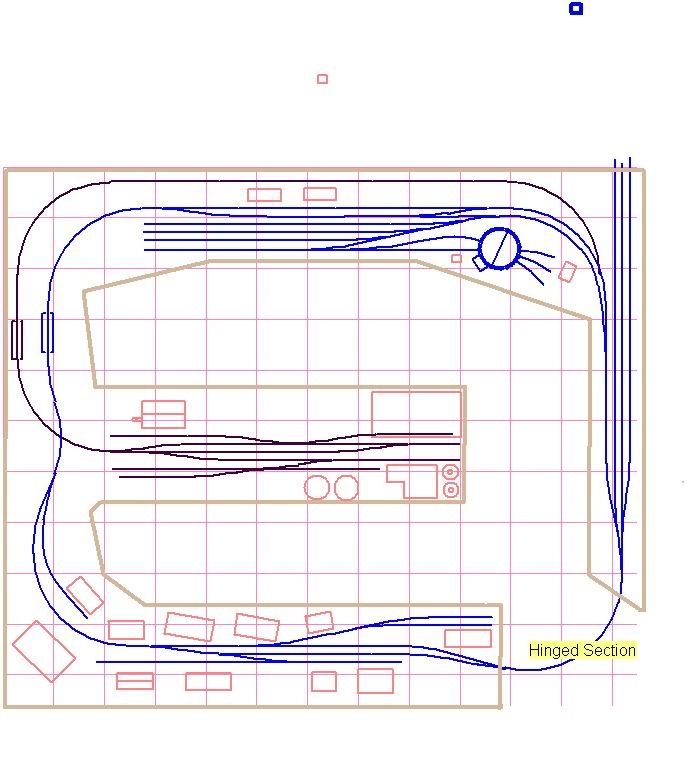
My room size is about 10.5 X 12. Our layouts are somewhat similar and my layout is based on the San Jacinto Central. I added a branch that comes off the mainline behind the yard and rises up to the paper mill on the peninsula. The branch is in black on the track plan. Benchwork is about 2 feet wide and I have a minimum of 2 feet for aisles. You can most likely do the same. Best of luck.
You could “break” the layout in the back corner and use another short liftout section like you did in the front. Since you don’t need frequent access, you could build it as a full-width lifoff section. Run the wires against the wall around the corner.
From a quick study of that photo, it looks like you could move the entire layout with some extra hands in order to have complete and unimpeded access to that panel. That’s what I would recommend, and that is what I would do before getting any further along with progress on your layout.
To expand to the left wall you could put a light weight pop-up access in the corner to allow access to the panel. If you could arrange your trackage so that area could be just scenery. It really doesn’t take much space for a pop up and they are easy to build using foam sheets.
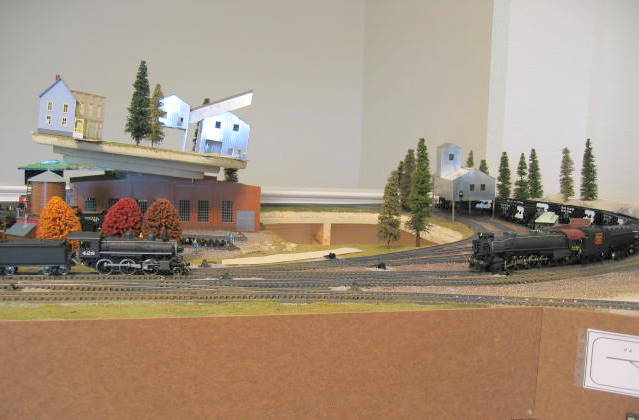
Here’s a pop up that’s all foam and give me plenty of room to work on the “wall sides” of a 4X6 section of my layout that’s in the corner of the room. It was “cut in” after the scenery was started and I realized that I couldn’t reach the back of this part of the layout.[:$]
On another track, I think code would be that there must be instant and unobstructed access to the electrical panel, even if you are not there. Anything in its way would be considered a hazzard and may well cancel any insurence you may have in case of fire or other emergancy. The question would not be if you could get at it to fix a breaker, but could the fire department or a police officer get to it in an emergancy. I think it also needs to be easily seen by an emergancy person entering under difficult curcumstances in your absence.
A full map of the room would be helpful. It may be just a little rearranging is all the need be done. But as Arthill stated there should be unobstructed access to the panel. Some states may even give you a ticket now. However if the layout can be put on the other side of the room (to the left of the picture) giving full unobstructed access to the panel.
First, I seem to see a 24" wide access to that (fillintheadjective) electrical panel. That should be adequate, especially if the panel is clearly visible from wherever the entrance to your hobby space is located.
Second, to double-deck your layout, consider converting the track closest to the wall into a train elevator. Using a steel stud, U side up like a rain gutter, you should be able to provide a ‘car’ six feet or so long - adequate to move short trains. A bit of design finagling can arrange things so there is still a thoroughfare track in place when the car is at the upper level - have it on springs that will depress under the weight of the elevator but not under the lesser weight of a train. If the upper end elevator access is also double ended there won’t be any fancy switching required. Just run a train straight on, move the ‘car’ to the other level and run straight off. No backing or other messing around required.
Chuck (Modeling Central Japan in September, 1964 - with a train elevator)
First double decking may only be practial if you use a no-lix approach which would be basically several laps around at 2-3% grades to gain the necessary height. Lots of complex construction involved - but doable. In my view 10 x 12 is marginal for a helix
An uypgrade portion of the railroad such as a branch would fit in very easily within the current outline - and provide more places to spot cars and scenic opportunities.
You can also grab more real estate for the RR by basically suspending a large, lightweight liftout section between the wall and the RR in front of the panel. Keeping at least 2 feet away from the panel you might be able to buy back a section that’s roughly 2 x 8 - if I interpret the photo properly. I’d keep the main off of this portion, but it could be used for an industrial switching area with only one or two tracks leading into it just to keep alignment somewhat simple. When access is needed or when you need to service the track simply lift it out and set it aside.
However, before doing any of that, if you haven’t already, I’d suggest looking at the subscriber layout database for more inspiration - there is a lot more you can do with the existing space and benchwork constraints that what the photo would seem to imply.
As an electrical contractor in Connecticut, I can tell you that a fair number of homes, and for a fair number of reasons, have buried an electrical panel. These panels are where everything comes into, and [contain], among other things, your branch circuit protection, and in most cases, your main swritch. Burying these enclosurres is a definite “NO-NO”.
NEC mandates that all boxes, enclosures, SHALL (mandatory) be made readily accessible.
NEC mandates minimal working clearances be maintained, which will, be min. three feet front out, a foot on either sidee, and a foot above. If you see otherwise in a structure, it means that someone went ahead and “made up their own rules”-and will have sooner or later cut their own throat in the process!
You definitely would be in a jam of you needed to get at that main, or one of the branch circuits in a hurry, if you have buried them by your layout. Search or an alternate means of setting up.
I totally agree. As a general contractor, I see this done frequently, especially on basement living space “remodels”. Codes do vary by state and local, however the panel should remain accessable regardless. Many towns here won’t even allow a fixture within 3Ft to the side as well. But if there’s a fire, the first thing to go is the meter which the Fire Dept doesn’t even concern themselves w/ the panel.
[quote user=“ef3 yellowjacket”]
Scribbit;
As an electrical contractor in Connecticut, I can tell you that a fair number of homes, and for a fair number of reasons, have buried an electrical panel. These panels are where everything comes into, and [contain], among other things, your branch circuit protection, and in most cases, your main swritch. Burying these enclosurres is a definite “NO-NO”.
NEC mandates that all boxes, enclosures, SHALL (mandato
Hello everybody, thank you so much for all of your infos, ideas and comments; they are greatly appreciated.
You were right about the code requirements, I called one of my friends that is an electrician and he informed me that the electrical pannel has to be accessible at all times.
I measured the witdth of the aisle going to the pannel and it is 30", so i’m OK there. I also measured the ailse in front of the layout and it’s 40"; so there’s nothing much I can do there. As for switching space with my wife, she even has less than I do.
So I guess the only solution to add tracks to my layout would be to go up; and that I must admit I have no clue how to do that; as you can see everything is kind of flat on my layout…
Tomikawa, can you elaborate a little more on the “Elevator” suggestion on the back part of the layout.
Serge – I agree with those who say that you could probably optimize your use of the existing space a little more.
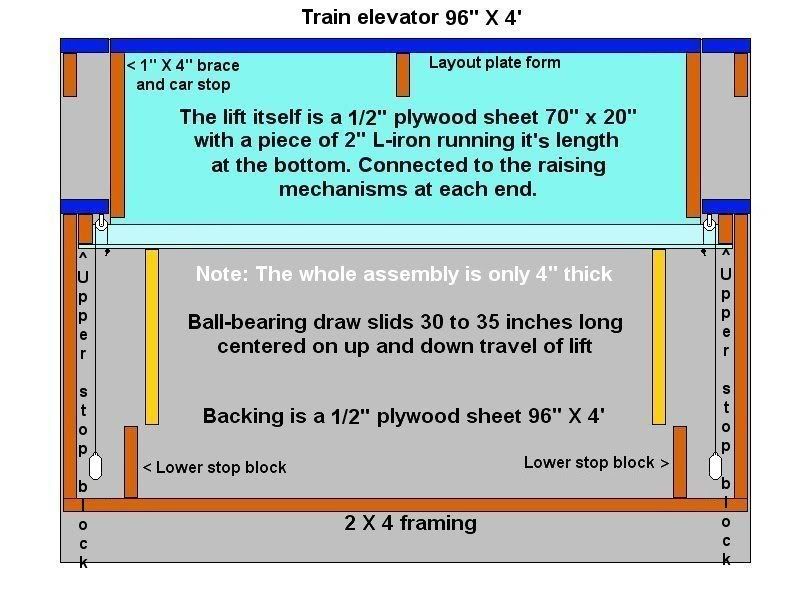
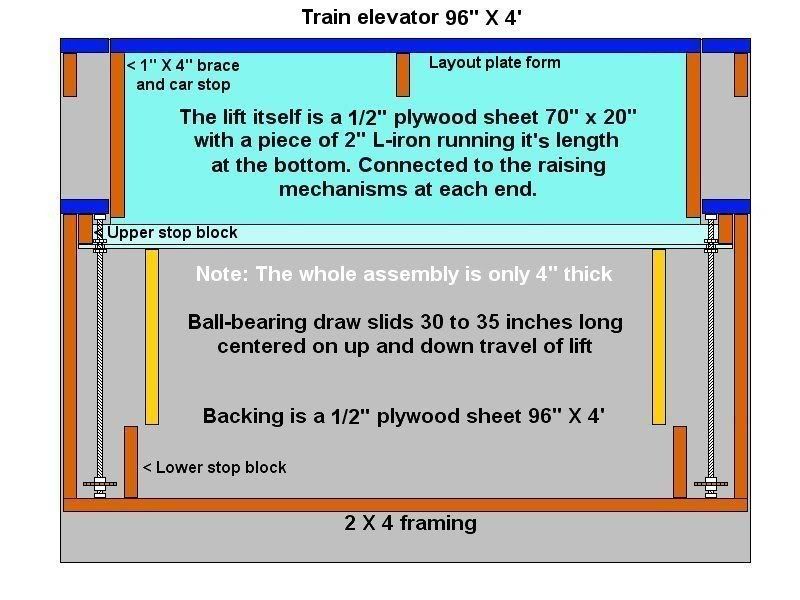
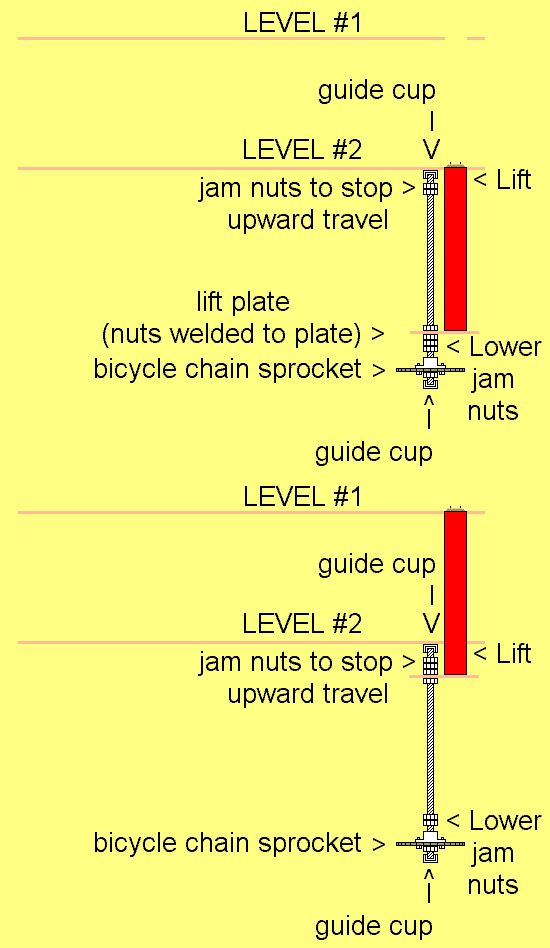
However, if you must go up… a train elevator is a length of track that rises straight up and down to move a segment of track with a stationary train or cut of cars between levels of your layout. It is not designed to operate while trains are moving.
They can be constructed of plywood or metal, and use pulleys, garage door openers, old electric motors, or many other things to move the track segment up and down. There was an article about one in MR a couple of years back… maybe someone can provide the issue and date?
Check into the hide a screen things for flat screen TV’s. I’ve seen a few where TV’s pops up out of a stand that looks like a butlers pantry. You could fit this under your layout and have the “TV” pop up with a shelf or top acting as the elevator. You don’t need the TV but it might be nice to have.
A few years ago I was thinking along the same lines. Here are just a few ideas,
Seems like a lot of work to do to make this unit, then there is the constant worry if it breaks down. To me it doesn’t seem to be worth all the trouble.
The Wife’s space may be less but why not just put her space on the side of the electical box and shift the layout over? If her stuff isn’t as permanent then it could simply be moved if needed.
There was a special issue of MRR last year ( “How to Build More Layout in Less Space”) that included an article on a train elevator. It was presented as a compact replacement for a flat staging yard and a helix. Pretty detailed article with plans and pictures.


](http://cs.trains.com/TRCCS/themes/trc/utility/%5B!%5B(http://img268.imageshack.us/img268/2672/1ermars2010002.jpg)%5D(http://imageshack.us/photo/my-images/268/1ermars2010002.jpg/))