You do make a good point about SCR being a mature technology with the rest of Caterpillar’s engine lines and if GE experiences major technical issues with the upgraded GEVO it may give EMD an edge.
But I haven’t read a single blurb anywhere saying that any of the Class I’s want SCR if there is another option available which is why I doubt you’ll see an SCR equipped EMD freight locomotive demonstrator in the near future.
Of course Cat/Progress/EMD will be demonstrating the SCR based emissions c
The Rail Industry is well aware of what was seen in the OTR truck industry, and the still have no use for Urea. It isn’t going to happen unless they are forced. The 9900 was the only unit outfitted to come close to Tier IV. It failed. The rest (25 total, not 12.) are straight Tier 2 ECO v12s. UP did order a few more a thought, but I haven’t heard anything about them.
as for GE, they’ve received Certification for the locomotive under CFR 1033 for Tier IV. So, no idea how it will survive in real use, but according to the EPA et al, it meets tier 4. They MUST, by LAW build one of them for each Tier 3 unit they build this year, so we’ll see.
I didn’t catch the blog entry that EMD will have demo units out this year. The last blog entry from him I read related to tier 4 was so riddled with factual errors that it couldn’t even be posted on Loconotes until it had been fixed. So I’m not sure I trust him on this topic.
I posted above a link to a paper that indicated that UP 9901 at least, as well as 9900 had exhaust gas recirculation. I checked the compliance decals on three 9900s including 9900 itself and they all state “Tier 0”
EMD are definitely building the Tier 4 units right now. I asked a friend at EMD about another project and he said “It was delayed while the factory turns out the Tier 4 units”. So they are being built and have some priority. Whether they appear in June is another matter.
My reading of the Tier 4 arrangements about Tier Credits suggest that EMD could deliver Tier 3 units under Tier Credits, if like GE they build the same number of units meeting Tier 4 in the same year. The text didn’t seem to suggest that this arrangement was limited to the 2015 year.
I can’t speak to 9901, because the guy I know that works in the shops in Roseville has never had a particularly bad thing to say about it so I assumed it was the same as the other 23, whereas the 9900 is well loathed. They may all state Tier 0 on the blue card, but the 16-710ECO Prime mover with that radiator arrangement will meet Tier 2 and later ones Tier 3 without problem. I’m actually surprised they only state tier 0. I was under the impression that with that level of remanufacture/rebuild, they would have been required to meet tier 2.
Reading that article it states that GE has not yet received official Tier IV certification from the EPA, which they must have before delivering any production locomotives to a customer.
But, you are correct that they appear to be confident that they have the bugs worked out of the system and expect to get that certification very soon…
The tier 4 story is far from over. It appears that GE and MTU have tier 4 compliant engines. EMD/Cat is working hard to get one. Cummins has decided to go with SCR.
What we don’t know is how these tier 4 engines will do in service. There is a substantial price increase for tier 4 locomotives. If they are so complicated that they become roundhouse queens and are unable to turn off the required mileage to pay for themselves, or burn through prime movers , the railroads may have to take another look at urea. I know they don’t want it. However, if the non urea units can’t cut it, they may have to. The trucking industry didn’t want it either, but now urea dispensers are going in everywhere they sell diesel.
Just think with urea and some tweeking, EMD might just get another decade out of the 710.
MTU engines are not a great fit for locomotives, low oil sump capacity, for example SCT Logistics, those CSR Class units are laid up in storage at 3 years old because they’re due for a rebuild at an extrodinary cost. So they’re running EMD units. See if Cummins has better luck. High speed engines don’t have a good track record in main line freight application.
I don’t think you are correct regarding SCT’s CSR class.
As I write this CSR003 is leading 9721 freight at Horsham in western Victoria.
After the iron ore traffic they were purchased for ceased due to the fall in commodity prices the CSR class have not been used as much.
The MTU 4000 (in 16 cylinder form) is used in the British Rail HST Power Cars which are amongst the hardest worked locomotives in the world as far as speed and distance travelled are concerned.
Equally 16 cylinder MTU 4000 engines are used in Royal Australian Navy patrol boats. Small ships need large sumps to cope with pitch and roll, so larger sumps must be available for MTU 4000 series engines which could be fitted if there was a problem with the existing sump capacity.
The New Zealand Railways are buying more of their DL class locomotives with the 20V4000 R43 engine, so they can’t be a complete failure.
These MTU engines are the default diesel engine in European locomotives, offering 2.4 MW in the 16-cylinder version and 3 MW in the 20-cylinder version (nearly the same as an EMD 710G-16 )
Makes perfect sense, new locos going into storage and run GT46C’s
In October 2013, the entire fleet was withdrawn from service and quarantined, after white asbestos was found in the engine area. This is despite the locomotives being certified as asbestos free.[14][15] By January 2014 remediation work had been carried out and most of the class was already back in service.[16]
Didn’t care to touch on that, also the generator ends that CSR had to replace on these units. The asbestos issue was already handled.
Another question here is will the railroads be willing to go anywhere near something associated with the 265H, considering its past reputation and how conservative the Class I’s tend to be. The MTU 4000 would be interesting to see on this side of the pond, but would face the same xenophobia. As hard worked as the HST’s are, I imagine they come home to a shop every night and can be worked on, a far cry from what would be expected of them in a North American freight locomotive.
And to top it off, GE still doesn’t have their tier 4 unit in production, only the test units running around. A few were demonstrating on CN this winter, and my employer’s response was to order 25 export model ES44AC’s shortly afterward (not tier 4 compliant so they can’t operate stateside). Just another chapter in the tier 4 debacle.
As I write, CSR003 is back in Horsham awaiting a train and CSR004 is in Port Adelaide on train 4102.
I check the ARTC reporting system which only shows lead units.
Around four of the fifteen SCT class GT46C-ACe units show up as lead units but they usually run in pairs or with a CSR trailing.
The SCTs have bigger traction motors (those used on SD70MAC units) and are often loaded to maximum capacity on east-west intermodals. The SCTs are 4300 hp compared to 4000 hp for the CSRs which might indicate why they are used on the longer and heavier hauls.
But there is nothing to indicate that the CSR class are “stored” as a group.
But to answer Groomerman’s original point the railroads would prefer to continue buying EMD units with the 2 cycle 710 engine but EMD was not able to succesfully develop a Tier iv compliant emissions system for the engine series so 4 cycles will be the standard…
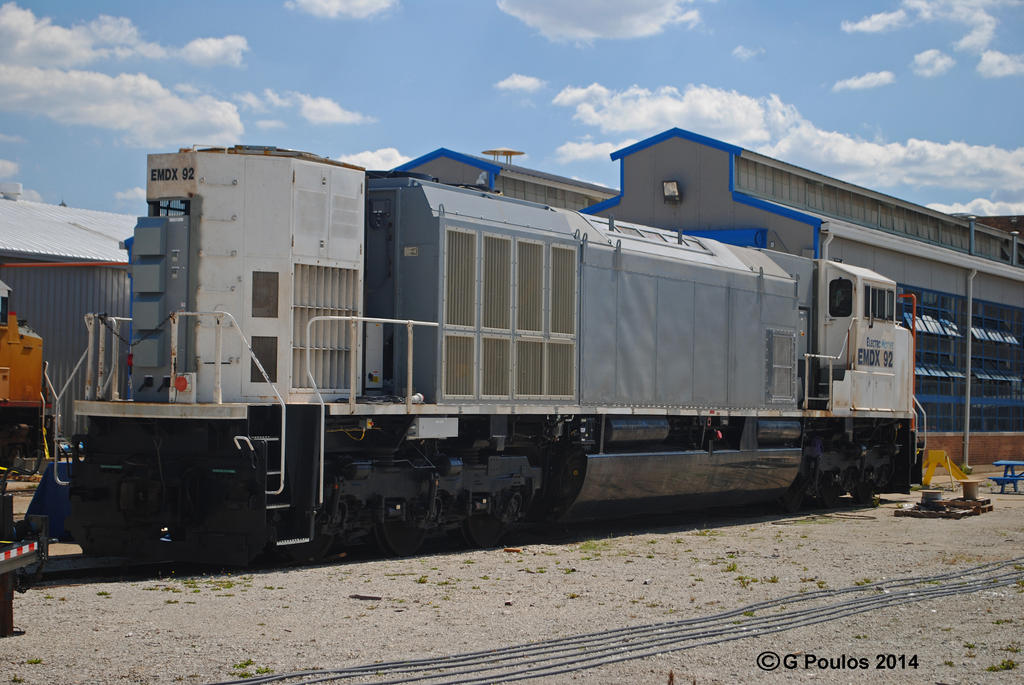
After a quick skim through the October issue, I settled on the “Locomotives” section which illustrated two versions of the GE ET44 and an EMD test unit, #92.
I think it was at least implied that #92 was testing the EMD engine at the title of this thread, but it has a full cowl carbody which would be unusual, even for a test unit if a normal hood unit was intended.
I’ve heard that 92 is in fact testing the Caterpillar C175 intended for the F125 passenger locomotive. Certainly, that engine needs to be tested just as much as the freight locomotive engine.