I hate it when there is a strange phenomenon on my little railroad where I belive something important got lost. Currently this phenomenon is adding weights to cars. I dont see any reason why I should not weigh the cars, exept I have up to 4% grades on the track plan. I dont plan to run trains any longer than 7 cars and 2 engines (both powerd geeps, cars no longer than 50’), but would the weighted cars affect the anility to access the elevated areas? Also, with what and how much should I weigh down my cars for this application? Thanks.
The old hoggers here will almost universally answer thusly:
It’s impossible to answer you, certainly without knowing the engine(s) involved. You are the only one who can determine definitively if your engines, singly, doubled, or trebled, can do the job in the conditions you have set for them. The way to do this is to mock it up reasonably and to conduct trials. It’s what I just did four weeks ago with my Rivarossi Heisler. I set up risers, roadbed, and then laid track temporarily. I had my Heisler shove two BLI H2a hoppers with the fake coal loads in place up the entire switchback. Yup, it did the job. They will go up empty, of course, so I know it will actually shove three of the same hoppers as empties.
Nuthin’ like having real facts.
The NMRA standard for HO is 1 ounce, plus 1/2 ounce for every inch so a 4" car should weigh 3 oz a 6" 4 oz. etc.
I have no specific advice for your 4% grade as I never had more than 2%. If there is a curve combined with the grade, that effectively increases the grade.
Not everyone adds weight but some people add more than the standards.
My frame of reference is my 2.4% curved (one of the drag factors) grade. My first loco, an HO Genesis GP9, will pull 10 plus cars ok, but mine are average underweight. So as others note, your case is best determined with a real test, as it depends on your locos and other factors.
It does get me thinking, though my trig is beyond rusty. As the grade increases, of course the backward pull of the cars (plus the loco’s effective weight “drag” that kicks in as the angle goes above horizontal, where that was zero) increases significantly, related to the sine of the angle and maybe the hypotenuse?[:P]
At the same time, the loco’s max pulling force (tractive effort?) would reduce as grade increases, since the loco’s force perpendicular to the rails is reduced. With a constant friction factor of your loco wheels / track, the loco max pull reduces proportionate to the loco “force” that is perpendicular to the rails, which reduces on a grade as the perpendicular force vector reduces from the max weight vector which you get on vertical track.
The point is there’s a double whammy as grade increases, first because of the rearward effective drag from train weight downhill vector but also because of less traction. The 2nd effect may be minor at lower grades, but in extreme cases, say from 4% to 8%, might have significance.
For what it’s worth.
My layout is an around-the-room type, with a partial second level. The room itself is an odd shape, with a total of 10 corners, as you can see in the sketch below…
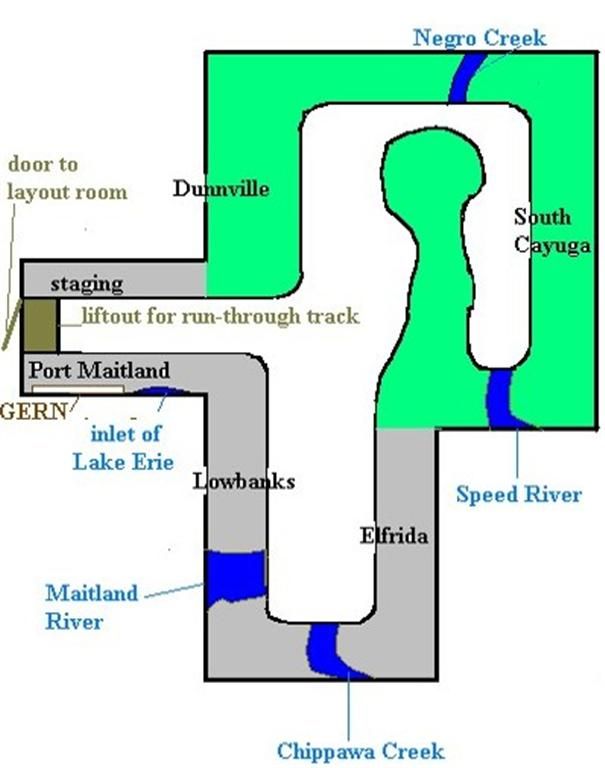
The area in grey represents the section above which is the second level, with rail access to the upper level via a track around the peninsula.
As you can see, there are many curves and most of those are on 2.5% grades - certainly not 4%, but possibly just as challenging because my layout is all-steam.
I ran many test trains using loaded Athearn 34’ hoppers, the “loads” being Black Beauty blasting medium. It gave the cars a total weight of 8oz. each.
While not all of my trains are loaded hoppers, I do plan to run a tri-weekly coal train of 12 hoppers and a caboose (100oz.) from an interchange to the upper staging yard, basically covering the entire layout. It appears that two locomotives (Bachmann Consolidations or Athearn Mikados, both modified with as much additional weight as I could apply) could usually handle that train. If necessary, I’ll add a pusher.
This is DC operation, and the train described is repeatedly do-able.
Most trains won’t be that long, and definitely won’t be that heavy. Some, however, may be longer, and I now know that additional locomotives can be added, as needed, to move pretty-well any train I choose to run.
I have run a 71 car train around the entire layout (up the peninsula, too, although the second level wasn’t built at that time) without incident, and also backed it around the layout, too.
As Crandell has suggested, build a temporary test track mimicking the worst scenario (steepest grade on the tightest radius) you foresee on your proposed layout.
Diesels generally afford more space for additional weight than does steam, so you have some possibilities that weren’t availa
I have a 4% grade both straight and around 22" and 18" radius curves. I run cars weighted to NMRA specs on trains like you plan on with no problems. I tested with a strip of track on a 2x4 during the planning process.
But the effective grade around your curves substantially higher.
Remember the lessons for helixes. Grade with a curve = a higher number (effective grade from a discussion over at MRH forums):
So for your situtaion with a 4% grade on straight track, after a train continues into an 18" radius curve with an actual grade of 4%, it would experience an effective grade of 5.8% in the 18" curve in terms of drag.
Good thing you tested since the train is experiencing a 5.8% grade in the curve.
[quote user=“doctorwayne”]
My layout is an around-the-room type, with a partial second level. The room itself is an odd shape, with a total of 10 corners, as you can see in the sketch below…
The area in grey represents the section above which is the second level, with rail access to the upper level via a track around the peninsula.[/QUOTE]
How high is that second level from the first?
[QUOTE]As you can see, there are many curves and most of those are on 2.5% grades - certainly not 4%, but possibly just as challenging because my layout is all-steam.
I ran many test trains using loaded Athearn 34’ hoppers, the “loads” being Black Beauty blasting medium. It gave the cars a total weight of 8oz. each.
While not all of my trains are loaded hoppers, I do plan to run a tri-weekly coal train of 12 hoppers and a caboose (100oz.) from an interchange to the upper staging yard, basically covering the entire layout. It appears that two locomotives (Bachmann Consolidations or Athearn Mikados, both modified with as much additional weight as I could apply) could usually handle that train. If necessary, I’ll add a pusher.
This is DC operation, and the train described is repeatedly do-able.[/QUOTE]
What sort of radius are the curves?..any, or many around 24" ?
Do you have any longer articulates that make the trip?
What was pulling that ??
The second level wasn’t in place at the time of the tests, but the grade leading to it was, so the train had to stop where track ended, and back down.
The lowest part of the lower level is at 36.5", while the highest point of the grade (and now also all of the second level) is 59.5".
The minimum mainline radius is 30", and occurs only at one place. Most of the other curves are 32" or 34" radii, but there are a few larger ones where there was sufficient space.
I have only one articulated locomotive, a Bachmann USRA 2-6-6-2…
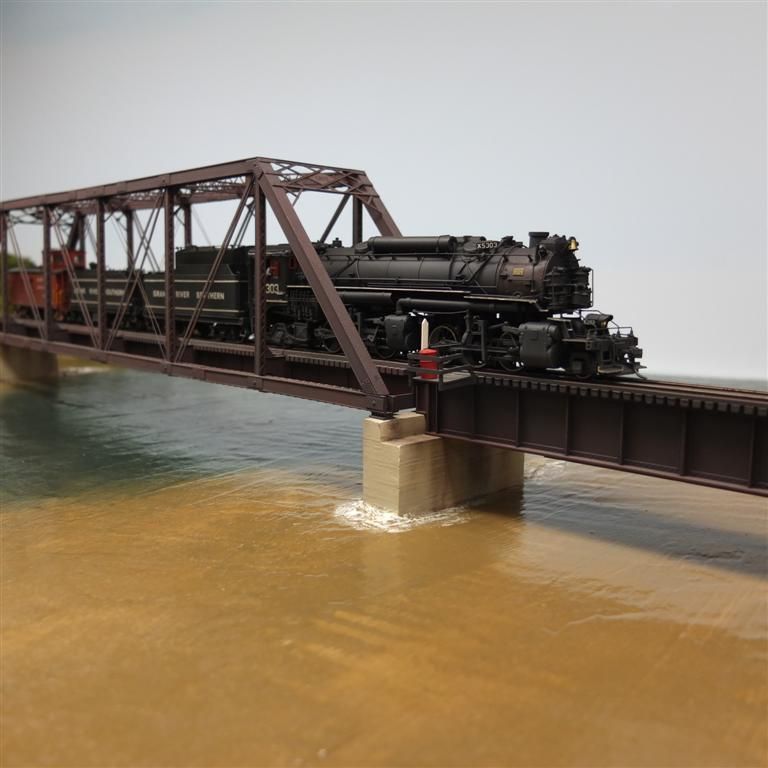
Even with added weight, it’s not a great puller, and that’s mostly attributable to the fact that I put wheel wipers, for more reliable electrical pick-up, on all wheels of both tenders. There’s simply too much drag. Without the tenders in place, I get about 5oz.-or-so of drawbar pull, which is fairly respectable. Perhaps I should think about making it into a tank engine. The weight of a lead saddletank and a loaded coal bunker would likely turn it into a real monster. [:P]
This locomotive was not around when the tests were done.
[quote user=“railandsail”]
doctorwayne
I have run a 71 car train around the entire layout (up the peninsula, too, although the second level wasn’t built at that time) without incident, and also backed it around the layout, too.
Thanks for that extensive reply,…you really did do some testing,…ha…ha
When I first viewed your overall layout view I guess I just assumed to had tighter radiuses. Cheers
I’ve heard those articulates are not that good of a puller,…the Heritage line from Proto 2000 as well.
I wonder if more weight could be added to these locos utilizing shotgun loading ‘shot’ into the small, widely distributed cavities.
http://www.ballisticproducts.com/Shot-Information-Data-Tables/products/595/
Brian, I actually added as much weight as could be fit in, while still keeping that weight balanced about the mid-point of the overall driver wheelbase. There’s additional room at the back of the boiler and a lot more in the cab, but no way to balance weight added there. Both engines should contribute fairly equally to the over-all tractive effort.
Here’s a LINK to a thread showing the rebuild of that locomotive, including adding weight.
Wayne
WOW and dbl WOW. That custom kitbash work of yours is truely inspirational !!
I joined that discussion and will relay some ideas that I have toyed with on kitbashing a C&O H7 loco. (I believe I added a discussion about this idea to this forum, but I will have to find it).
Its interesting what can be done with some of these plastic locos. Your work is truely an inspiration…thanks
Brian
Thanks for your kind words, Brian. They’re very much appreciated.
Wayne
I wish I had written down how steep the test grade was before I experienced problems. Seems like it was in 7%-8% range.
The main thing is, what I have is working for me & should work for Alexander too.
KenK
I have a 4% grade both straight and around 22" and 18" radius curves.
But the effective grade around your curves substantially higher.
Remember the lessons for helixes. Grade with a curve = a higher number (effective grade from a discussion over at MRH forums):
Grade equivalent, is the drag (expressed as a grade) that a train sees from going through a curve.
There is actually a complicated formula to figure this out, however there is also an easy rule of thumb for HO. Basically 32/radius of the curve= grade equivalent.
So a train going through a LEVEL 24" radius curve will experience a drag equivalent to a 32/24 = 1.33 degree grade. So if a 24" radius helix produces an actual 2.65% grade (~2.5%) then the train will experience an almost 4% grade.
So for your situtaion with a 4% grade on straight track, after a train continues into an 18" radius curve with an actual grade of 4%, it would experience an effective grade of 5.8% in the 18" curve in terms of drag.
Good thing you tested since the train is experiencing
I have one articulated locomotive; a BLI Blueline Big Boy. It’s a good puller because the drivers on one axle has traction tires on it. I was having issues with it running intermittently. I traced that down to a connector inside the tender being loose. Seated it fully and it runs great again.
Hi Alexander.
.
I will have a 4% grade on a 24" radius curve on my layout. A single Walther H-44 switcher engine will easily pull 6 40 foot cars weighing 4 ouces each and a brass caboose up that grade.
.
I built a mock up test track using Kato Unitrack to test the operation. Everything works as I need it to.
.
I think the consist you proposed should have no problems.
.
-Kevin
.
Back to the OP for a second…before adding weight to your cars, you should weigh them first. Most cars made in the last decades came with weights already installed so their weight is correct (or close to correct) per NMRA recommendations.
Second, are you thinking of adding weight because your cars are derailing? If they aren’t, and everything else seems OK, why add more weight?
Anecdotal engineering at its finest.
https://sites.google.com/site/markgurries/home/technical-discussions/anecdotal-engineering
Mark is talking about DCC wiring, but it applies here as well.
As selector, who first replied said, mock it up with your actual locomotives and cars and test before you commit to it. And I’m not all that old…
EDIT:
And here is why you need to mock it up. Not all model trains are created equal:
Athearn Genesis GP7 w/Hep: 11.3oz
P2k GP7: 15.2 oz
Atlas Classic 16.2oz
The Athearn GP7 can be helped with some weight addition tricks…
Typically speaking, I have found that *most modern cars weigh “approximately” the NMRA recommended weight. Flat cars, most notably, do not. They are typically underweight. This allows putting loads on the cars with out having an excessively over weight car. Overweight cars in a train with underweight cars can cause their own problems.
Do tell, do tell (or did you already).
Why go through the trouble unless you have an actual problem.
I found that Staples has relatively inexpensive postal scales that are good enough for our purposes for weighing.
About the only weight I add to cars is metal wheels. Accurail 50ton hoppers are underweight without loads. When you fill them with WS coal (live load), they come out to the NMRA RP weight…same can be achieved with the accurail coal load…