Filosophy Phriday Januay 30, 2026

Less is more? Well, more or less.
How we populate our layouts can depend on the amount of time we have on our hands. Most of us get the track down and trains running as quickly as we can, stand back and think “now what, where do I start”?

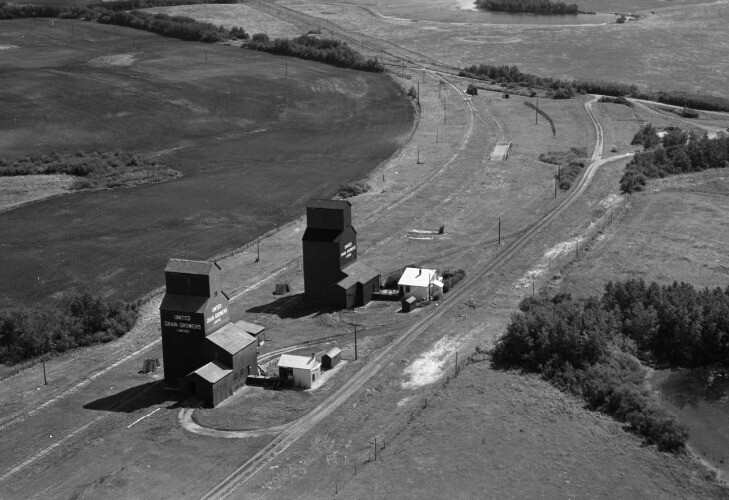
A prairie grain elevator was a must for me and as a kid who was hauled back and forth across the prairies numerous times I noticed that those grain elevators could be out standing alone as in the above photo or surrounded by the structures of the town that was written on the side of the elevator.

I had a list of must haves and as I went along adding structures and scenery, I realized how appropriate it would be to add certain, larger and/or fine detail bits around those structures and other places, even though I was looking for a more remote, rural feel for my layout.

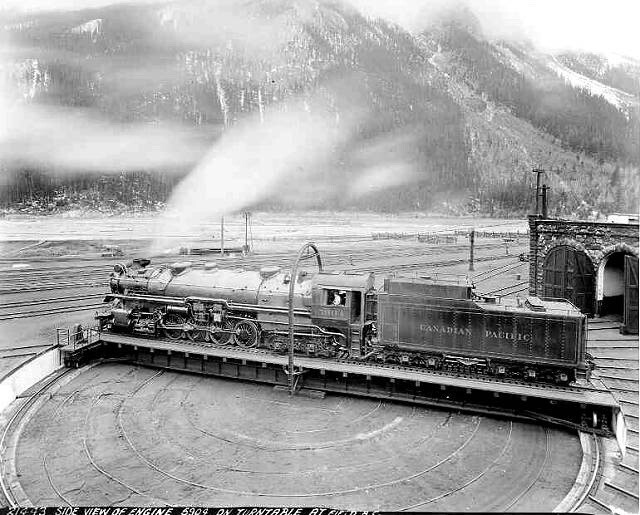
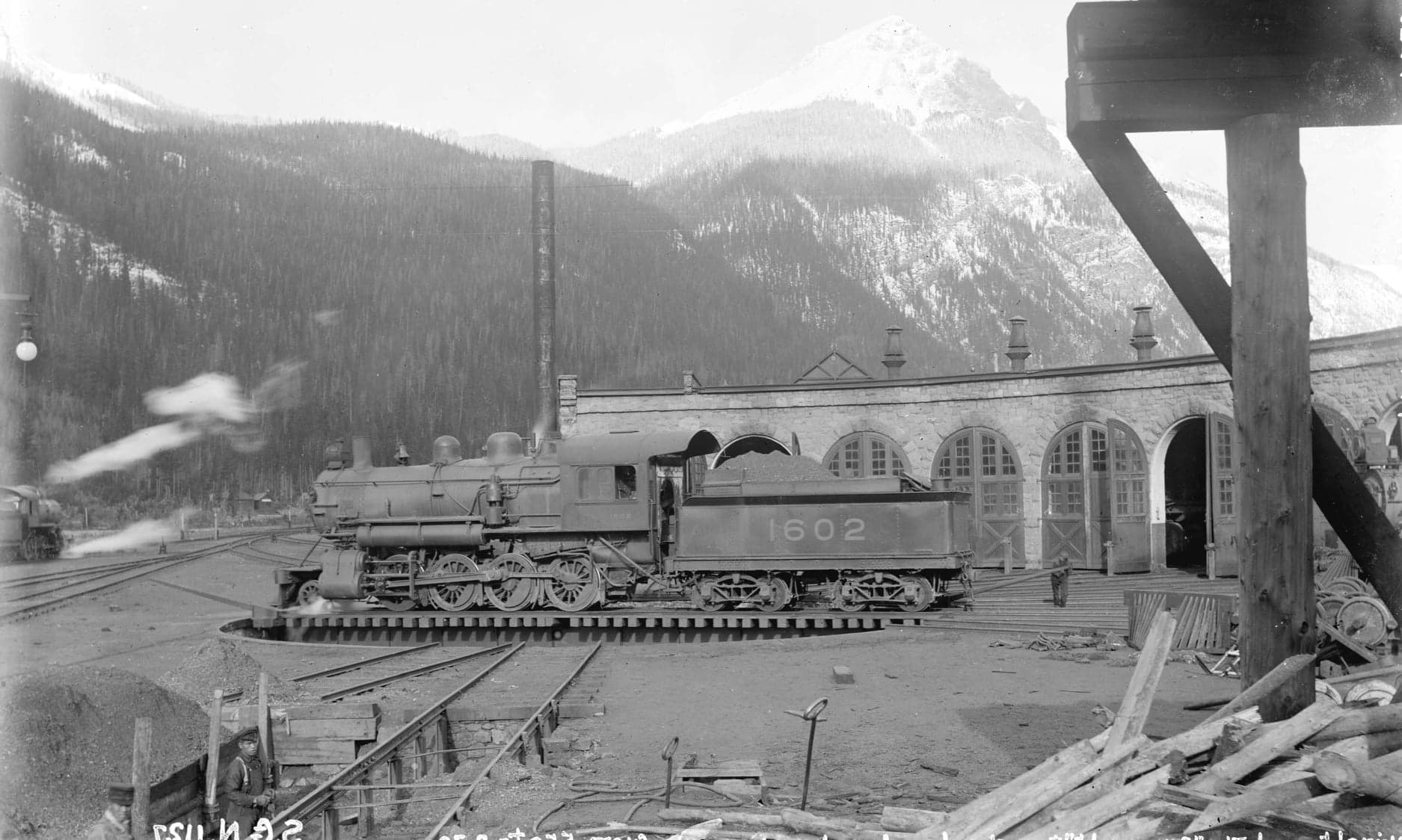
A roundhouse/turntable was the other must have and soon I realized how much space these things took up. So instead of trying to build a metropolis around my RH/TT I decided my must-have service facility would be a pusher station in the Rockies. Rocky mountain railroading was what I wanted, lots of scenery few inhabited spaces. Long single track runs, such as they can be on a model RR. It is coming together at a glacial pace and as I go I am finding some spots where more signs of humanity would fit in nicely without losing the remoteness I am trying to achieve.

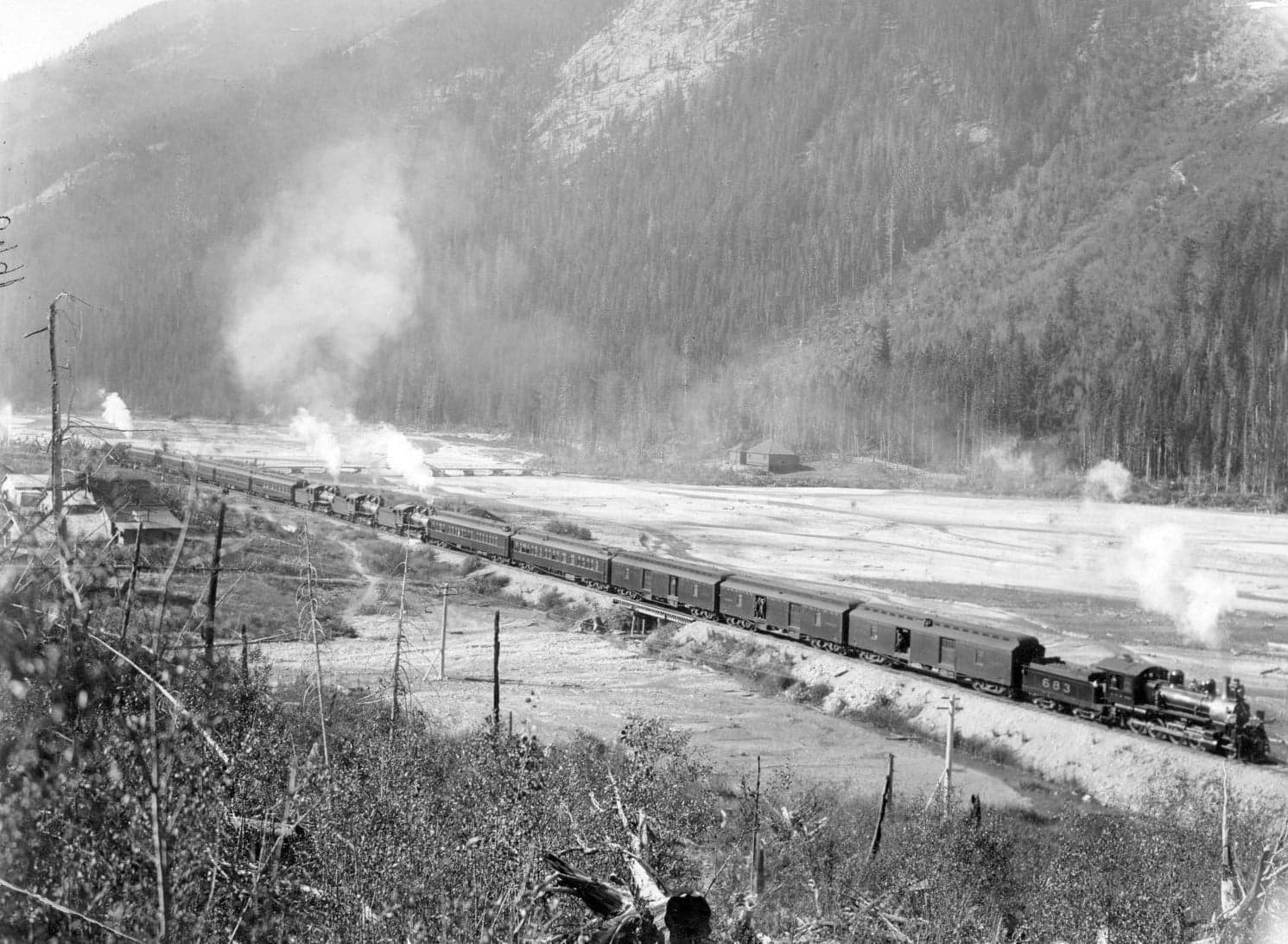
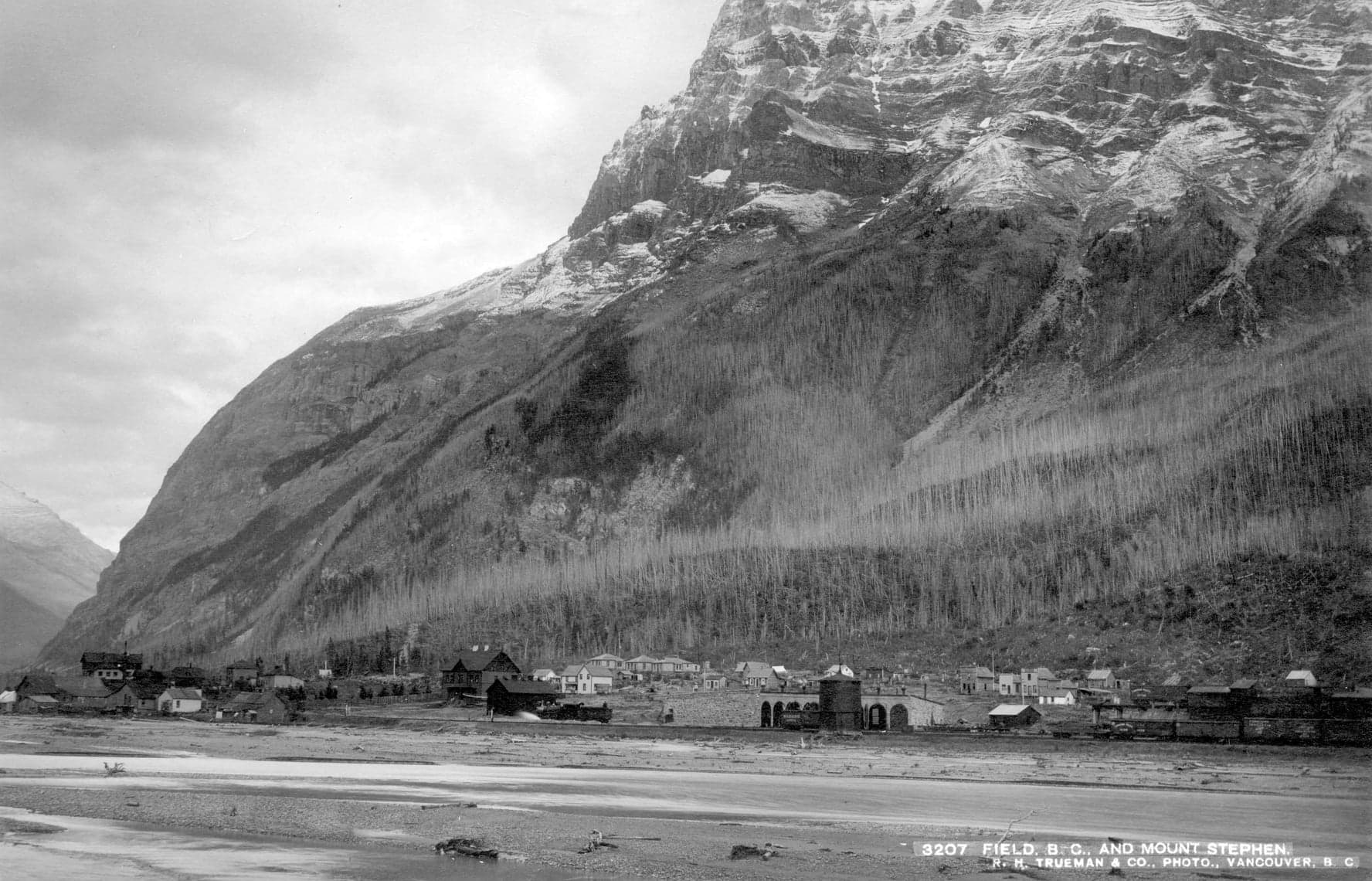
Wapta Lake is where the continental divide is on the Canadian Pacific’s mainline, and a stones throw to the West is the small town of Field where once upon a time there was a pusher station. The very few structures that make up the town are just up the hill a bit and I do have just enough space to add those if I ever get that far.

Field, where the RH and handfull of other small buildings sit out alone, works for me.
So this brings us to you.
Do you want a train table loaded with as many structures and as much track as you can squeeze in?
Do you think about how your layout transitions to where it falls off the edge of the world?
Dose being realistic when it comes to knowing how much you will actually get done over time have anything to do with your plans as far as the number of structures you will be required to build?

The larger the layout, the more time you need to spend maintaining it and this definitely cuts into the time you have to do other things such as build structures and add scenery. How does layout size factor into your big picture?

Tell us of your wants and wishes and realities, nothing wrong with any of it as it is about the journey, not the destination.
7 Likes

I have more structures than is realistic. I have a fairly small layout, but I really enjoy scratch-building structures. The result is more and more buildings.

It doesn’t really bother me too much because it’s what I do. I imagine if another modeler came in and looked at my layout, they would say it’s too crowded. Luckily (?), I live in an isolated area with no other model railroaders I know, so I don’t think I’m in danger of being criticized.

2 Likes

Hi Brent, this is a nice Topic for discussion, thank you.

My Layout ‘must haves’ are;
Continuous Run.
Classification Yard, however small, with an attached Team-track, which serves for switching Local Industries.
Diesel Service Pad, a small one.
Control Tower, with a flat roof and windows that slope inwards towards their sills.
Suburban Station, small - in one of the two corners.
Old Depot, converted into a Theme Pub - in the opposite corner.
All these with associate Roadways and miscellaneous Out-buildings and Sheds, etc.

These complete my Bucket-list and afterwards, I hope to concentrate on Scenery and Scenic details, but even they won’t be up to much.
I have some small pockets of Baseboard space, but these will be remain ‘green’ and open, with a few Trees, maybe.

Even if had twice as much space, I don’t think I would model a small Township or Industries etc.
Everything like that would be on the Backscene. I prefer openness.

When I looked through the photos and got to the one of Field B.C. with Mt Stephen, my jaw dropped.
Cheers, Paul.

2 Likes

I am trying to selectively compress three towns on the Santa Fe sub in Texas; Lometa (junction); Brady (current end of track) and Eden (original end of the line.

I am going to be able to model all of the rail related structures in Eden in about 20 feet; a depot, two grain elevators, a mohair warehouse, and cattle pens. I have seen branch records that oil and gas were shipped to Eden in the 20s and 30s; so I’ll add a small oil jobber. There was also a two stall engine house inside the wye that was torn down in the 1950s.

Brady is going to be a lot harder. Until recently, there were nine frac sand loading plants spread out on two tracks; the main line, and an industrial spur that was the original FW&RG main built in 1907ish. There is a beautiful union station on the old ATSF main. Several grain elevators; a furniture warehouse, mohair warehouse, a grocery warehouse, cattle pens, and oil/gas distributors. I have about 25 feet of space. I think I can get the depot (needs to be scratchbuilt), one or two warehouses, grain elevator, and maybe a sand plant. Sand is what kept this branch alive, but it wasn’t a big thing until the 1980s.

Lometa is going to be the focal point of the railroad; it is what you see when you walk in the room. It will have a depot, small yard, mohair warehouses. There was a 4 stall roundhouse for the branch that was in use until the 50s; it blew down in a violent windstorm in the 90s. I was able to photograph it in the early 80s. Another scratch building project. Lometa will also feature at least one, and maybe two grade crossings with functional crossing lights and gates. There is also going to be enough room to build a couple of blocks of small town city; utilizing Woodland Scenics or City Classics buildings.

I am thinking I am going to build Eden as it existed in the 1950s; when it was still served by a passenger train; whether it is a mixed train or a doodlebug is yet to be determined. Lots of cattle were shipped in this time frame.

I think I will build Brady in the 1980s; when sand became a thing on this branch.

This gives me the opportunity to run steam and zebra striped Geeps to Eden; and Fs, rebuilt Geeps, and CF7s to Brady.

What I haven’t yet figured out yet is how to add some meaningful staging.

Benchwork for Lometa is built…

3 Likes

Model railroading is all about pudding.

Pudding this here…

Pudding that there…

3 Likes

My layout is very small at 5 by 7 considering I’m operating O31 and Lionel Standard Gauge trains. After years of building layouts of many kinds I’ve settled down to one basic criteria: it must be easily changeable.

It has to be a floor layout for Christmas because the tree will be on it, but the rest of the year it could come off the floor. However, storing a layout table or even just a dedicated layout board would be problematic living in a one bedroom apartment. So the dream of getting back to a tabletop layout is at least on hold right now.

The compromise is what I’m working towards right now. I want to build small, easy to install, easy to store minimal elevation scenic panels that will be built to fit the between the track voids on the floor layout. I’m planning on stacking up layers of corrugated cardboard and covering them with brown kraft paper. I’ve been collecting both so glue should be the only construction expense. I also have some packaging material that’s made of shredded fabric. I’m hoping to shred that again and dye it for my grass.

The overall theme is “a small railroad junction around 1939”. I want a depot, a coal tower, water tower and one industrial structure. There also needs to be a small representation of the Ohio and Erie canal including a mill race and a lock. The big industry is going to be a grist mill. Other than that, maybe a house or two, maybe some sheds and other small MOW buildings. It should be a bucolic scene.

The big compromise, besides the obvious ones necessary for operating three rail trains of two different gauges, is that everything I build has to walk the thin line between toy and scale realism. And after years of building layouts of many different themes I find that I want a layout that operates reliably and removes me from my daily problems. I will enjoy the construction but just laying there on the floor watching the trains go round and round is all I’m looking for.

5 Likes

Love all your ideas for your railroads folks it’s great to read about other projects.I feel lucky to have a room 25by14 I’m 3years into building my dream layout ho scale my time frame is late steam to mid 60s mainly hiawhatha passenger and Union Pacific .im working on a large passenger station with Milwaukee background on wall have small town of Delavan wi with a circus parade . Have a long way to go as time and money is hard to come by but I need to focus on the details it’s hard when there’s so many cool locomotives available today eye candy to me .take care everyone

6 Likes

What I failed to mention is that I will have a continuous run feature; while Lometa will be featured, there is a whole 'nother side to plan. Whether it is based on my current home of Dodge City (which has a great yard and trackside industries); or one of the tank car plants where I worked one college summer (I helped build four new tracks into one side of their main shop building). I could also just go with some Central Texas scenery. I can’t decide.

I will basically have a 30 x 8 oval to run trains; passenger trains specifically. I have assembled a 1971 Texas Chief; the UP funeral train for George Bush; and I have a 1930’s era HW Super Chief that my son liked to run back when he was home.

1 Like

Tin Can II, I also made my layout with a continuous run double track. It’s for my passenger trains that I love to watch running. Have fun!