On my bench work I would rather use foamboard vs plywood as the base…What are the pros and cons to doing this type of base? Thanks[?]
I’m using foamboard. The only negative I’ve run into so far has been trying to mount Tortoise switch machines under the foam board. There are ways to do this, some have been described here on this forum and a recent article in MR using Velcro fasteners is another possibility.
But if you are considering Tortoise, I’d think plywood if I were doing it again.
Doug
I personally prefer plywood as the base so that I can screw stuff to the bottom of the layout. Many people here are having excellent success with just 2" foam though. Whatever you use I would suggest to support it well. I use 1x4s every 16" or so to support the plywood and have never had a problem. Foam will sag! I say this with fear and trembling as I am likely to offend some people here who are devout in their acclaim of using foam. I have a 1" x 4’ x 8’ sheet of foam that has been leaning against a wall for about 8 months. It now has a definite curve in it. So, use good support no matter which route you go and you will not be dissapointed.
Let’s not forget that in the event of a fire, foam burns VERY fast and gives off toxic fumes.
Plywood is a lot easier to make grades with.
Foam is a lot faster to shape scenery.
Plywood is sturdy
Foam is lightweight.
I’ve used 1/2 plywood with foamboard on top for most flat sections.
Gordon
Not true. The MSDS for Owen-Corning pink foam indicates no such fume problem. ANd the flash point of the foam is HIGHER than that of wood. So if the foam is burning, so is the rest of your house.
–Randy
The truth about foams. (Truth is not subjective)
Here is another thread with alot of good info on this: http://www.trains.com/community/forum/topic.asp?page=-1&TOPIC_ID=47973&REPLY_ID=524812#524812
I love working with foam. I use the pink stuff. Like howmus does with plywood, I use rafters every 16 inches for support, although 1x3’s seem to be enough. Cutting with either a knife or hot-wire cutter is quicker and neater than sawing through wood. (I can’t imagine getting permission to haul my circular saw up into the family room and start cutting plywood over the carpet, but I cut foam in-place all the time.) For wiring, I can just poke a hole through with an awl.
My layout is a free-standing, 5x12 foot table mounted on wheels, 6 legs total. I did that because I’ve got a 45-degree roofline I have to duck under, and this lets me roll it out for working, playing or viewing, and move it back when my time is up and the girls get the room. The foam makes the whole thing very light, so pushing it around is no problem.
Foam takes paint and glue well. Small nails or track spikes will not hold well, but I’ve had good luck with straightened out paper clips. I can gouge it out to make gullies or ponds, or stack up more pieces and make hills. For inclines, I cut a long piece of foam and then support it on the benchwork with trestles, just like cookie-cutter plywood.
Use both.[:0] I think that they both have a place. There are many ways to combine the two for strength, weight and easy-to-work-with advantages.
Take a look at the SJSRR for one example…of many.
Have fun,
I am a firm, and often zealous, proponent of foam construction. My small 48"x78" L-shaped N scale layout is entirely constructed of foam, with the exception of my old kitchen table as a support underneath. I have experimented with 1" and 2" foam, using them as structural parts of a support system (excellent results), cutting 1/8" thick strips and glueing them into spline roadbeds (not as successful as I had hoped), and for making Woodland Scenics-style foam risers (lots of work,but excellent results).
Having viewed the photos of SteelMonster’s layout, I am beginning to believe that a mixture of wood and foam is the best way to build a layout. My little layout suffers from not being able to adequately support a fascia panel, although the sides on the foam are painted dark brown and look like an excavation as seen in this pic:
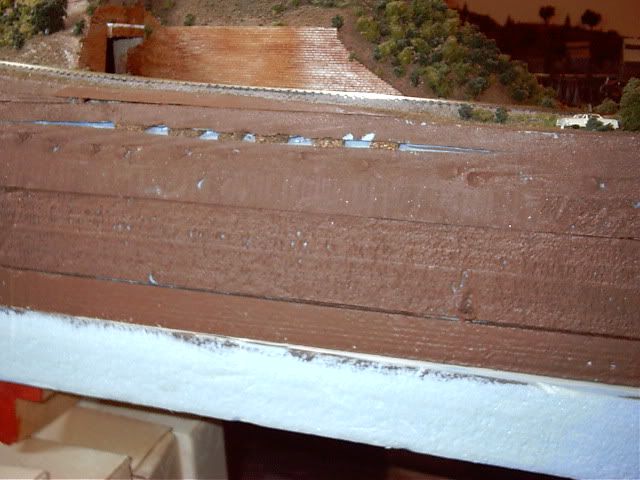
Having a frame below the foam would allow the use of sturdy fascia panels.
Small lumber can be used with foam, especially 2" thick foam. Although 1" foam will sag if unsupported, 2" foam is much stronger structurally and shows no sagging over 8’ with a single support in the middle. The wood used can be as small as 1x2, although 1x3 is better to work with and is usually of a higher quality than 1x2. Crossmembers in a wood frame can be installed flat (with the wide side up), providing a place to mount terminal blocks and wiring supports to keep the underside of the layout neat.
Tortoise machines can be used with foam. The technique outlined in MR (I think?) is the best technique I have seen for mounting Tortoise machines. The machines are mounted to a small plate which is set into a recess carved into the top of the foam. The machine hangs down th
I’m a plywood person, but portability is not an issue for me. What I design and build stays where it is designed for and built. When I move, I redesign and rebuild using the open-grid method. That said, I understand why people use foam. It is a viable alternative.
One word of caution, though. I have used foam for other projects and be very careful what adhesives you use. Things like latex caulk are excellent. However, some contact cements will eat the foam in very short order. If in doubt, experiment on a scrap piece of foam before you try it on your “slab.” Watching a scrap get eaten is a lot easier to take than watching a large section become scrap for scenery.
Just to make the data in this thread a little more complete, here is a link to the Owens Corning MSDS for thir Pink foam product. I bookmarked this when I was researching construction materials. The Owens Corning product is the onle readilly avialble to me locally through Honme Depot and others:
http://secure.owenscorning.net/Portal/uploads/document/20040618/24901_01_c.pdf
From reading the sheet you can see that udring the breakdown process, ie burning which includes cutting with a hot wire cutter, the product will produce some noxious and potentially toxic substances. This is not a prouct of the polystyrene itself it would appear, but of the other compounds used in the production of the board.
If you are going to cut these extruded foams with a hot wire it would seem prudent to do so out of doors or in a very well ventilated space and wear appropriate respiration gear.
The white ‘bead-board’ is usually an expanded polystyrene product with some pretty toxic side-effects and I understand has no flame-retardent added to it.
Woodland Scenics claim that their product is completely safe and non-toxic, but I haven’t seen the MSDS yet. I have asked for it and when they provide it I will put it on a web-site with a link for general use.
John
Thanks for all the great tips…
There are advantages to each but to me the big advantage of foam is the weight. If you are building a portable layout or one you might have to move someday, I’d go with foam but if you are building a permanent layout, I think the scale tips toward plywood especially if you are using switch machines mounted underneath. I only use a flat platform in my towns and yards and open construction elswhere. I used foam for the first town I built and it was too much of a hassle mounting the switch machines so everything else I went back to plywood.
Instead of using plywood, consider 1/8 " lauan as an for your sub-base material with your foam attached to the lauan. Anything heavier is overkill. I have used this successfully in several shelfstyle layouts. If you use 1 x 4 pine boards as your framing material and glue and screw the lauan to the framing, you end up with rigid light weight benchwork. Then simply use foamboard adhesive to hold the foamboard to the lauan.