Is there a reason we keep seeing reference to an “H. Robert Grant”?
I was assuming this was the H. Roger Grant that edited the R&LHS publication decades ago, and who was one of the ‘authorities’ consulted when Henry Rentschler donated the balance of the Baldwin records to Pennsylvania in the early Nineties.
Grant is a long-time professor, which is an automatic negative for some posters on here. I never read his book on the CGW, other tham skim it a bit in a library. Seemed like a pretty solid work, though a rather boring writing style in the tradition of “Dull, duller, Dulles” kudos to John Foster D., Princeton, class of 1908.
Grant’s book on CGW has to be regarded as one of the biggest “duds” in my personal library; you can get a better picture of daily operations during the “Deramus era” from Kip Farrington’s Railroads of the Hour (1958).
Essentially, once multiple-unit Diesel operation became possible, Great Western operations on its main lines consisted of one long daily freight in each direction, plus what passenger service could be sustained by a mail contract, plus local peddlers, and the latter two were on borrowed time. If any unit train operattions fund their way onto CGW rails, I’m not aware of it.
Certainly part of this discussion should be the push to find a way to finance highways outside of the direct revenue that could be collected from their users between exits. MacDonald led this Federal effort for some time, culminating with the publication of Toll Roads & Free Roads in 1938.
As one can imagine the report, now 80 years old, suggested that toll roads, even those limited ones that could exist, with relatively many, overlapping short O-D pairs that could charge a higher per-mile rate, where not in the national interest, free roads were, to be paid for by a general tax. This concept was developed for quite some time, to culminate in the 1956 Interstate act, with various statements that it would be self-liquidating, with a 1961 report that was to set the tax rates.
However, a fuel tax rate is never a proxy for paying for a highway, as the actual mileage of state highways is a distinct minority here in the US of all public roads (1/15 th). The fuel tax is on the use of locally financed roads, paid for by both cities and counties out of their general funds, or put in place by developers.
Hence there is always going to be a leveraging of investment toward highways on the back of taxes on the use of the locally financed road system.
Many groups ignore this effect when trying to fix the Highway Trust Fund. One can run a financial analysis of the revenues and costs of the Interstate system at the historical discount rates and find a needed investment of about $0.10 per automobile mile from the widely spread fuel tax and about three times that for commerical veh
As they say, the squeaky wheel gets the grease. One might wonder just how much the regulators got “leaned on” by who knows who (including politicians actually looking out for their constituencies).
I’m sure there were plenty of off-the-record conversations indicating that appointments might be at risk with the ‘wrong’ decision.
Hey greyhounds the founder of the company here would tell you the same thing about the OTR side and how screwed up the ICC had it. Companies were restricted at one time to 6 lanes of service that meant only 6 different cities and customers in those cities they could service peroid. The shear stupidity of some of their decisions was baffling to even him. One he never figured out that directly impacted him was he could haul Liquid Mag Sufalte from a customer we have still to this day. However the powder from the same customer had to be carried by a different carrier even if going to the same place. Why he wasn’t authorized by the ICC at the time to haul powdered Mg Sufalte in bags or in bulk. Yet he could haul all the liquid of it he wanted.
The regulators didn’t suddenly become competent when they expanded in to trucking.
A big difference was that rail was 100% regulated while only about 30%-35% of trucking was regulated. A major exemption for trucking was that agricultural commodities were not economically regulated. Neither were private fleets. And truckers were allowed to contract with customers while railroads were prohibited from doing that.
All in all, economic regulation of transportation was a fool’s errand that harmed the US economy and the US people. H. Roger Grant supports trucking regulation in his article and I did complain about that.
I’ve often challenged anyone to name two positive results from economic regulation of transportation. So far no one has done so.
The history of economic (rate/price) regulation is long and complicated; it can be traced to the “Commerce Clause” (Article I, Section 3) of the U S Constitution, via which the individual states were prohibited from imposing tariffs on each other’s goods – essentially, a free trade agreement well in advance of the huge success of the European Economic Community (Common Market). Unfortunately, the same wording was also used to justify Federal control of what ought to have remained a private matter.
In Munn vs. Illinois (1876), in response to pressure from the Granger movement, the Supreme Court granted the states the authority to set storage charges for grain elevators and, by extension, rail freight rates. Then in the Wabash case of 1886, this authority was restricted to commerce within one state. That set the stage for the (Federal) Act to Regulate Commerce (1887) which created the Interstate Commerce Commission.
Self-propelled highway vehicles weren’t envisioned at that time, and river, canal and coastal carriers were minor players, so the railroads were the only form of transport that drew any serious attention; it was recognized that setting rates artificially low amounted to violation of the principle of due process, so little by little, developing a fair valuation of railroad property upon which rate structure could be based evolved – leaving us aficionados of iron-horse manure with all those “valuation” photos from the early Twenties.
But no sooner was the ink dry on the Transportation Act of 1920 than the trucking industry developed and skimmed away the high-value and high-rated traffic that was expected to provide the revenue to cover most of the overhead. By 1930, all-weather highways had developed to a point where truck hauls of several hundred miles were feasible for perishables, and/or sophisticated high-value merchandise. That set the stage for the Motor Carrier Act of 1934.
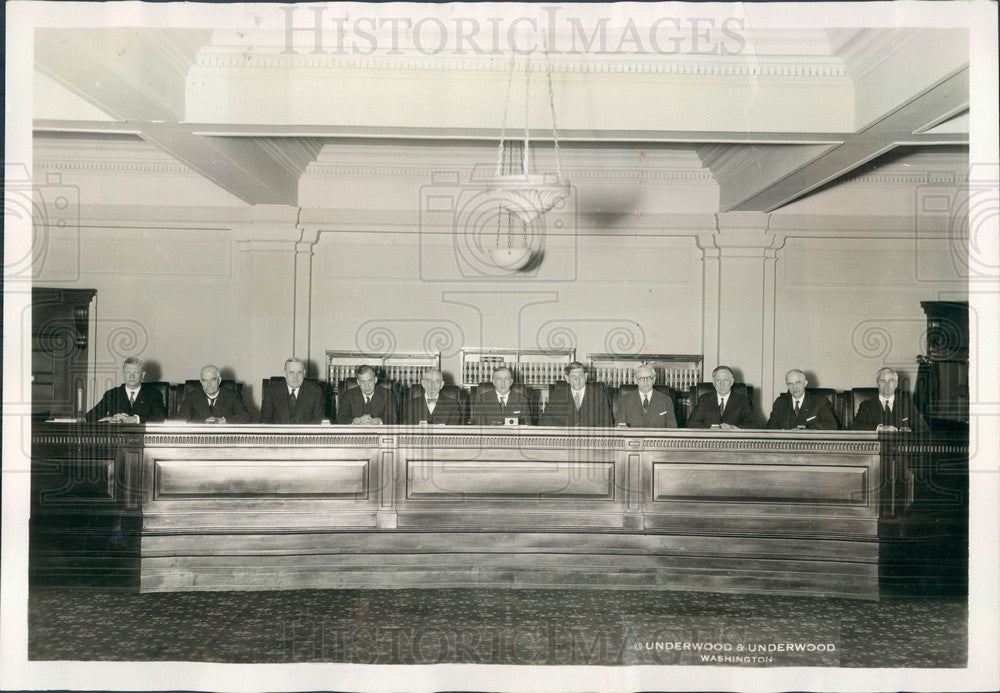
Washington, June18, 1931 – Handling cases involving billions of dollars, the Interstate Commerce Commission has gone through its forty-four years of existence without ever a hint of scandal touching one of its members. Individual commissioners have been accused of bad judgment or prejudice. Wall Street bankers have protested restrictions on railroad securities. Farmers have complained that the railroads were granted rates too high. Railroads, naturally, have sometimes been dissatisfied. But no member has ever been charged with corruption or ulterior motives. Aside from integrity, most of the commissioners are high-grade men of experience and ability. They have to be in order to deal with the vastly complex and variegated cases which come before them. Both in mental capacity and erudition in their field, the 11 members are comparable to those of the supreme court. Little of the criticism, consequently, that has been hurled at such other regulatory bodies as the power and tariff commissions has fallen the way of the I.C.C. Its decisions have generally been regarded as impartial… Lawyers have predominated on the commission in the past and a half a dozen lawyers are members now. A couple of them have been judges. Four have served on state regulatory commissions. Another worked his way up through the ranks of railroad labor and the commission staff. The average commissioner’s age is about 56. The chairmanship rotates from year to year and is now held by Ezra Brainerd. Jr., who came out of
Actually, the author’s name is H. Roger Grant. That was my mistake. I own it.
But it’s been over a month since my detailed complaints of bogus history and distored facts in the article were forwarded to Grant by the editor of Classic Trains. I’ve heard nothing.
Well, greyhounds. at least he has not responded with an irate communication blasting you for daring to dispute his word with your facts.
Often, some people are so sure of their knowledge that they cannot accept any criticism of their words, whether spoken or written. Perhaps he thinks your corrections are beneath his notice? Or, he is so ashamed of having written without having checked the full history of his topic that he cannot respond?
After a month or so of this thread, it occurred to me - as far as I know, the UK railways developed near-standard containers for interchange by the late 1920s (pre-grouping), which was expanded and eventually (under BR) developed into Freightliner services by the 1960s. Would that be a good analog (to a certain degree) to what container shipping development in the US could have been if the ICC had been more flexible and liberal to railroad container rate pricing in it’s 1930s decisions?
[quote]
[R]ailway container designs were standardised during the later 1920’s. The new RCH approved standard containers were based on the existing designs of the time. This move was mainly lead by the LMS who began promoting containers in 1928 in order to counter the competition from road haulage companies for door-to-door services. I believe the earliest railway company door-to-door container services started in about 1926 but I cannot confirm the details.
By the 1930’s the container had proved its worth for furniture removals work and was also popular for the transport of higher value cargo. One of the big successes for the railway container was the shipment of meat and although the railways continued to build vans for the carriage of meat the containers dominated this trade from the mid 1930’s onward. The LNER only used meat containers for this trade after 1935, and several of these might be included in a fast express goods train rake. British fresh meat was shipped mainly from Scotland hanging on hooks in ventilated containers. Imported frozen meat was carried from the docks in refrigerated and insulated containers.
British railways built many thousands of containers, mainly to the standard pre-war ‘van’ type designs. Up to the 1960’s it was usual to send containers through the system as single loads, hauled in standard mixed goods trains but under British Railways that all-container ‘liner’ services began to emerge in the late 1950’s.[/quot
He can hit me with his best shot and I can respond effectively over this one. I know this subject and realize it’s very important to keep the history straight.