I’m working on planning my next layout. It will mainly be centered around a small NYCS steam-diesel servicing terminal and freight-passenger depot.
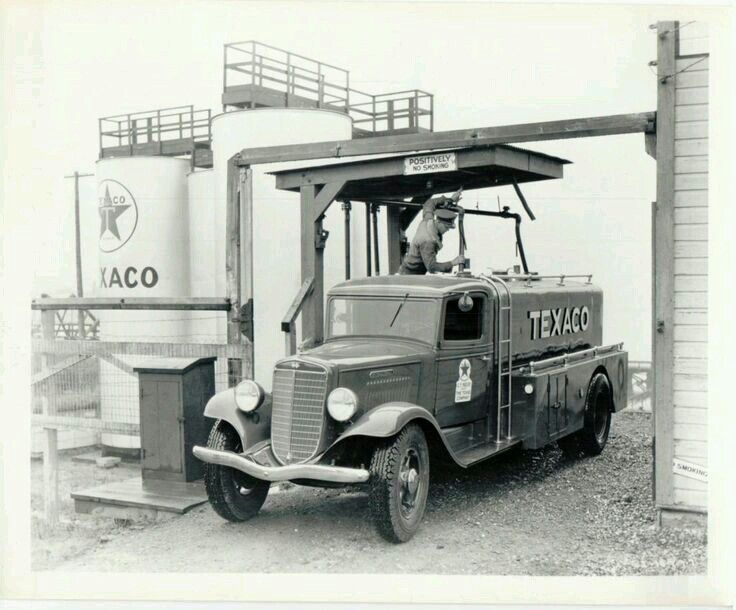
I’d like to add an appropriate fueling station for late '30s - late 40’s vintage tank trucks. What I’d like to understand is how gasoline was distributed to those tank trucks. Was it delivered by tank car then distributed to the trucks at that location? Or, were tank trucks fueled at a specific location - i.e. away from the railroad?
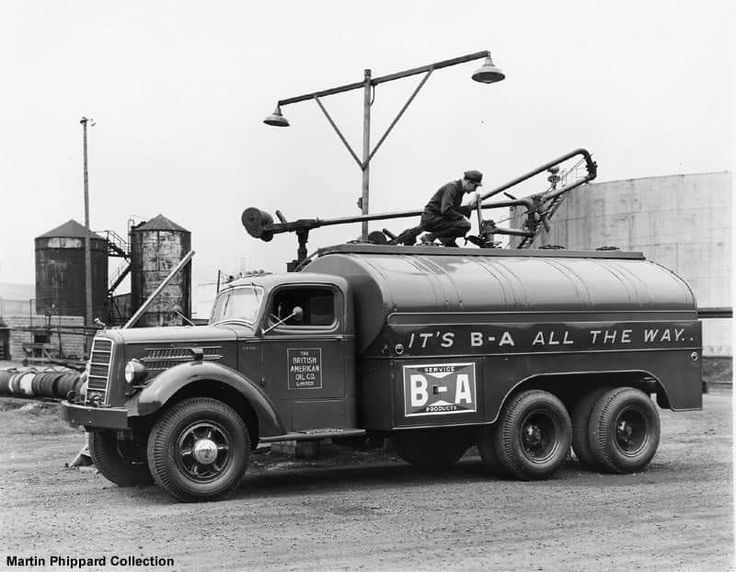
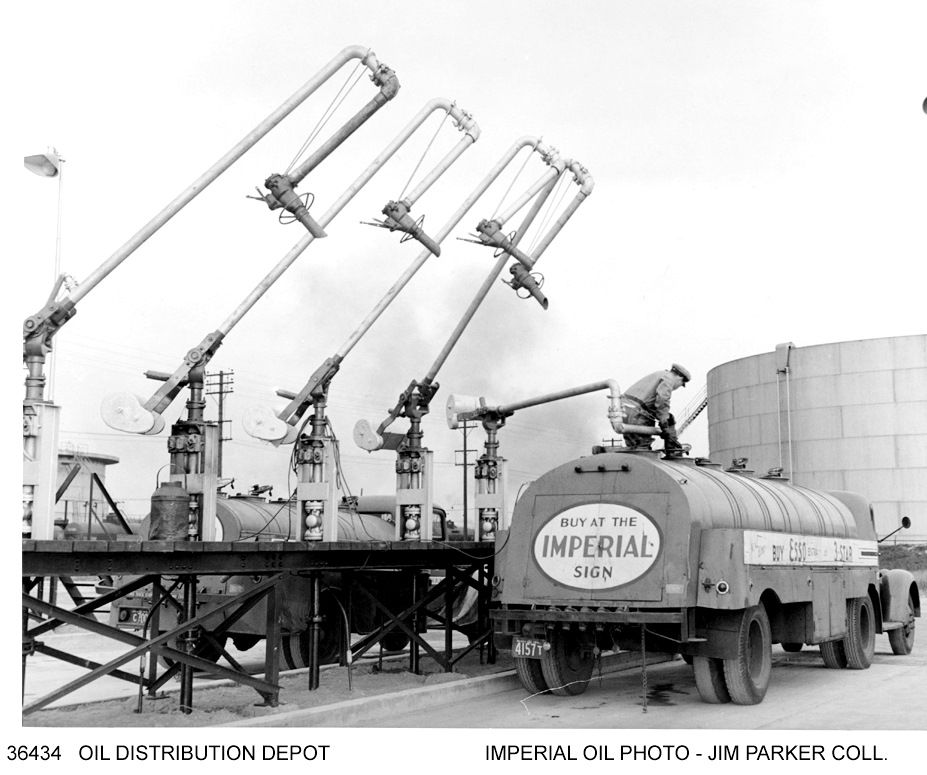
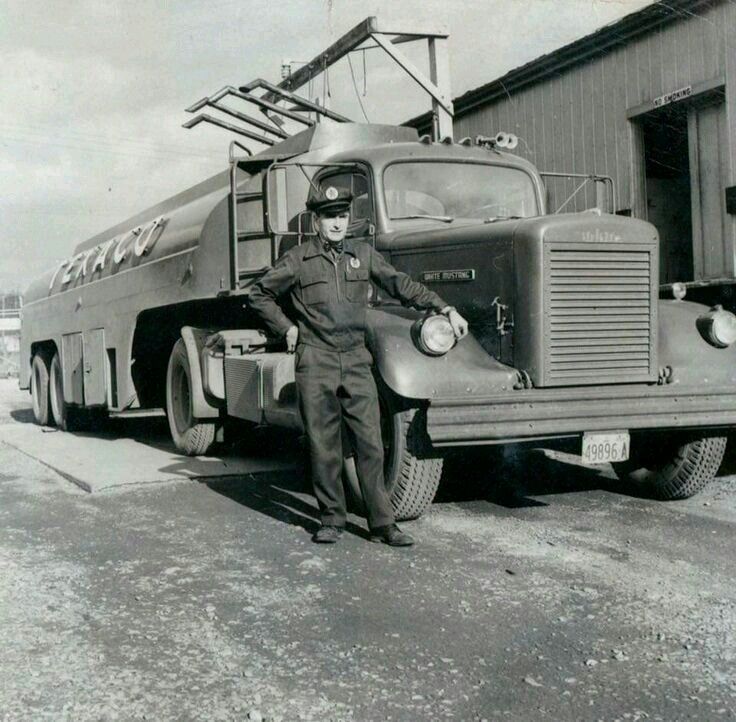
I’ve been able to find a few pics of tank truck fueling stations…
I see a lot of nearby behemoth storage tanks or storage bays that utilized clustered smaller tanks but no tank cars or rail.
Q: Would it be prototypical to have gasoline delivered by tank car to a fueling platform that then pumped the gasoline to a delivery system for fueling tank trucks at an adjacent location - e.g. a paved lot next to the platform?
If you have any pics to share or can point me in the right direction for reference materials, I would be appreciative. Thank you in advance.
The development of pipeline architecture in the United States (propelled to a degree by the loss of cheap coastal tankerage and lighter age starting in late 1941) is a major reason you see relatively little delivery of gasoline to ‘local’ tank farms via loose-car tank cars. In part the increased cost of maintaining a siding and paying local switching charges may make a tank car a less attractive option.
Ethanol does not transport well through pipelines, and moves nearly exclusively in tank cars and tank trains, but is blended with gasoline at refineries rather than at local facilities (to my knowledge).
Unless you want the ‘fun’ of switching and of modeling the connections to a tank car, I’d see about a branch pipeline connection, or delivery by large tank trucks for transfer to other smaller or compartmentalized trucks.
The Amtrak City of New Orleans was regularly refueled in Memphis using a 10-wheel straight truck; as I recall these had multiple compartments and hose reels, probably to allow delivery of multiple specific products.
Most if any tank car that handled petroleum products to a oil distributor would have been filled with things like heavier oils like gear or even motor oil especially if it was being delivered in bulk amounts. Most engines in the 30s and 40s literally didn’t have engine oil filters on them. The pickup floated above the top of the crud in the sumps.
I would be surprised if pipelines fed all fueling stations, especially smaller ones and during the era you are modeling. I think you could justify spotting tank cars at one for gasoline delivery.
Gidday Tom, looking for photos that describe what you’re looking for is not easy, I guess that taking photos at your local fuel distributor during WW2 was not a clever idea; and not “sexy” before or after the “Main Event!!”
However, I hope the following helps, and I should note that each article was accompanied by at least one prototype photo.
On page 46 of the June 1959 Model Railroader, there is an article “Bulk Oil Depot” by Lloyd Giebner, describing a rail serviced facility, based on the Standard Oil Company depot, at Eagle, Wisconsin.
On page 104, in the November 1999 Model Railroader there is an article “Kitbashing Chief Petroleum” by Bob Foltz. The blurb basically reads that Chief Petroleum, located on State Highway 24 in Colorado Springs, Colorado, is a small business typical of those commonly found throughout North America, especially in the agricultural regions. He describes that oil tanks and a railroad siding were installed in 1928, and at that time all fuel was delivered by tank car, this slowly changing over the years, but most pertinent to you is that the last rail movement was in 1965.
On page 64 of the August 2002 Model Railroader there is an article “PetroleumTerminals” by Mike Small, describing “Tank Farms” for bulk distributors of petroleum products to retail business. While currently served by petroleum pipelines, the crux of the matter is that pipelines were only built in the late 1960s.
As an aside, in the March 2001 MR, Jim Hediger wrote an article on the rail served Seagram’s bottling plant in Relay, Maryland, now that’s more to the Bears taste!!!
Very interesting discussion, thank you. My short line railroad Is set in 1999, and it receives diesel fuel by tank car. My story is that the demand is small enough that it would not warrant a pipeline feed.
Before WW2, pipelines existed but were much less common. East coast cities often got oil in bulk via ships coming from ports on the Gulf of Mexico in Texas and Louisiana. During the war, these ships were easy targets for German U-boats, so long trains of tank cars were used instead. Eventually, pipelines were built that lessened the need for the long tank trains.
However, I suspect part of the reason the OP’s pictures don’t show any rails or railcars is quite likely because they’re fairly close-up pictures of how trucks were loaded for distributing the gasoline to gas stations or other users. Quite possibly, there are tracks out of sight (like on the other side of the storage tanks we see) where railroad tank cars were unloaded.
Until the 1960s…tank cars brought in fuel from the refineries to the local distributor who would store it in their tanks. Fuel from the distributor’s tanks would be loaded on to tanker trucks, which would deliver the fuel to local gas stations, businesses, and farmers. Oil and lubes would come in via drum or carton using boxcars to deliver to distributors, although some were big enough to bring in lube oil via tank car.
It was common to see several fuel distributors along rail lines-with their own sidings. Many of them had the oil company logo painted on their tanks-which is a good way to determine the region and time period for your model RR.
Menard, TX, at the end of a branch line in TX had a track with three oil distributors side by side by side. Sanborn maps shows the oil dealers, but it does not identify them by brand.
Since my layout will have a fueling/servicing terminal (with a supply track), a 4-track yard, and a freight/passenger depot, I will definitely be modeling switching and the detailing that goes with it. Perhaps not your cup of tea but it will make for an interesting and engaging contrast to the 2-track mainline along the perimeter. I do like your idea of a larger tank truck being the “supply line” for the smaller local tank trucks.
Thank you for the comments so far, everyone. I’m really enjoying the discussion.
Except in the 1930s there really weren’t “large tank trucks”, the ones in the pics in the OP are about as big as they got. Plus there was no Interstate Highway system for the existing trucks to roll on. Heavy bulk goods were virtually 100% sent via rail.
As AZRail noted, railroads had their own tank cars dedicated for hauling diesel fuel once they started buying diesels (usually yard switchers first, so the first diesel fueling places on the railroad were probably in the yard’s engine servicing area.) Petroleum companies owned tank cars which they used to ship gasoline from their main plants to various fueling stations around their area.
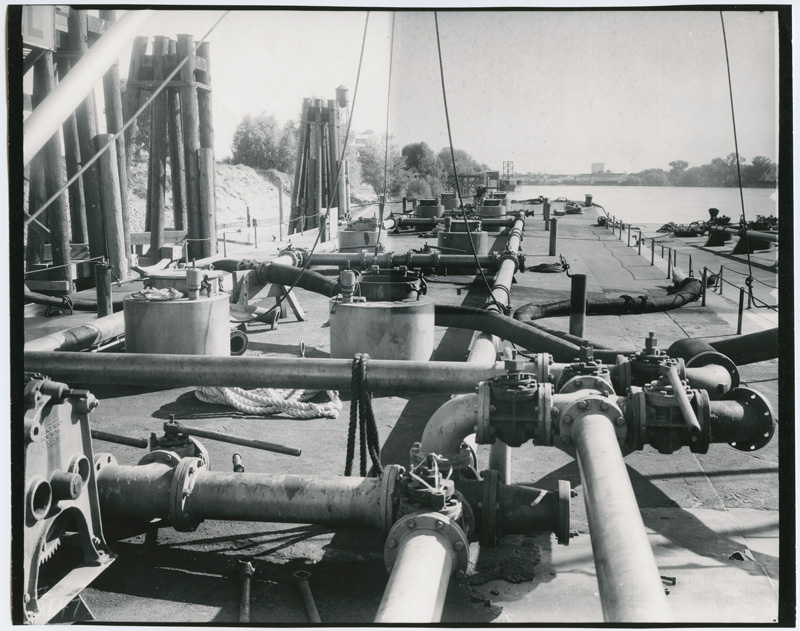
One other alternative, if your fuel facility is on a river, is refueling via barge! Before completion of the pipeline from San Francisco Bay Area refineries to Sacramento, fuel was sent upriver in river barges, and pumped from the river via this dock, into tanks that supplied both railroad tank cars (via a Southern Pacific spur off their Sacramento Southern branch line) and tank trucks.
Prior to the age of affordable digital cameras, or cameras in mobile phones (the stuff of science fiction) that allows one to randomly click away at anything and everything that takes one’s fancy, the more the merrier, as some acceptable images may turn OK, it should come as no surprise that photographic evidence of the more esoteric subjects like railroad tank cars unloading at the local bulk fuel dealer are rare.
I say this as someone who started off with a second hand basic Kodak Instamatic, who went through the process of sending the reel of photos to the local chemists, with money, and then receiving the results two weeks later, only to find that half were out of focus or some other defect, and the rest of dubious quality, and therefore was choosey regarding the subject, I wished to capture.
And, of course, the internet is not necessarily the host of all interesting photos ever taken.
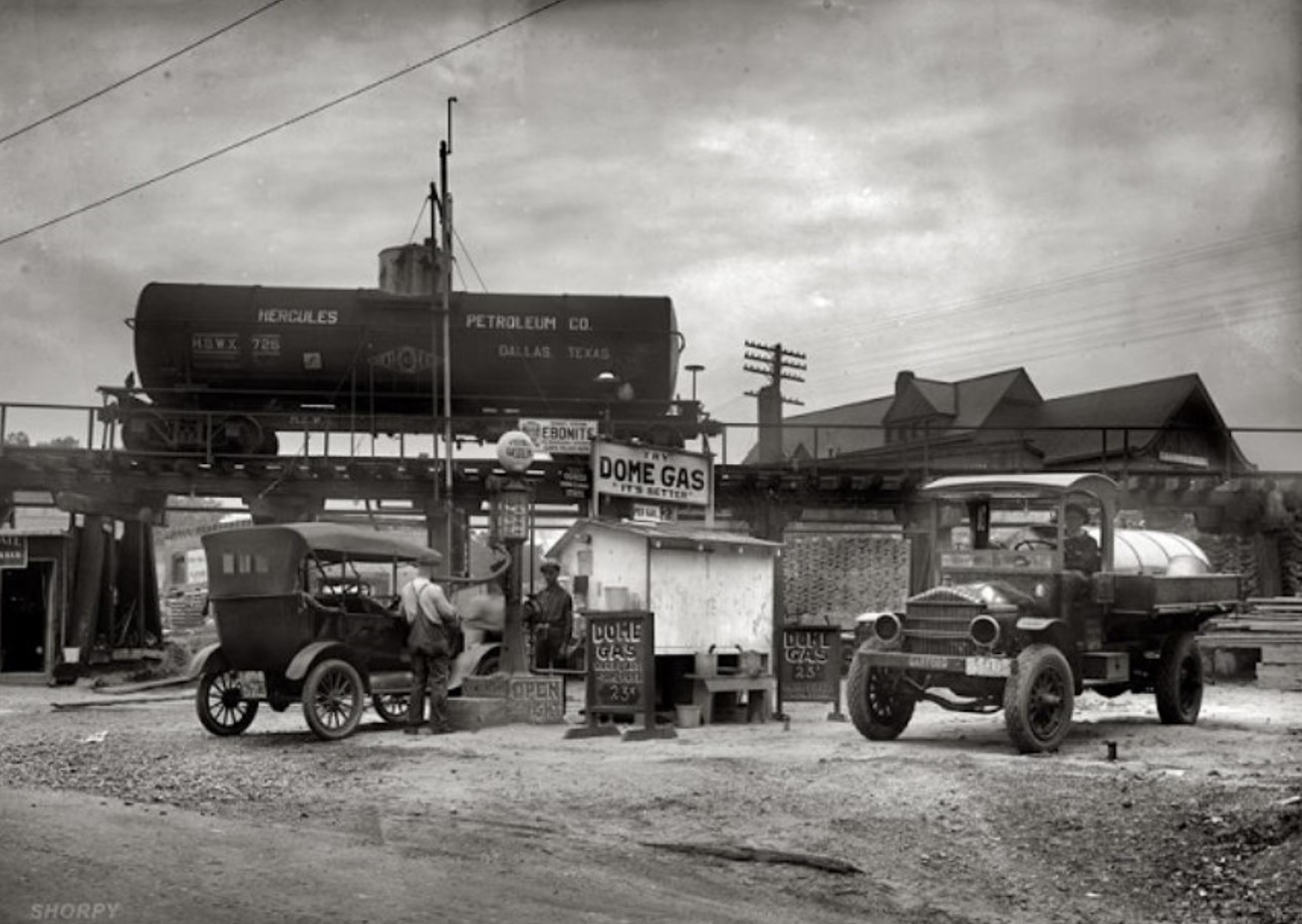
So, after quite a few coffees search, while there are a reasonable number photos of Modelled local bulk fuel dealers serviced by railroad tank cars, and box cars delivering drums or cases of lubricants and greases, I have only come across this one prototype photo, which is 20 years to early for Toms 1940s.
“Try Dome Gas, it’s better.” Tank car unloading from elevated trestle Takoma Park, MD 1921. Unknown photographer. Dome gas by Bear, on Flickr
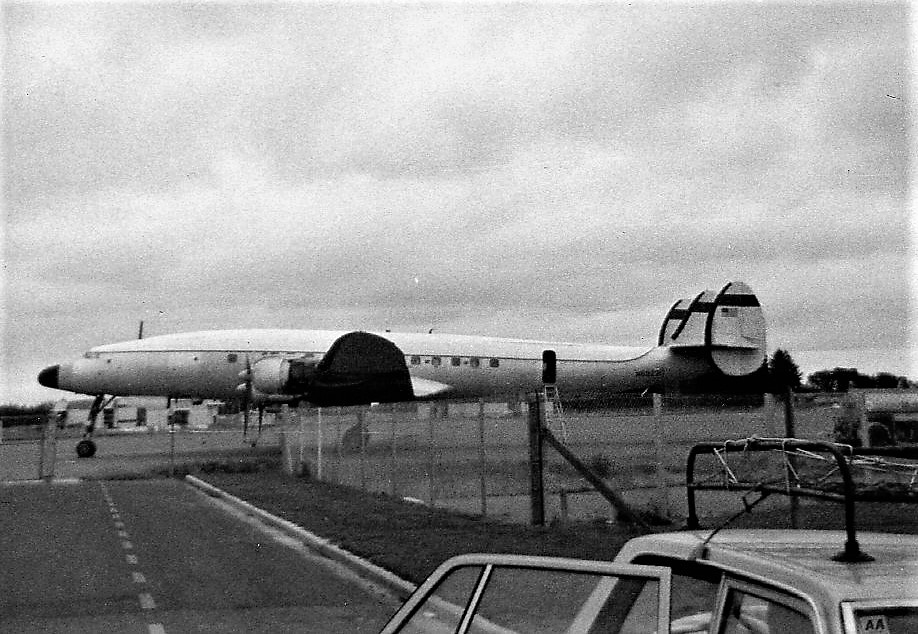
And an off topic photo which I took on my Instamatic, and am still pretty pleased with.
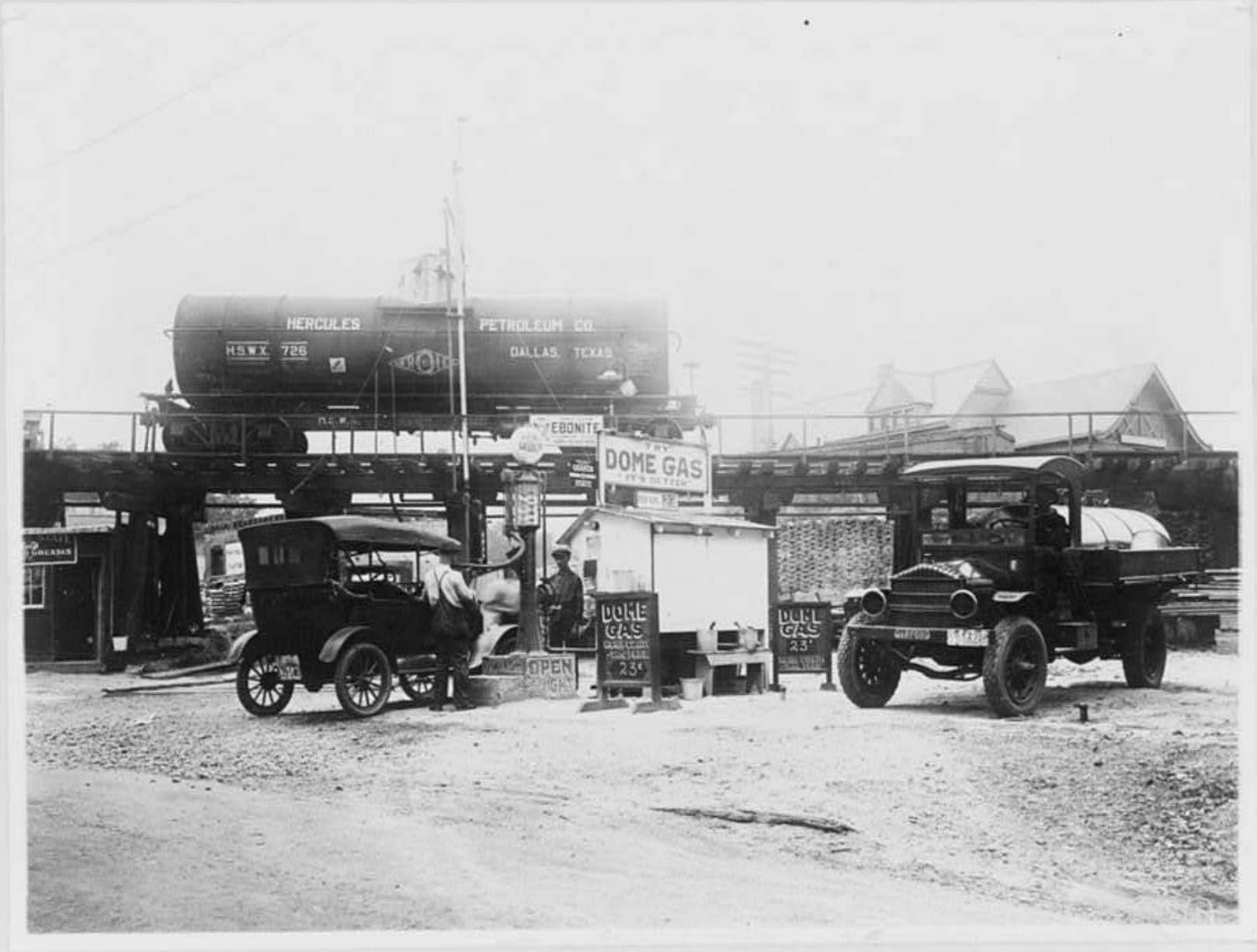
You are the 2nd person that has posted the Dome gas photo with the elevated track and tank car in the background. (The other on another forum) Parts of the original photo from the 8" x 6" negative were pretty washed out. I presume someone took the time to clean it up “digitally”.
The location is Takoma Park, MD and the photo was taken in 1921. It’s just a great pic and you can really glean a lot from this snapshot in time. And, actually, the original untouched photo reveals some clearer detail - particularly the background - that are enhanced photo mutes.
Since seeing this photo the first time Thursday, it got me thinking about and working on an elevated track and ramp design for my planned layout. The ramp will have a somewhat steep grade of 3.1% because the track needs to clear a 2-lane road within 61" of length. By my research and calculations, that will provide 14’ of overhead clearance - adequate for 40s/50s truck traffic. Once over the roadway, the track will level off at 17’. A R24"/R18" curved turnout will then split the single lead into two tracks, thereby doubling delivery capacity.
The ramp and elevated platform design is coming along nicely so far. I’m finding that the research of, deciding on, and implementing the details are what really soak up the time. I’ll post a screenshot of the 3D design when I’ve have it completed.
Stands to reason that any coal dealer with a trestle might find it cost-effective to park his ‘storage tank’ on it and hook up to new-to-him nozzles… or to underground storage tanks to avoid demurrage, but you can probably pay a LOT of demurrage with the cost of digging up your yard!
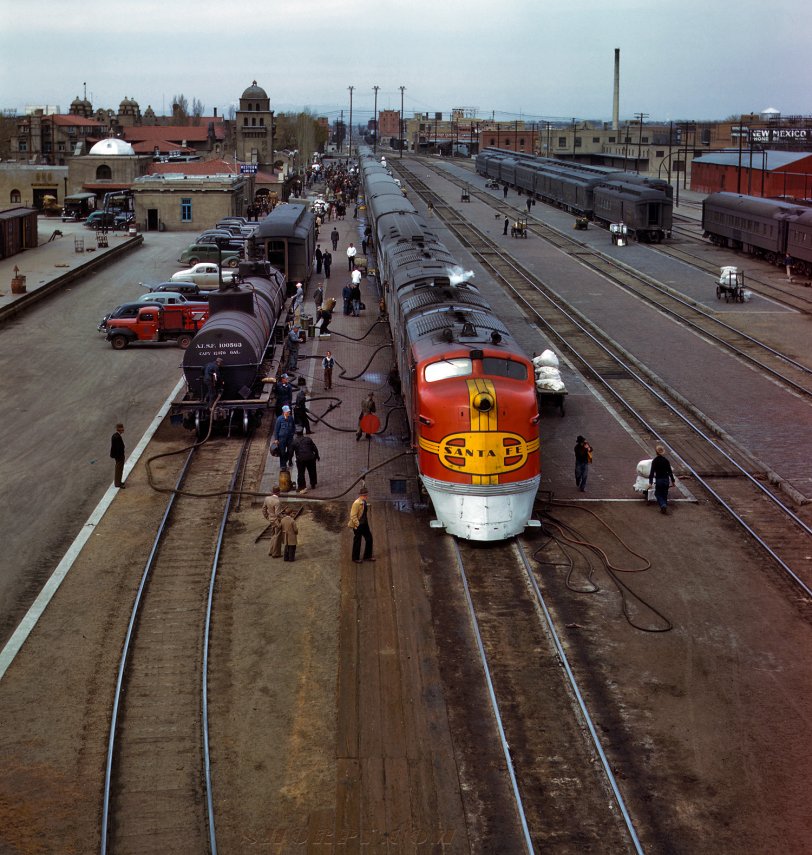
This made me think of that ATSF color picture where they are fueling and watering the units during a 5-minute stop. ATSF used tank cars and hoses as the source!
Gidday Tom, I had expected to see an above ground tank in the Dome Gas photo, but then I had expected to find more photographic evidence of rail served bulk fuel dealers, full stop!! (I even got to inspecting photos of road fuel tankers at fuel distributors, in case a tank car was in the back ground.)
I’m guessing that in the early 20s there was only one octane rated gasoline for road vehicles, and that the requirement for bulk diesel, gasoline (petrol), and heating oil(??) came later, so by the 40’s there would be the need for three different storage tanks, giving you additional tank cars to switch. Just to complicate matters, (a Bear Thing), would idler flat cars been used between the locomotive and tank cars to negotiate the trestle?
That would be nice, thanks.
During my search, I did come across some modelled scenes depicting what you describe, tank cars gravity feeding the lower level above ground storage tanks.
I apologise for the poor quality of the photo, but I’ve thought that this would make for an interesting scene on a model railroad.