German ICE trip report

I had a chance to take a German DB ICE4 from Nurnberg to Berlin this past weekend.

Route is a mix of high speed and conventional lines. Train originated in Munchen.

From Nurnberg we stopped at Bamberg, Erfurt, Leipzig, Bitterfeld, and Berlin. These stops were typical. There were no nonstops between Nurnberg and Berlin.

Distance was 440k/275m. Time was just over 4 hours. That’s only 110k/70m per hr. Not very impressive. The steam 4-6-4 Class F7 Hiawatha of the Milwaukee Road in 1940 did CHI-LaCrosse of 281mi in 4 hours with a similar number of stops. The TGV does Paris to Bordeaux nonstop in 2 hours covering 500k/310m.

I noticed that while the TGV bypass the intermediate cities full speed (with spurs for trains stopping) the ICE doesn’t seem to have bypasses and they stop at most or maybe all cities in between running over suburban tracks in the city portions.

Note I’ll round all conversions to miles to the nearest 5.

The segment to Bamberg was conventional line with a MAS of 160k/100m per hr. The train was late arriving from Munchen by about 20 minutes. So naturally leaving Nurnberg we immediately got stopped by signals as we were out of our slot. But the dispatchers did a good job and we did not lose more than a few minutes more the rest of the way.

From Bamberg to Erfurt the MAS is 300k/185m per hr. But the ICE4s can only go 250-265m/155-165m per hr depending on gearing. I clocked a high of 260k/160m per hr.

From Erfurt to Leipzig MAS is also 300k/185m per hr. Again I clocked a 260k/160m high.

From Leipzig to Bitterfeld MAS is 200k/125m per hr. I noted that at 200k the train hunts a bit. Not unnerving but a noticeable yet gentle rythmic sway. At 260k it did not hunt. Ride at all speeds is smooth and quiet. Seats comfortable. Wide and good pitch. Like a domestic US first class airline seat. On DB I rode 2nd class.

Bitterfeld to Berlin has two possible routes. A more direct and faster routing is 200k/125m per hr. via Wittenberg. We took the longer and slower routing via Dessau with a MAS of 160k/100m per hr. Why I have no idea? Maybe track work? Although we didn’t seem to lose time so maybe that’s its normal routing?

One difference is that the line via Wittenberg arrives in Berlin from the south naturally while the round about route via Dessau arrives in Berlin from the North.

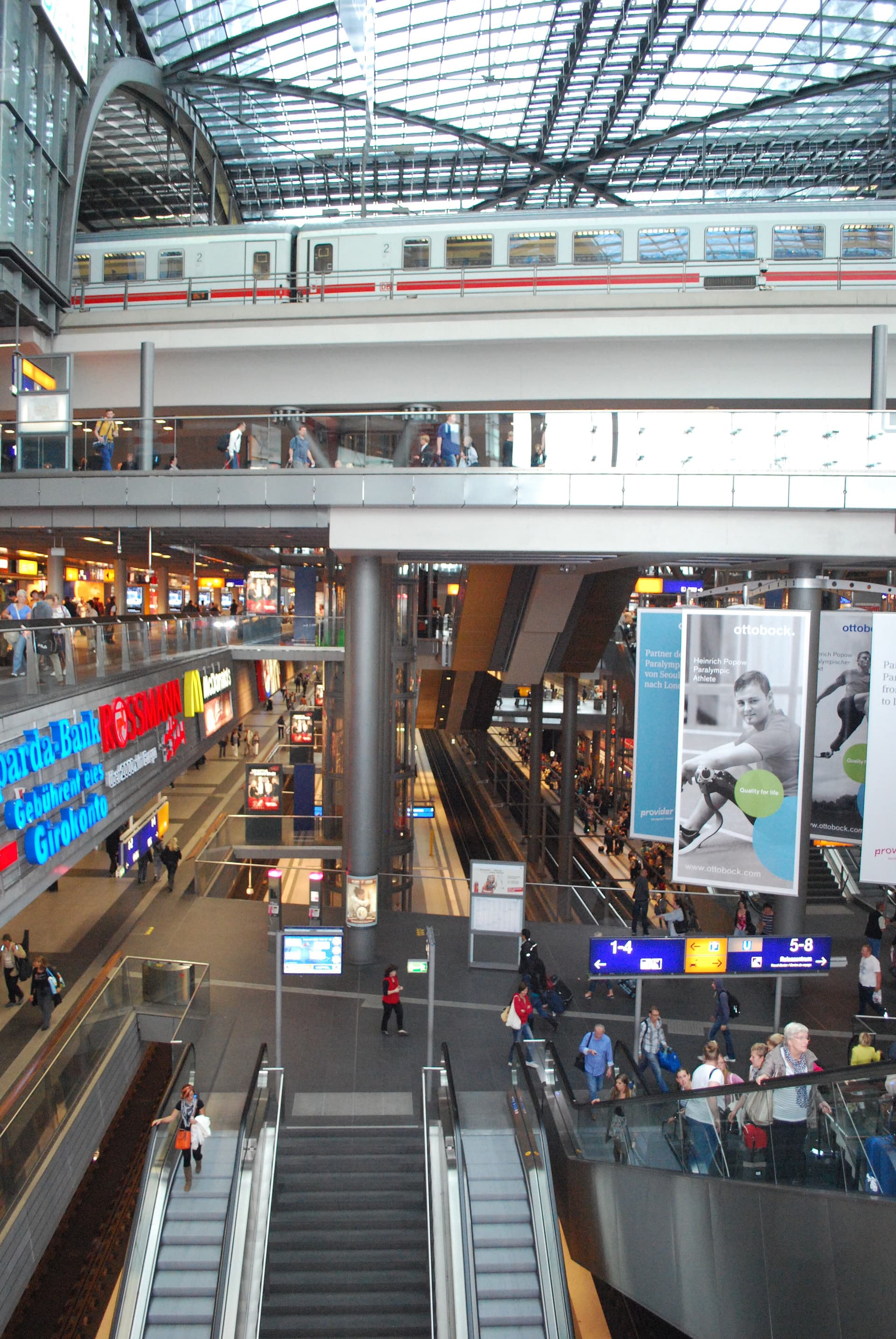
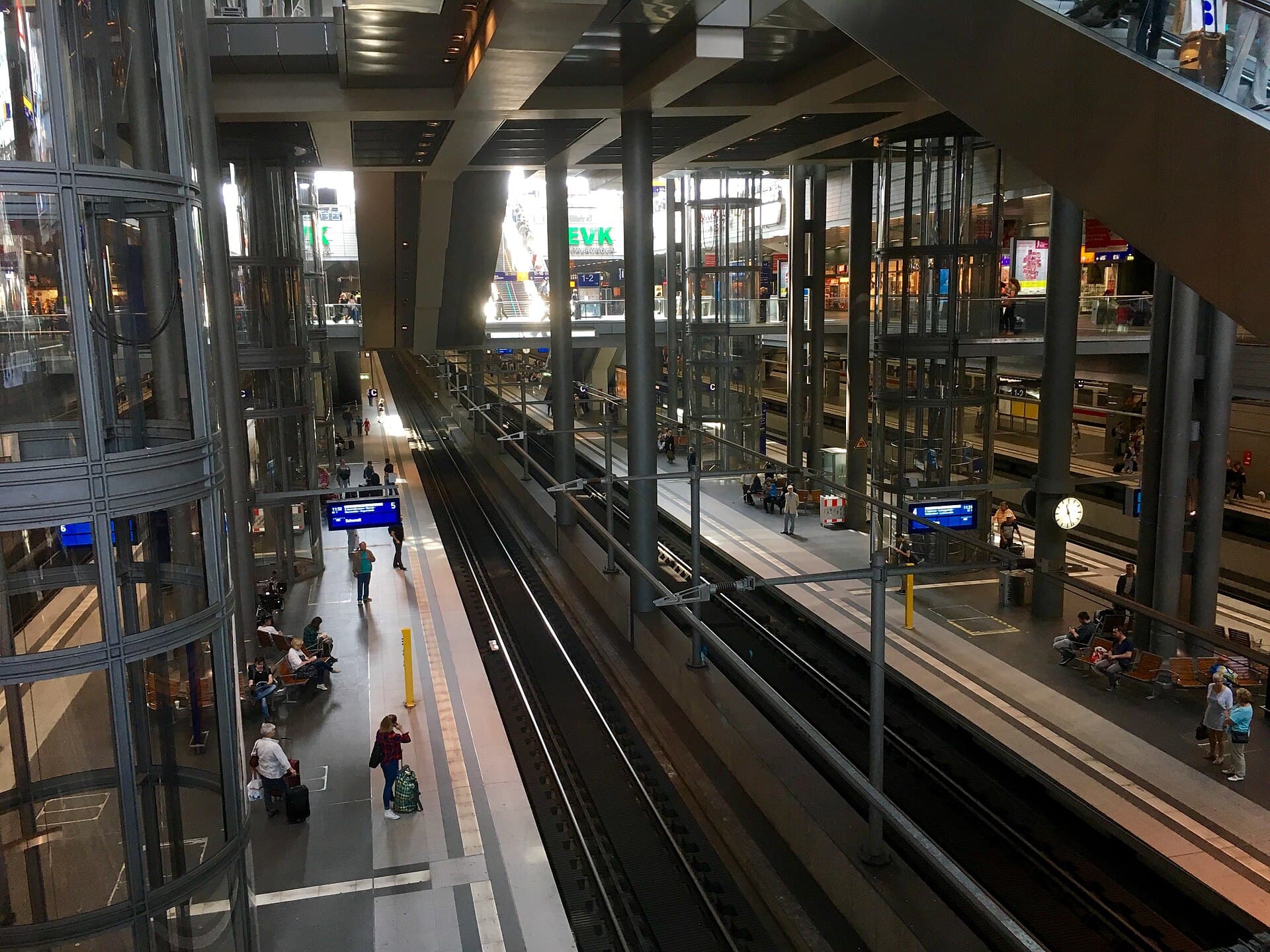
One thing any train enthusiast should see in Berlin is the Hauptbanhof (main train station). Very new (about 2000) but the most impressive train station I’ve ever seen (although I’ve not seen the train stations in China that I hear are also spectacular).

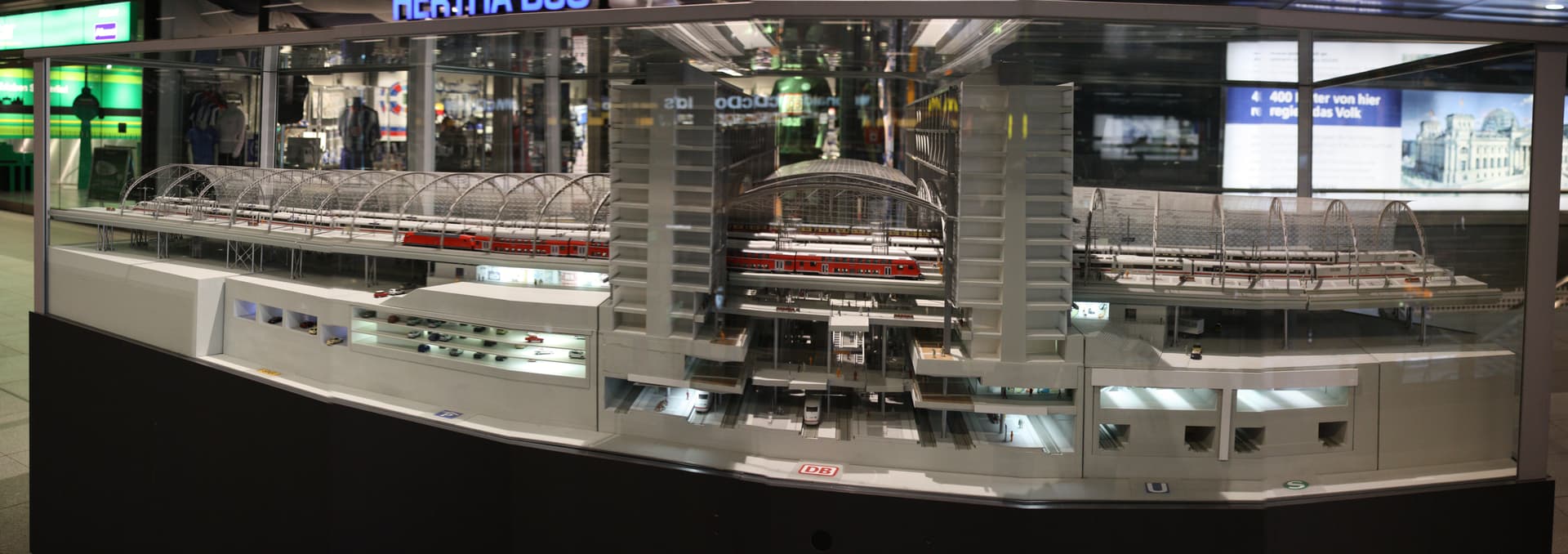
Here are a few pics of the Berlin Hbf including a model that shows the scale of the place.


1 Like

nificantly higher than France’s, with Germany having roughly 240-241 people per square kilometer and France around 122 people per square kilometer. This means that Germany is almost twice as densely populated as France.

There is another difference. France is centered around Paris, all power is concentrated there. Berlin isn’t an equally powerful center in Germany and it is far of the geographical center.

While high-speed lines connect cities with Paris in France in Germany the higher and high speed lines connect cities with each other.
Federal states have to give their OK for all building projects of DB in their state and they use their power to get intermediate stops on high-speed lines slowing down the average speed. Which happened on the line Munich - Berlin with the intermediate stop at Erfurt, a detour of 90 km (56 miles) from the direct route.

Dessau and Wittenberg are both served alternatively which may be restricted due to construction sites.
Regards, Volker

1 Like

I might add one impressive thing in Germany is the amount of trains. For a car obsessed country (no speed limits on the autobahn are a thing more sancrosant than religion) this surprised me. There are a bewildering variety of options one can take to get from A to B within a metro area.

U Bahn Subway. S Bahn above ground to nearby suburbs. Regional suburban trains to outer suburbs and nearby cities. Plus local street trams everywhere. Service is very good. Frequent. Pretty clean. I’d say better than anything in the states.

And one fare system for all. Just goes by ring like zones radiating out from the city center. ABC.

Two types of Regional services: RB (Reginal Bahn) many stops
RE Regional Express, fewer stops

In both cases, Regional trains go well beyond suburbs, some as far as Berlin to Stralsund, for example, 154 miles Also Regional trains are eligible for riders to use a Land Pass or Deutschland Pass.

There are also trains run by private operators such as FLIX Train or ALEX or Westbahn. Older equipment, slower, cheaper similar to the old Interregio trains.

Are they publicly subsidized or self sufficient? Sincerely asking.

Quasi-govrrnment company.

Does that mean it draws revenue from the general population tax base or revenue comes only from fares and fees charge to its riders?

Local public transport costs around €25 billion annually. About half of this comes from passenger revenue, with the other half coming from tax revenue.

Public transport is regulated by various federal and state laws.

In Monheim am Rhein, public transport is free for residents, and in Augsburg, it is free for everyone in the city center.

Other cities have also tried to encourage people to switch from cars with free public transport. However, they have abandoned this idea for cost reasons.

From a legal perspective, public transport in Germany is part of the public service provision.
Regards, Volker

2 Likes

Subsidized. Just like the highways/autobahns. I saw no toll roads in Germany.

There are toll roads in Germany, but only for trucks with a total mass of 3.5 tons or more on all freeways and federal highways.

The recording is done automatically via an electronic onboard unit, which records the route based on a combination of mobile communications (GSM) and satellite positioning (GNSS).

Toll bridges check whether vehicles are subject to tolls, whether the OBUs are working, and whether the weight and number of axles of the trucks are correctly recorded. The entire process takes only a few seconds without disrupting traffic.
https://company.toll-collect.de/static/media/bilder/maut/autbahn-kontrollbruecke-verkehr_pageintro_corporate_16_9_1200x675.jpg
Detail: https://company.toll-collect.de/static/media/bilder/maut/sensoren-kameras-kontrollbruecke_gallery_16_9_543x305.jpg

A few tunnels, such as the Warnow Tunnel in Rostock and the Herren Tunnel in Luebeck, are subject to tolls for cars also, otherwise there is no car toll. But there are alternative routes for the tunnels.

Nevertheless are German freeways and federal highways tax financed. The toll isn’t even high enough to pay for the damage reucks cause.
Regads, Volker

1 Like

I am looking forward to that eventually changing…

BUT go back to some of the arguments presented recently in the trucking thread. Were trucks to be tolled in true proportion to the marginal damages they cause… the additional costs, probably with some agio or profit or vig added, would be passed along to ‘consumers’ in the usual ways, and this might be viewed as less desirable than inherently subsidizing trucking under the current model. It would be highly interesting to see how the toll arrangements were decided upon.

Does Germany have a gasoline tax or other measure of road usage.?

I think the difference between roads and trains is that roads provide increased mobility in that you can drive on any number of pathways, even drive right up into your driveway. A true public infrastructure. The routes that trains run are way more restrictive and more niche-ish. More useful for the people who actually live on the routes. But Germany is pretty densely populated so the track network probably reaches all kinds of nooks and crannies of population.

Danke!

I’m not so sure that roads always provide more mobility than trains. First off I can easily walk to a train station up to a mile away. Do it all the time.

Second in many countries trains are a lot faster. People I meet in countries with fast trains think nothing of taking a day trip to destinations up to 250 miles away. 4 hours max round trip. In my entire life I’ve only once tried to drive to a place 250 miles away and back in one day. Driving alone took 8 hours of that day.

Flying is no longer an option for day trips. Some coworkers and I from Chicago once had an afternoon meeting in Cincinnati that could not be done by video. I flew. Some drove. I got back home later than the guy who drove.

If they had to pay the true costs of the wear and tear and pass on to consumers the railroads could gain a competitive edge. As this is a rail forum we should all favor that but I know it won’t happen and flags will appear like lemmings!

1 Like

Germany levies an energy tax on all forms of energy, which varies depending on the type.

For gasoline, it amounts to approximately $2.75/gallon. In addition, there is a 19% value-added tax. At today’s gasoline prices, the tax share is approximately 61%.

The problem is that the taxes are not earmarked for road construction but disappear into the general budget.

The German rail network is an open access network. In addition to Deutsche Bahn, there are currently around 350 other rail transport companies operating on German tracks.

All of them book slots for their transports and pay track access charges to DB InfraGO AG, which is now completely independent of DB transport companies. Additional funding comes from the federal government.
With the overall approach of the Service and Financing Agreement, the federal government no longer finances individually defined measures and investment programs, but instead makes its infrastructure contribution available to the railway infrastructure company for its own use.

DB Fernverkehr, DB Regio, and DB Cargo do not receive any subsidies; they must finance themselves from their revenues.
Regards, Volker

2 Likes