Was there graffiti on trains in the 1950’s? [}:)] I never see any layouts with graffiti on freight cars that is set in the 1950s.
I would agree with that assessment. Back in the 50’s “artists” had to work with brush and bucket. Trains were not the easy targets they are today. Just think about how many more employees were around back then.
not much in the way of spray paint graffitti as such. However, cars were marked with chalk to show switching locations, and some railroad employees would add their own signature or trademark drawing. One signed “Herbie” with a sombreroed guy under a palm tree was chalked on hundreds of freight cars, don’t remember the years for sure. And there was a Frimbo somebody. Remember reading about them in 1950s Trains magazines and “Railroad Man’s” magazine…
1 Like
While graffiti wasn’t as prevalent, it was definitely there–but typically done with chalk or charcoal rather than spray paint. “Kilroy Was Here” and various hobo signs would appear on cars occasionally. I have a couple of old decal sets with circa-50’s “graffiti” which includes a “Kilroy” and some hobo-appropriate markings.
2 Likes
I have lived along the SP in oregon during the 70s thru the early 90s and have viewed a lot of Grafitti over the years. It didn’t seem to erupt until the 'Gang" culture spread out of LA and the need to leave ones mark as a territory boundry became a gang necesity. Before the artsy bad spelling blotches of the modern era, grafitty seemed to be small and personal. I remember specifically the well chalked signature of “Water Bed Lou” I have always wondered who he was and how he came to put his signature on so many RR cars
Jennifer
1 Like
Some cars were chalked with “BOZO TEXINO” and J B King esq.
Graffitti hasbeen around for thousands of years (look at Pompeii), but until the advent of spray paint, it was all pretty much subdued. In the 1950s, taggers were limited to chalk, rocks, or cans of paint and a brush.
Chalk marks on freight cars aren’t technically graffitti; they’re yard crew shorthand for car routing information. For the 1950s, chalk marks should be on just about every car on your roster. Sunshine and Westerfield make decals of chalk marks, or you can make your own by using a VERY fine line paint pen, marker, or artist’s pencil.
I’ve actually seen more 1950s graffitti on engines than on freight cars, with the crews naming a specific engine or picking on a specific crewman. Writing on a smokebox front with a piece of coal, or cleaning the soot off the tender side seems to be especially popular. I’ve got photos in my collection of OC, P&PU, PRR, and NYC engines with crew graffitti on engines.
1 Like
I thought this was an interesting question. From my limited recollection, I’m guessing that the modern “graffiti movement” didn’t really start taking off till the late 60’s & early 70’s. Now it’s so common place but I don’t remember seeing hardly any photos out of the 50’s where there was graffiti on rolling stock. Good thread. [:)]
Tom
From the Railroads of Madison County memory pages:
In days gone by, maintenance workers marked a car good (or bad) with a chalk mark or initials. Over the years, some of these marks became drawings and were notable and recognized nearly everywhere trains ran. Of course, some marks were put on the cars by others and varied in content. This was long before today’s ‘Taggers’ took to painting the sides of hoppers and boxcars with their ‘art’.
One of the best known of the Boxcar Artists was Herby and his mark was seen on cars coming through here. It is my personal favorite and I created this black and white from a photo of his mark.
The boxcar artist known as Herby passed away 12-9-95. His sketch depicting a character wearing a sombrero sitting under a palm tree has adorned the sides of thousands of boxcars. His memory lives on as other artists are rebuilding his older sketches that have faded and memorial sketches are now starting to circulate.
Enjoy and remember!!
- Copyright 2003 Roger Hensley -

Do you guys actually know any of this or is it all just off a whim? Because I’m trying to do a social studies project and I need to make sure that all my information is accurate.
1 Like
Welcome Aboard, @DRAG0NL0RDx
Uh… thanks?
Welcome on board, DRAGONLORDX.
Here in the U.K. graffiti was virtually non-existent. Putting paint on buildings or vehicles was just not done. Property was respected and causing damage however caused was frowned on.
It was only from the 1970s that graffiti was seen around.
You’re not expected to know this but apart from Anonymous, the posters to this thread are what I’d describe as “serious” modellers, and I wouldn’t suggest the information is merely a whim.
That said, I personally like to have at least three independent sources when I’m researching a topic.
Good luck with your project. Perhaps, you’d post it here at a suitable time?
Cheers, the Bear. 
2 Likes
@DRAG0NL0RDx, I completely understand your frustration. Comments on forums like this rarely provide evidence. Also, while the Internet is accumulating more and more information, search engines are not evolving in the direction we want them to.
For your reference, I have translated the glossary I compiled for Japanese railroad fans and will show you.
my Model Railroad Dictionary 5
[Graffiti] In the early days, it was just chalk, but spray cans began to be used in the late 1960s, and it expanded around 1980. Railroad facilities and rolling stocks were also targeted, especially the New York subway (Kotobank “Graffiti Art”). It is said that in the 1990s, due to the effects of citizen movements and security, it moved from the city to the suburbs and railroads (Wikipedia).
Freight cars, which are difficult to reach and have long stop times, became ideal canvases, and large-scale graffiti appeared. Some people accepted it as a scene and culture, and decals became commercially available. See page 48-53 of the Sept. 2006 issue of Trains magazine, and page 28-55 of the Jan. 2020 issue of MRH-RE magazine. The first full-side drawing model in MR magazine was on page 138 of the Sept. 1994 issue.
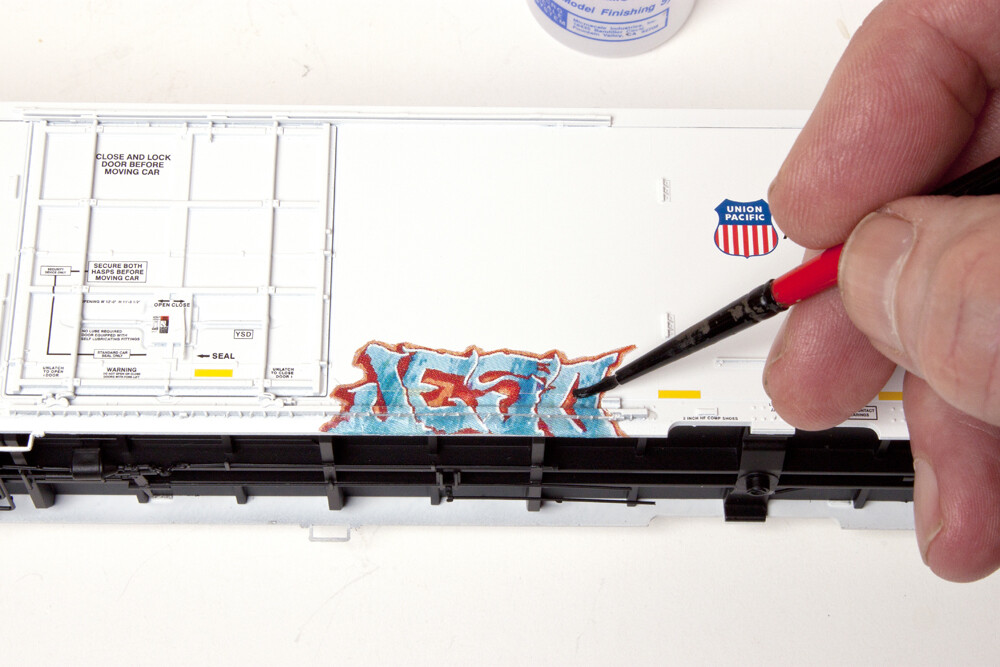
The image is from an explanatory article in MR magazine (Dec. 7, 2022).
The line drawings are made with chalk or marker and are called “scribblings” or “tagging”, and originate from hobos (America Obscura).
The famous “KILROY WAS HERE” (Wikipedia), which appeared at US military facilities during World War II. Many of the drawings were made by railroad workers, and some of the more well-known classics include “BOZO TEXINO (Bill Daniel’s website)”, “J.B. King Esq.”, “WaterBed Low”, “Herby” from the 1970s and 1980s, and “Colossus of Roads (RRPictureAchives.NET)”. In the late 1940s, Champ and Walthers sold decals. See Trainorders.com.
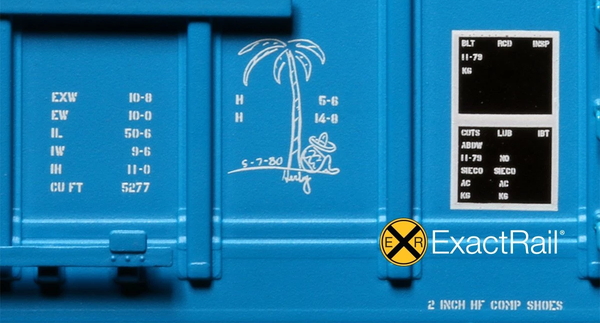
In the 2010s, ExactRail painted them on their finished models (image taken).
Related terms: [Spray] [Rattle Can] [Weathering] [Decal] [Vandalism] [Tagging] [Herbie Safety Slogan Car] [Hobo] [High Numbers]
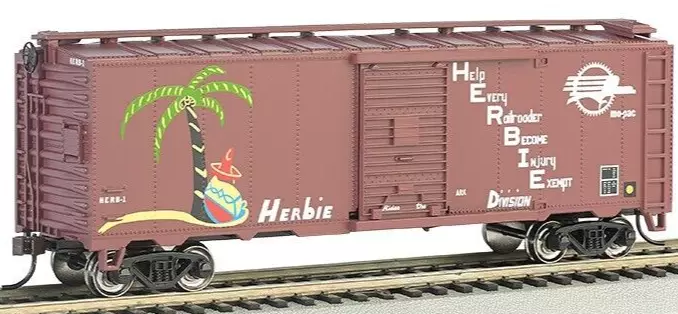
[Herbie safety slogan car] refers to a box car on which the Missouri Pacific Railroad (MoPac) painted the phrase “Help Every Railroader Be Injury Exempt” as a railroad safety slogan in 1979. UP, which absorbed the railroad, also made a box car with the exact same design in 1983. Herbie was originally spelled Herby, and was the subject of graffiti that one railroad worker continued to paint on freight cars. See TrainWeb.com. Models are available from various companies. Image is of Bachmann products.
4 Likes
This link may have more weight for your research:
I first learned about “J.B. King Esq.” from an ad. About 50 years ago, a whiskey company had full-page ads with a painting of a hobo and the story of the famous “JB King”, including an apparently old poem. I only recall the start:
Who is this fellow, J.B. King
Who writes his name on everything?
3 Likes
Thank you very much I really appreciate it.
2 Likes
If you’re in the Midwest, Graffiti is very common on railcars (rarely locomotives though) especially in Des Moines, near the East Des Moines IAIS/UP railyards
Please forgive me for making a statement that does not fit the title.
Atlas is selling 64’ Trinity Reefer UP cars with the annotation “High Numbers”. Is the following explanation correct?
[High numbers] refers to the reporting mark and car number of a freight car written high up on the side of the car body. UP started implementing this on white reefers around 2020 (?) as a measure to prevent the previous low-positioned markings from being covered up with graffiti and becoming invisible.
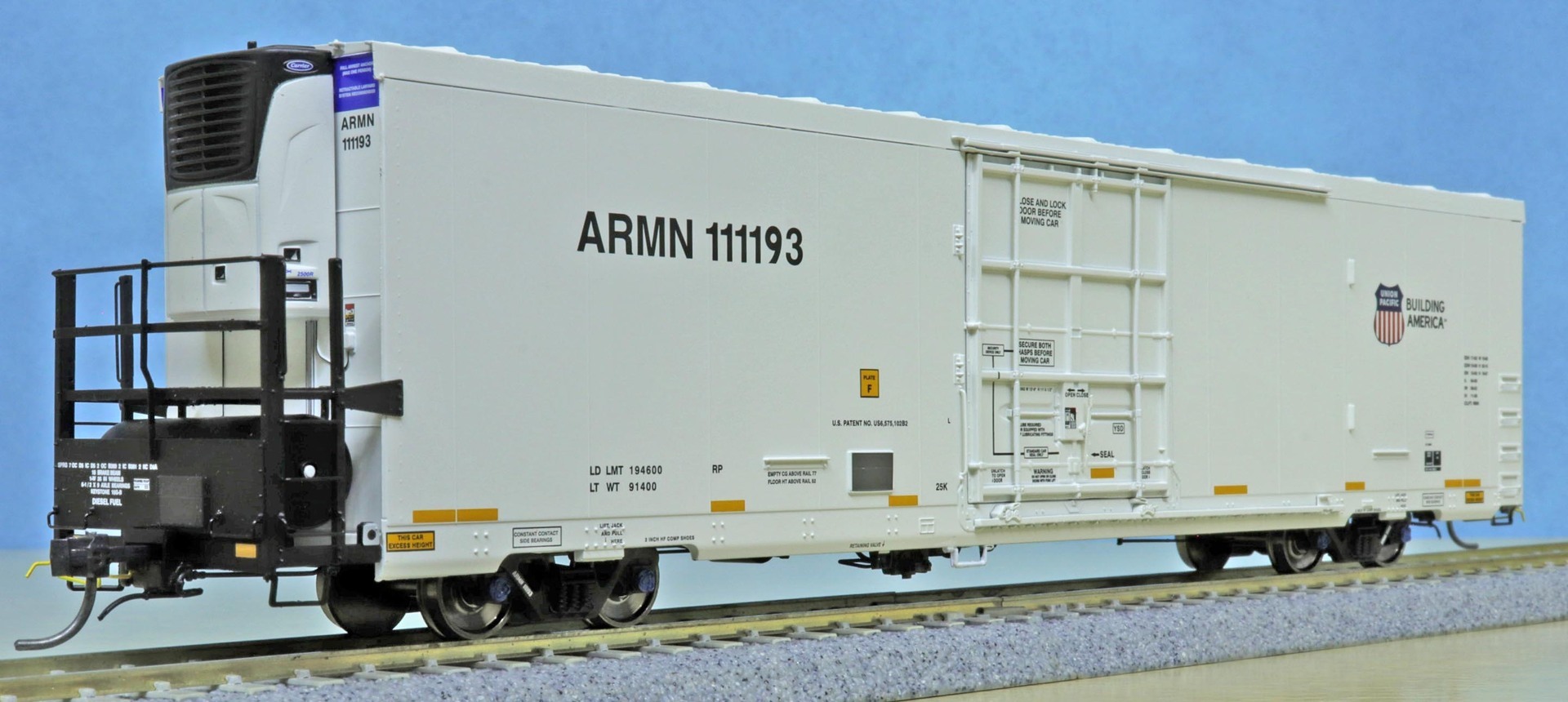
Atlas Master item#20005284
1 Like
Send it over her. I bet I can reach the high numbers. 