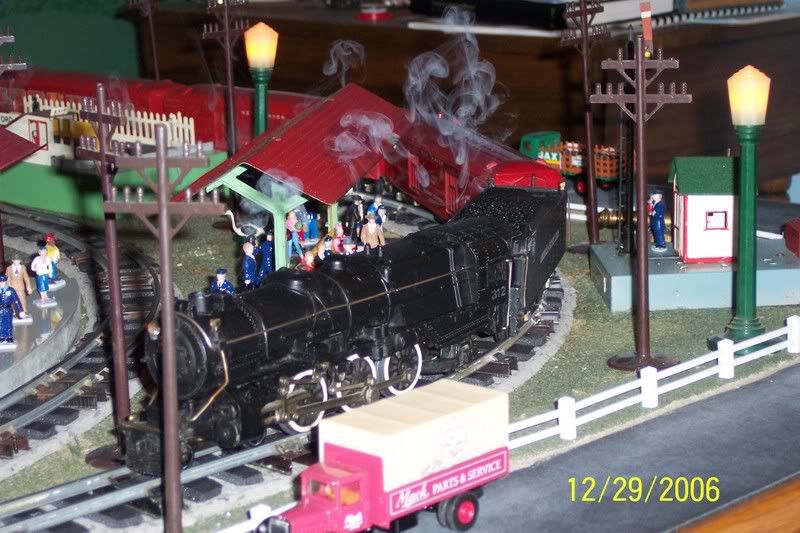
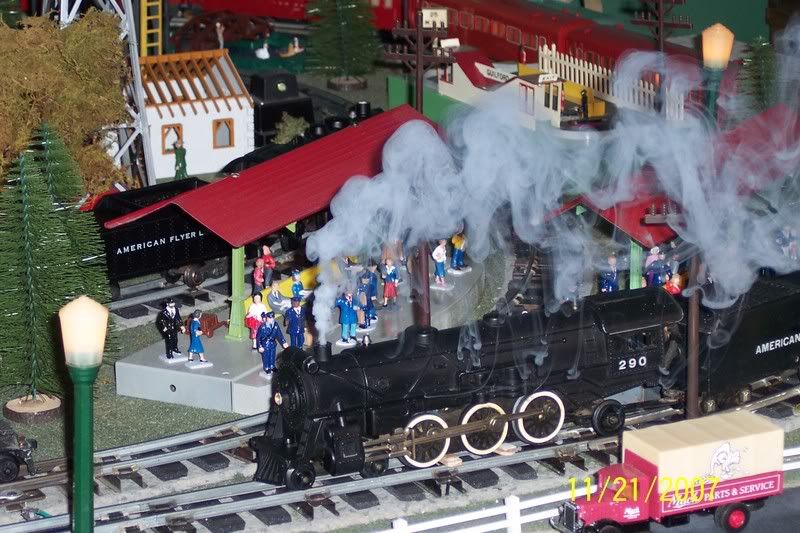
I just bought a buncnh of old am flyer from someone. Included was a steam engine #312 and a gp-7 # 370. When I put the 312 on the track I am getting a humming noise from the tender, I traced the wires out of the tender so I checked them with a voltage meter and they are giving juice to the loco, my thought was that the motor wasnt getting any power. as I was touching the wires leading into the back of the loco I would frequently get a small spark and the train would start moving for a split section but I cant figure out what it is that I touched to make that happen, hopefully someone knowing their stuff could school me on this.
On the 370 diesel switcher, when power is applied the lights work and the reversing unit clicks as I believe it should but once again im not getting any motor movement. These engines are I believe from the 50’s and I dont know how long they been in storage, could it be dirty connections somewhere? anyway I am really stuck and I cant seam to find much help online. If someone could helkp me troubleshoot I would really apreciate it, even if someone knows of REALLY GOOD LINK. Thank you
Of the “this train doesn’t work” scenarios I’ve had with just a humming unit the e unit usually needs attention. First find out if the trouble is in the loco or the tender. This is my usual sequence of events on the 312 and similar locos
Separate the loco from the tender. There should be a jack panel between the two and you can disconnect them.
Turn the loco over and role armature with your finger. It should rotate freely and the wheels and linkage should move.
If they do not
i. check for binding in the linkage
ii. Remove the lower grease plate and clean out the old dried up grease around the gears.
If they do move direct wire the loco by:
i. Put a jumper between the center two sockets in the jack panel
ii. Put a lead in the sockets on the extreme left and right socket in the jack panel
iii. With test leads attach a variable voltage from your transformer to the leads inserted into the jack panel
iv. The loco should run if the wiring is OK; if not start investigating the wiring
If the loco now runs finish cleaning the old grease and re-lube using just a little grease and oil and now focus on the tender1. Take the tender shell off the frame
Apply low voltage ~ 8v to the tender and watch the reversing drum; it should rotate with each cycling of power
If all it does is hum
i. Find the coil in the reversing mechanism (it will be towards the back of the unit) and manually cycle the drum by pressing and releasing the little plate under the coil. This should rotate the drum.
Clean the moving parts with an electrical cleaner that is plastic compatible. Radio shack has a good product as well as CRC 7-36
Pay particular attention to where the e-unit pawl goes through the side frame of the unit. Sometimes they with stick where
I was playing with tdrum and the fingers touching the drum, I noticed that the fingers in some spowerent touching the drum due to them be a little bent. I bent them so they now touch and then I noticed when the top 2 fingers touched eachother before touching the drum, the loco would run in forward. but I dont believe the drum is rotating in sync because I have to turn power on nd off like 4 to five times for the loco to get back into forward and start running. butI still cant get a reverse out of it. Do you have any ways that I could fix that because when it warmed up in reverse it ran very strong and the smoke stack was amazing, it pumpeed out alot of smoke and I didnt even refill it. Could I use lionel smoke fluid in the af or use seuthe fluid?
Now as for the 370 switching diesel, the lights work and the drum seams to rotate freely, after inspecting the motor a little closer I noticed that one side of the motor brushes is missing a brush completedly, would this stop the motor from turning at all? If so what could I use as a substitute brush.? You have been very helpful, do you know of any online tuturials or a site wheer I could get help like this?
The fingers should touch the drum, not each other. If the coil is cycling, (clicking) That is good. You’ve got power to the coil, now you have to correct the mechanical problem of the mechanism sticking. You have the most common AF failure. A sticking eunit. Clean the unit with electrical cleaner, paying particular attention to the moving or what is suppose to be moving parts. As you cycle the power, watch the drum and see if it moves. It should rotate a bit with each power cycle. See if the pawl is releasing or sticking in the up position. If so this is where you can slightly bend the pawl or debur the eunit sideframe where the pawl may of worn a notch. It does not take much to make it stick or to free it up. Usually a good cleaning is all it needs to loosen it up.
The 372 as far as that goes needs the brushes to work. The brushes are the sliding electrical contact to the armature (the part that goes around)
If I were you, I would order a set of brushes and springs for both engines, a set of eunit fingers and some smoke fluid from RFGCO or Portlines Hobbies. Should come to about $15. There is a lot of debate over which smoke fluid works best, but they all work.
yes it does smoke very well, why do you think when I soldered the top 2 fingersso they have the same contact the engine will now run forward but still cant get them to go reverse. does it matter which way the fingers are positioned to touch the barrel or just that they do touch the barrel. Like I said it takes the drum about 4 turns untill a viable connection is made.
The reversing sequence goes forward neutral reverse neutral, so if a set of fingers was not working it would just cycle through the four steps. Look closely at the end of the fingers they should look like a small shepards crook or staff. Sometimes they get worn and do not make contact to the drum.
The fingers are easy to replace. Solder them before you put them on the eunit body.
I did what you said by attactching the 2 middle connections and applying a wire each to the right and left terminal and the engine started running great but when I reverse the wires shouldnt they move in the opistite direction, for reverse. I have a feeling that the fingers are the main problem. what a great smoker this engine is, im am so debating on keeping it as it doesnt look that awkward with my o scale stuff., thank you for all your help and any more that you could offer. A PICTURE OF A CORRECT REVERSING UNIT WOULD BE GREAT.
after further studying the reverse unit I noticed that one of the bottom fingers werent making contact so I bent it some so it would touch and not I could get the engine to go into reverse but I can no longer get the engine forward, which one of the fingers set the forward action. also its not going the way it should (forward, neutral, reverse) It taves a couple turns to get in to nuetral, it also goes in to a vibrating engine position. Is that neutral?
I would say all your problems are with the fingers now the drum is turning. The fingers are delicate and if they put too much pressure on the drum it can prevent the drum from rotating as it should. On all the eunits I’ve messed with, the fingers and wiring is the only things I’ve had to replace. And they are easy. Just make sure you put the correct set on top andon front, notice the position one is offset to one side and the other is centered.
Of the “this train doesn’t work” scenarios I’ve had with just a humming unit the e unit usually needs attention. First find out if the trouble is in the loco or the tender. This is my usual sequence of events on the 312 and similar locos
Separate the loco from the tender. There should be a jack panel between the two and you can disconnect them.
Turn the loco over and role armature with your finger. It should rotate freely and the wheels and linkage should move.
If they do not
i. check for binding in the linkage
ii. Remove the lower grease plate and clean out the old dried up grease around the gears.
If they do move direct wire the loco by:
i. Put a jumper between the center two sockets in the jack panel
ii. Put a lead in the sockets on the extreme left and right socket in the jack panel
iii. With test leads attach a variable voltage from your transformer to the leads inserted into the jack panel
iv. The loco should run if the wiring is OK; if not start investigating the wiring
If the loco now runs finish cleaning the old grease and re-lube using just a little grease and oil and now focus on the tender1. Take the tender shell off the frame
Apply low voltage ~ 8v to the tender and watch the reversing drum; it should rotate with each cycling of power
If all it does is hum
i. Find the coil in the reversing mechanism (it will be towards the back of the unit) and manually cycle the drum by pressing and releasing the little plate under the coil. This should rotate the drum.
Clean the moving parts with an electrical cleaner that is plastic compatible. Radio shack has a good product as well as CRC 7-36
Pay particular attention to where the e-unit pawl goes through the
Thanks for that link. My wiring is identical to the first diagram, the 4-wire example.
Do I place the two transformer leads on the two points on the jack panel where the wires run to the motor? What about the two points on the jack panel where the wires run to the lights?
I am not sure and I don’t want to screw things up.
After posting my response a few minutes ago and waiting to hear back, my wife strolled over to my temporary work bench on the kitchen table and asked what I was doing. I got her involved and she studied the wiring diagrams for a minute and then suggested that I jumper those center two jack panel connections and run wires from the transformer to the other two jack panel connections, just as had been suggested by Sturgeon-Phish.
Voila ! For the first time in 35 years, my beloved 4-6-2 moved. Damn near ran right off the table. As soon as I recover from my state of shock, I will continue to rehab this little sucker.
Just thought that I would keep you all posted.
Thanks.
Rich
P.S. I am sure that I will be back with more questions.
I went back and re-read Sturgeon-Phoebe’s instructions found earlier in this thread about testing the wiring in the tender. He says to apply power from the transformer.
My question is: how to do this? Do I run wires from the transformer to the outer leads on the other end of the jack panel going to the tender? And,
You are on the right track For the loco you jumper the two center posts and apply voltage to the outer posts. As far as applying voltage to the tender, the most direct path is to apply voltage to the rivets where the truck comes through the tender chassis and the wires to the e-unit are soldered. Once you apply voltage to the tender the coil in the e-unit should engage. If not make sure the lock out lever is swung out of the way, if it still does not work take some contact cleaner and spray the coil and drum unit then work the e-unit with your finger where the lock out lever swings. Try applying current again.