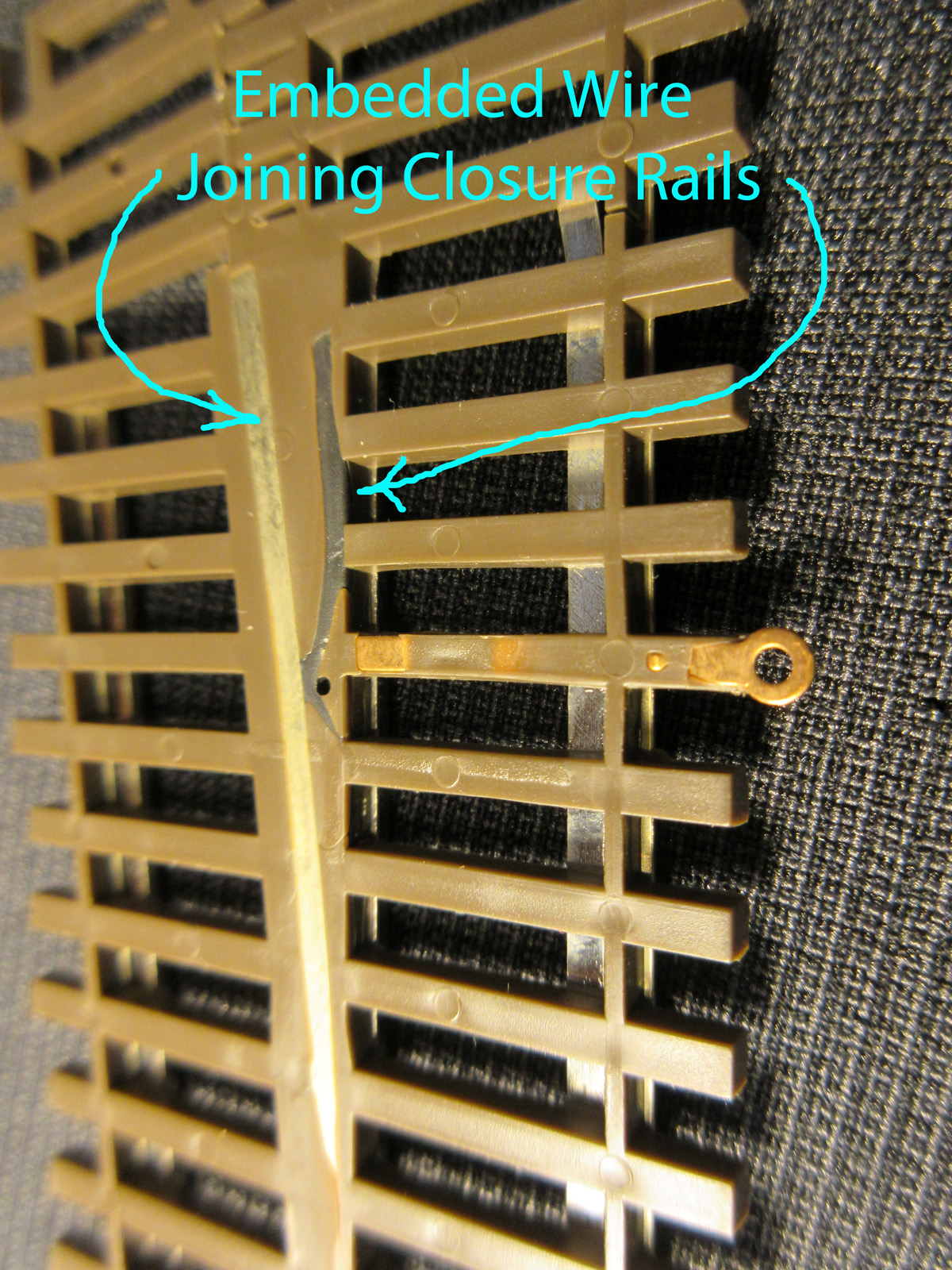
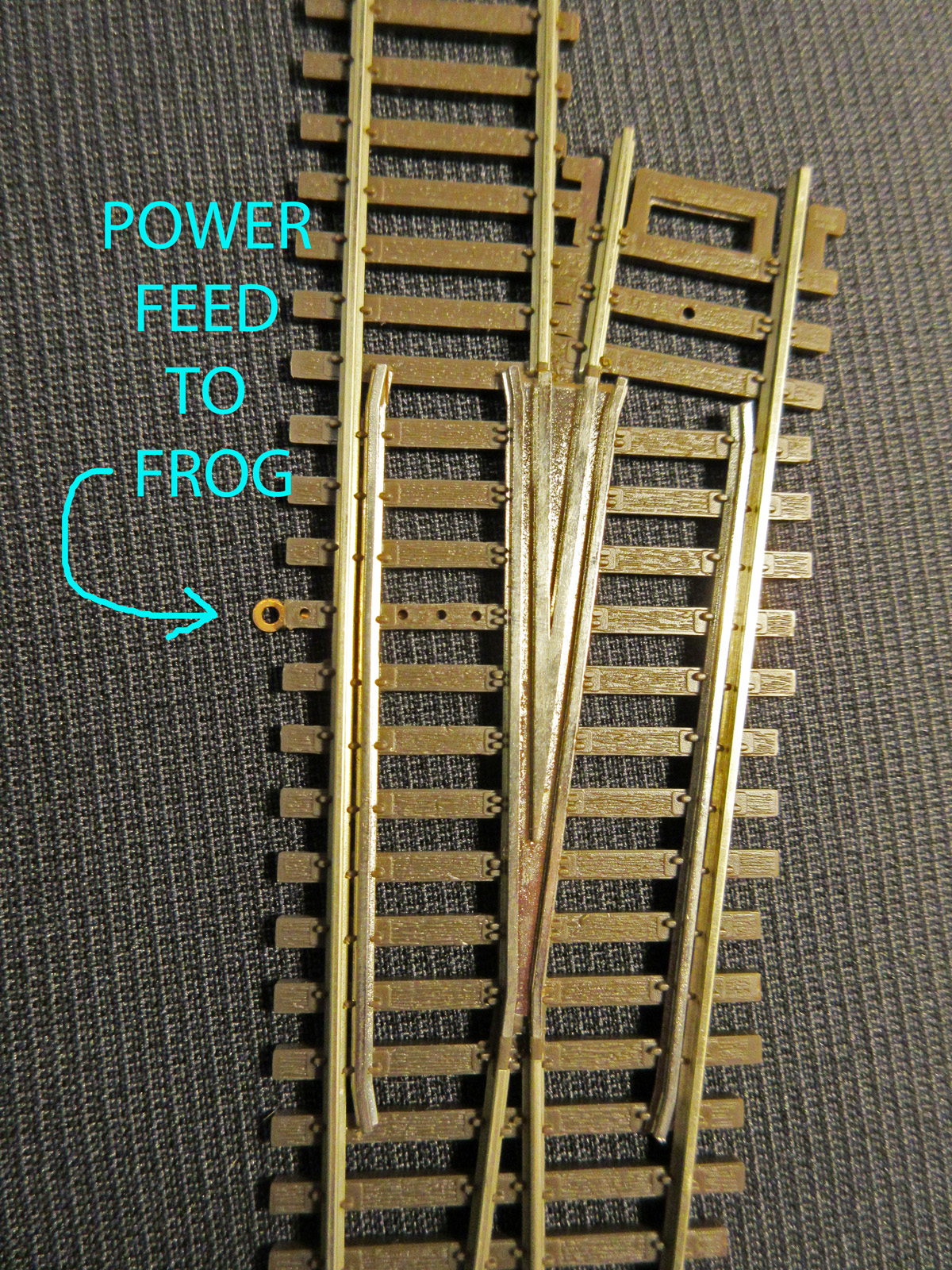
All I can honestly say now is…the turnouts ARE JUNK now…why on earth would You drill holes through the frog? There are jumpers under there, which is really a solid piece of rail with notches so they fit over one another, insulated by the thin plastic injected into the mold. That last photo, if you look at it…the frog is not longer sitting flush with the nubs that hold the wing rails in place…it is pushed into the insulated part where the nubs stop it from hitting the other rail.
All You had to do is solder a wire to that outside brass ring that is on the edge of the turnout…that goes right to the frog. There was no need what so ever, to drill holes in the frog.
I guess in our phone conversations, You did not fully comprehend what I was saying…sad.
I fully understood what you wrote. The turnouts aren’t junk. No matter if you’re no longer able/willing to help.
This frustrating issue has tested my mental capacity. I might just scrap using these turnouts.
it should not take this long to resolve such a simple issue. Perhaps closing the topic helps. No need to continue going round in circles. Either I’m not understanding what I’m doing wrong or there’s an issue with the turnout. Either way, no need to continue. Nothing to see here. Thanks
When I saw the photo’s, I wondered the same as Frank, why drill holes through the frog when Atlas has engineered in a tab for connecting a wire to power the frog.
I haven’t tried soldering a wire to it, but I have read that due to the type of metal, that is not feasible, at least on some of the Atlas turnouts unless they have changed the metal. My understanding is you use a screw to attach the wire rather than solder it.
Judging by the photo, it doesn’t look like Atlas would make an exchange on the turnout which appears to have been damaged/disfigured during the process of drilling a hole.
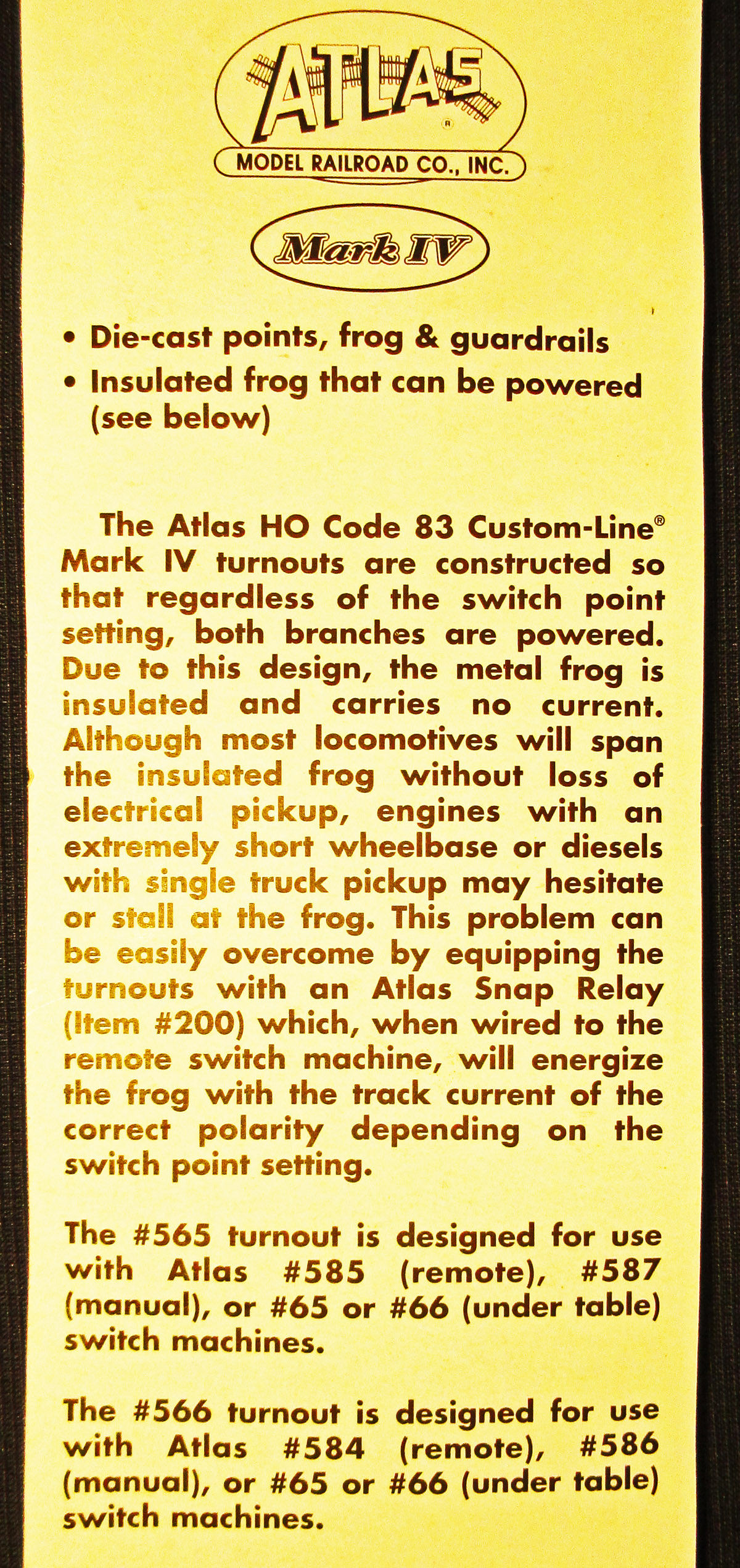
It might be salvaged by the user if it can be made to operate reliabley with wheels tracking across the frog. The issue seems to be how it is powered which by convention should be routed power via a device like a relay or switch machine with that capability.
If the Atlas turnouts are not working out for the OP, perhaps Peco insulf frog would be best as they have unpowered plastic frogs which don’t need any special wiring or considerations.
Do Yourself a favor…slow down. Get (or if You already have one) a multimeter and set it to ohm’s, that is where you put it on some for testing continuity. One probe on the frog, the other on every part/rail of the turnout, done with no wires connected to the turnout at all…like I said above and before. You should not get any reading at all. If You do, like on an analog meter, the meter would move all the way to infinitey, a digital will either beap or show resistance, that means, the frog is touching one of those rails…could be the jumpers imbedded in/under the frog. That is something that should have been done to begin with and I did mention that before. You would have known at the get go, if You had a bad turnout then.
In drilling those holes, You may have done exactly that…drilled through the jumpers and some part is touching the frog. Could even be some scrap metal that the drill bit left in the hole. Do a continuity test also on the brass ring for frog power and touch every part of the rails with the other probe. You should get continuity when touching one probe on the ring and one on the frog, But no where else.
DO THAT AND SEE WHAT YOU FIND…no need to start another thread. I’m just trying to help You out…But you have to start at the beginning…test.
Except that he probably wants #8 turnouts, and those often require a powered frog, particularly for short wheelbase locos. If he moves to Peco turnouts, he should get Electrofrogs since those frogs are factory powered. The only caution on the Peco Electrofrog is that the two inner frog rails must be gapped to prevent shorts.
Although code 83, Peco does make both insulfrog and electrofrog #8 turnouts.
Looking at the insulfrog #8 Peco, the dead part of the frog is probably as short as you will ever see on a turnout that long. Google them and check the images.
That said, it depends on what is going to be run and whether or not the Peco #8 would work as an insulfrog. The OP could buy a just one and run tests to see if it would work.
I am planning on replacing my old Atlas code 100 #6 turnouts in my future staging yard with Peco code 100 large, and have been debating insulfrog vs electrofrog for some months now.
OTOH, insulfrog are simple for wiring, but some report issues with shorting and there is the dead frog. I’ve slowly decided to bite the bullet and go with electrofrog large code 100 Peco for staging.
For the main yard, I’m leaning toward ME code 83 #6 which have a metal frog that can be powered. I did notice a guy on TrainOrders complained bitterly about his ME turnouts 2 or 3 years ago and said he ripped them all out and replaced with Shinohara.
Because of the way Atlas layers the rail through the frog area to make them continuous and non-power routing, what Frank said is true - the one with 3 holes drilled in it is almost certainly ruined and will cause a short just by connecting it to the rest of the track, before a loco even tries to run over it.
There have been several threads on this. It’s been mentioned numerous times that there is no need to try to solder to the provided lug, just use some brass nuts and bolts. That’s how the Atlas Snap Relay connect to the frog - brass hardware and a bar that runs between the hole and the relay, instead of a piece of wire. The flat bar easily runs under the turnout without having to gouge a channel in the roadbed to get it to sit flat, but a pieceof wire would work just as well and could go straight down through a hole drilled int he benchwork to underneath the layout and then connected to any sort of switching device. Snap Relay, Tortoise contacts, Frog Juicer, toggle switch.
There seems to be a need for some basic understanding of electron theory.
Even though you are running DCC understanding how electrons flow is important, especially in this instance of frog polarity.
I recommend getting the book “The Complete Atlas Wiring Book”. Less than $10.00 and, in my opinion, worth every penny.
No matter what system you are using; DC or DCC, understanding the basic principles of polarity will help you understand the problem you have created and how to solve it yourself.
There is also a section in the book of using a solenoid to reverse polarity on Atlas turnouts using Atlas components.
Understanding these concepts will hold true for other types of polarity switching devices- -including Wyes and reverse loops.
I have followed your threads since the first. Like others that have replied I can clearly see where your misunderstanding lies and how it stems from your perception of powering a frog.
As a retired electrician, one of the most difficult concepts most apprentice electricians have is grasping the three way switch; one light controlled by two separate switches.
Until you understand the purpose of polarity based wiring and the reason for switching polarity at the frog; either manually- -with a toggle or rocker switch- -or electronically, I am afraid you will continue to experience what Albert Einstein defined as insanity: “Trying the same thing over and over again and expecting different results.” (I am not suggesting that you are insane.)
Simply pulling power from one pole (one of the bus wires) to power the frog will allow you normal running in either the straight or divergent route but will cause a short when crossing from one polarity to the opposite polarity.
Step back for a moment!
Take a deep breath!!
Please understand all of us on this forum want you to succeed in solving your problem!!!
I’m at a loss for trying to understand why you drilled three holes through the frog.
Doing that guaranteed you made them into scrap. Atlas has no responsibility with this issue. Look at the bottom of the turnout in the frog area. You can see where the two contacts are embedded into the tie plastic that carry the power — under and isolated from the frog — for the two closure rails. This is what Frank and Randy pointed out in their reply on page 1.