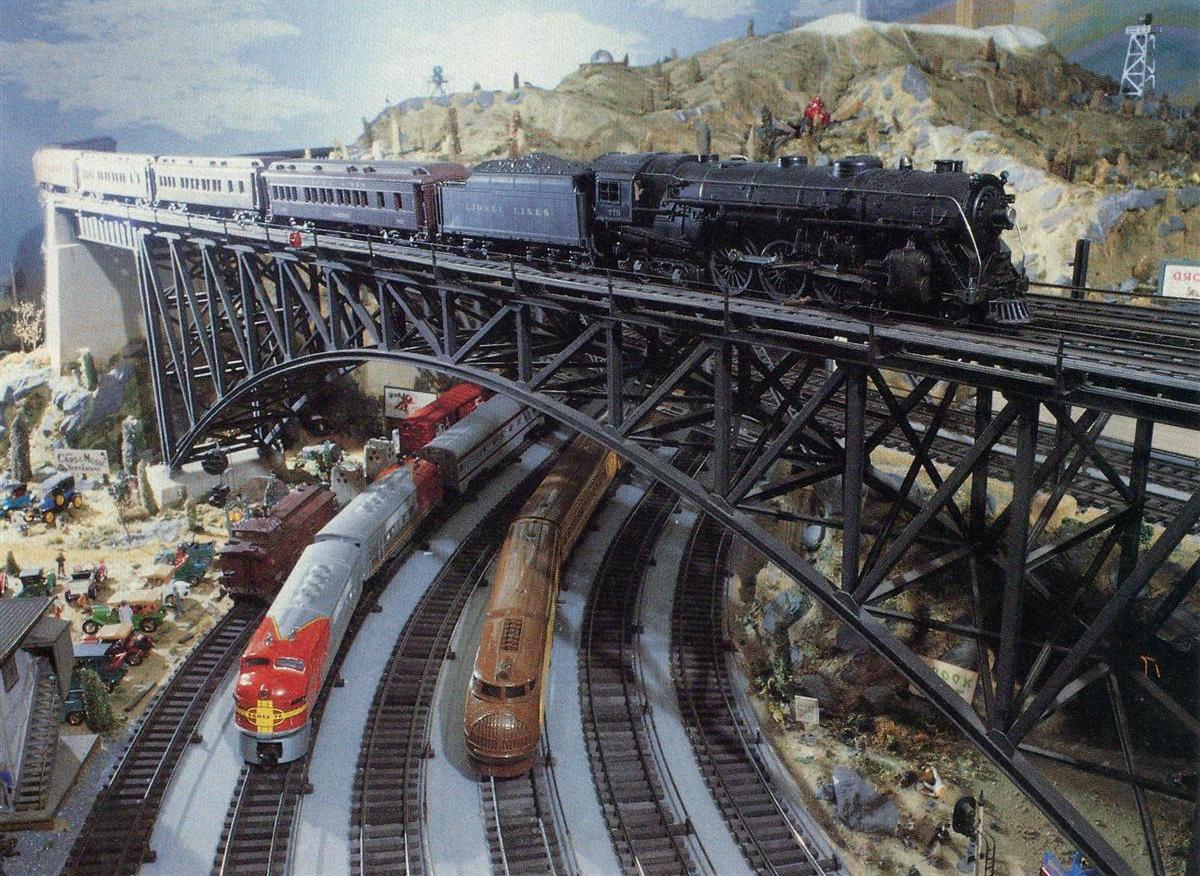
Hi rail modelers strive for the essence of realism even if they play fast and loose with the details and constraints their peers in HO ot N scale find absolutely compelling.
They can live with mixing elements of different eras and regions and have no trouble tolerating some of aberrations inherent with toy trains.
Only because Hi Rail is O-27 and nothing matters as far as detail. They like their smoke,operating crossing watchman,mooing cattle cars,operating search light cars, etc…
What’s not fun about that? Even I enjoy watching the action on a O-27 layout.
That’s kind of the opposite of what I recall of hi-rail. Back in the early '50’s. To me, hi-rail is using Gargraves flex track for wide flowing curves and 0-72 switches for gentle divergence, and having the rolling stock as close to scale proportions as possible. Buildings were often scratchbuilt, and scenery taken seriously. “Accessories” were rare, and those that were used were as realistic as possible.
Something like this:
or this:
Note that the second example has Gen-U-Wine third rail!!!
AND. A load of radioactive material just ahead of the neat model of an NYC caboose. Yikes!
Having previously been inot three-rail O-gauge and a former my er of a HI Rail club, your description nails it. However, being in a club, the tinplate stuff was welcomed too.
I believe the NMRA originated the term hi rail and defined it as the use of scale sized cars and locomotives on tinplate sized or tinplate standards track. Thus the old 1930s Lionel NYC Hudson, 1940s Pennsy 0-6-0 and New York Central caboose, would be hi rail. Perhaps the FM Trainmaster, F3s, EMD switcher, and 6464 boxcars would also qualify. Popular tinplate engines such as the 2-4-2 steamers, 0-27 Alco FAs, 520 boxcab electric, and such, would not. The Lionel GG-1 and Pennsy steam turbine, while impressive models, were far out of scale and would likely not qualify, however much just about any of us would be pleased to have one on a display shelf.
I’d think many of the recent offerings from Lionel, Weaver, and MTH would be hi-rail under that definition of scale sized but tinplate wheels and rail standards.
I don’t think NMRA originated the term. NMRA standard S13 (HIRAIL) was issued July 1957. I saw the term used in a paperback book published about 1951. And it was treated as an established term.
S13 deals mostly with track and wheel dimensions. It makes no mention of track radius, one of the key points with Hi-rail.
It appears that there are several flavors of HiRail.
When I started some 44 years ago the definition I saw was that HiRail used toytrain wheels, couplers, and track (with added ties for tubular track with 3 ties). But otherwise was the same as scale - could be O or S. Use of scale couplers was still considered HiRail. Engines and cars were 1:48 (or 1:64 for S). Smaller engines and cars, whether O27 or not, were not part of HiRail. The layout was sceniced in the same manner as HO scale layouts, but operating accessories were used by some.