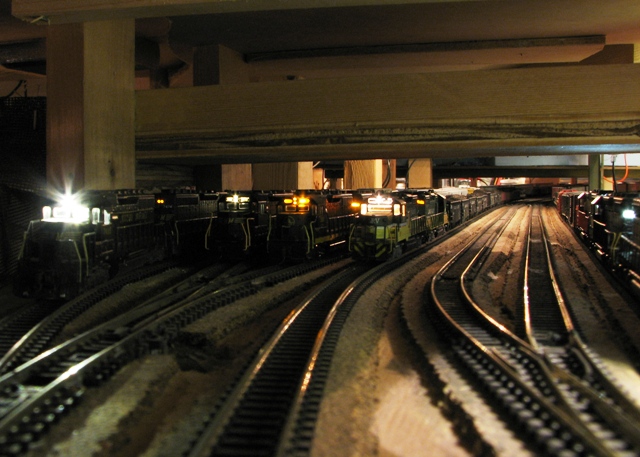
I’ve been busy planning my next layout that will use ME c83, C70 and c55 where suitable. But when I estimate the amount of track in my helix I get scared, their is also quite a lot in the staging yards. So my question is this. Do you guys use a cheaper alternative on hidden tracks? Like for example using Atlas C83 in the Helix would cost about half as much, same thing with the staging yard.
Another question, how does Atlas C83 match ME C83 track?
Someone I know is tearing out a triple-decker layout he worked on for 7 years, in part because he had over 50 turnouts in hidden areas that all started failing at once.
My advice, in that light, is not to go for cheap, but to go for reliable and robust when you’re talking hidden track.
In N scale that would mean code 80 Peco or even Unitrack. The reason is that you cannot afford derailments or turnout failures in hidden track, no matter how “accessible” you think it is.
When a kink developed in my tunnel I replaced it with Unitrack. Never had trouble again. And no one sees it.
In HO, code 83 should be fine; just use the best switches you can. Maybe throw in a few re-railer sections here and there too. Tony Koester uses code 100 track in hidden areas. Why not? Nothing’s more reliable, right? And if no one sees it, it doesn’t matter how toy-like it looks. Heck, if it were more affordable, I would recommend hidden Unitrack in HO too; it’s bullet-proof.
As someone who has been there, done that, may I add…
you might want to use Atlas c100 track in hidden areas. It is a relatively inexpensive quality track, and the bigger rails may help with potential derailments.
put in some Atlas rerailers wherever you can. Again, they are not all that expensive and could stop a mess from happening.
if you must have a turnout in a hidden area, make sure that you can get to it - or at least the switch machine - at all costs. Trust me on this one, I learned the hard way.
all of the above is sound advice but absolutely meaningless if your track is not laid with care and precision and all joints soldered. Oh, and don’t forget to throw in some feeders every 6 feet or so!
On my previous layout I used Atlas & Shinnohara Code 83 track and turnouts in visable areas and Atlas code 100 track and turnouts (# 6) in staging. I also placed Atlas rerailer sections every 6 feet in the staging yard. Great reliable operation.
My new layout is all atlas code 83. (I buy my flex track in the bulk pack of 100) Atlas track is not as finely detailed as Micro Engineering, but is is very reliable. I am building my layout for operation and enjoyment and not for photography.
I use Atlas code 100 for all my hidden trackage (so far). I also install re-railers at each end of staging yards, and in intermediate locations for other hidden track. My “helix” has 24-inch straight sections every half-turn, so each track has a re-railer every half turn:
All turnouts will be hand laid using the Fast tracks jig and will be #8’s. They are as reliable as they could be. Their will be a minimum of them in the hidden part and mostly or only at the staging yards which should be easy to reach.
I’ve used Roco c83 and Atlas c83 in the past and found both to be reliable. They are much cheaper then ME especially the Atlas so in hidden parts maybe I’ll use that. I plan to have NO turnouts in the helix where they might cause problems.
The point about rerailers is probably a good investment.
Agree totally with all of the above. My hidden trackage (all of my trackage so far) is laid with Atlas code 100 flex - except for one back-in staging yard which provides a home for some Italian-made code 100 brass flex at the extreme stub ends and another partially laid with raw rail (some of it brass) spiked directly to a pine board without benefit of ties.
I have used all hand-built specialwork in the to-be-hidden areas, but experience has proven to me that my hand-builts are absolutely bulletproof. I have never had a commercial turnout that dependable - and now I never will.
Note to the above. All of that brass rail is located where it will never be under a powered locomotive.
I’m a devotee of Atlas c55 for my visible trackage, but down in the bowells of the layout, good ole Atlas c80 super flex with Peco streamline turnouts are the order of the day. I also added re-railers at the mid point of each track… probably should have put one at each end…[sigh]
All the turnouts are near the front edge of the layout, so they’re easily accessed from the aisle.
Like the other posters, I recommend atlas code 100 in staging/hidden areas with peco code 100 switches. Mine have been down for several years and have been bullet proof.
I differ with other posters on the necessity of rerailers. I went with the common wisdom and put them in lots of places. They haven’t saved me any derailments (in heavy use). Probably because I was very careful with my installation of the hidden track. The reraliers have a big drawback which didn’t come to light until they were in place for a while: They are hard to clean with conventional cleaning cars. The outside part of the rerailer is higher than the rail and holds the cleaning cars (I use CMX/draggers) pads off the rails. Nothing like a stalled train where you can’t see it or reach it. If I had it to do over, no rerailers.
Magnus,When we added the second staging yard at the club we use Atlas switches and Model Power flex track and we haven’t had any problems…We got the MP flex track on a very good deal…$2.50 each.
So everyone agrees. Use cheaper rails on hidden track. I will go with Atlas c83 there then along with my very reliable hand laid turnouts. Anyone disagreeing?
I will also, and this have always been the plan, use about 36" radius on the helix to maintain good performance. I will never make the track so it’s more then say, 12" away, that will keep problems to a minimum when it comes to fixing things.
Do rerailers get in the way of the CMX clean machine, I love min and can not accept going without it.
I ask because I have alot of Power-loc track, and I could probably use it in a hidden area in a future layout. Also, I’ve actually neve had a problem with that track, unlike the track with the railjoiners.
Magnus, I will echo everyone else, code 100 for hidden staging yards. About the CMX and rerailers, no I run two of the CMX cars in a dedicated work train that gets all over the railroad, including staging, and never had any problems. Those suckers are so heavy, it would take a Sherman tank to derail them I suspect.
Brunton, I don’t see anything between the track and plywood on your helix. Makes me wonder about possible sound effects. Does this create an annoying sound when train running or is it comforting knowing your train is still moving while out of sight?
Bob has pointed out how my post about the CMX might be mis-interpreted. My CMX runs over the re-railers fine, it just doesn’t clean them very well because it doesn’t make good contact.
The stalled trains I’m referring to are smaller wheel base steam hanging up on the dirty track (reraliers) while navigating hidden trackwork.
Bob are you experiencing this problem? Maybe I need another CMX??
I agree with the rest on the Atlas flex. My only question, since you are using code 70, will using 100 be too much of a transition. I only ask this because I have never jumped 2 sizes of track. Maybe Atlas code 83 to your 70 may be a better choice. Do you guys see any potential problem that Magnus may run into?