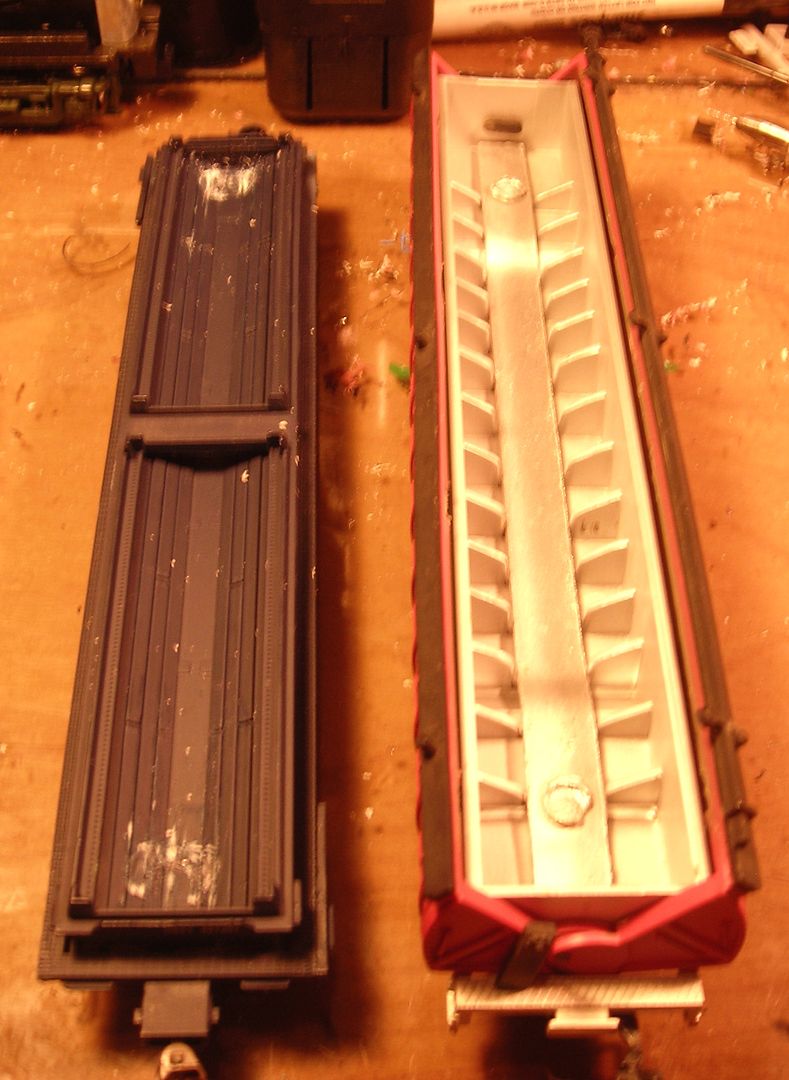
Both the P&LE and B&LE had some of these cars. The clamshells got pretty beat up by the time the crane operators loading the steel coils got done with them, a good idea as the cover did not have to be removed by crane, they were ratcheted down by a mechanism at the end of the car.
Eventually the covers were removed and they were just another coil gon that either had the standard covers or were used in hot rolled steel service.
The AHM/Botchmann Car is not prototypically correct and I have started but not finished a conversion using a Walthers Evans Coil Car and the Clamshell car to make a much better looking car.
The concept is shown in drawings the 1970 Car and Locomotive Cyclopedia; there was more interest then (and in the 1966 Cyc) in covered gondolas of various kinds, not just for coiled steel.
The model itself was, I believe, a Lionel HO item before Bachmann picked it up (as they did the Lionel tooling for the GP30). The exterior is not so unlike the prototype, but Lionel/Bachmann did nothing special whatever for the interior. While the two shells do move and separate on the model I guess the assumption was it would mostly be used with the covers closed.
The really funny thing (think stupid) about these HO coil/cable cars, starting with Lionel though AHM and on to Bachmann, the P&LE #42279 never changed road numbers. The last one I bought at a train show (early 2019) in Maryland, I asked the seller how much? He said ‘‘twenty five’’, I said ‘‘Dollars!’’, he said ‘‘Cents’’, I said ‘‘ok’’.
These are a interesting different heavy looking car, that has a certain time frame to run in, with hoods then without hoods. After we buy and take the time to modify whats out there, a manufacturer will come out with an up scaled version/retooled with a sticker price no less of what we are paying for seven of the old/used version. So far I have not payed over $6.00 for a car, some having very nice trucks and wheels (metal) and body mount couplers (Kadee). Most having truck mounted hook horn couplers and plastic wheels. Some with, some without coil/cable loads. The coils/cables are supposedly enclosed in a wood looking plastic protective crating.