HO Lift Out or Hinge track?

I’ve enclosed some pictures of my developing layout. I’ve completed all trackwork with the exception of the “Lift Outs” or “Hinged Track”. Does anyone have any pics of how they attached their liftout sections or how they may have “hinged” their track?

I have 2 sections, one about 4’ and the other about 2 1/2’.The width is approx. 6 ". The 4’ is too long to be hinged, but the 2 1/2’ could be easily. Any comments suggestions welcome! Thanks…

P.S. The dog was no help to me at all!

These are my personal opinions, based on what was posted in a couple of threads several months back:

First, considerations for (re)movable pieces of railroad:

  1. Positive rail alignment when in place.
  2. Protection of the (re)movable track and any associated scenic elements, in place and not.
  3. Electrical connections to the (re)movable track.
  4. Safety circuits and measures to prevent trains from crossing “the bridge that wasn’t there.”
  5. Protection of fixed scenic elements from damage caused by the moveable structure.

Second, how can the pieces be (re)moved:

  1. Lift out, both ends separate from the fixed structure. (Where do you put it down?)
  2. Hinge up. Hinge pins must be at or above railhead height.
  3. Hinge down. Hinge pins must be at or below the bottom line of the hinged element’s frame.
  4. Swing (like a door.) Hinge pins must be at or beyond the side line of the hinged element.

In all cases except 1, the thickness of the hinged element (or its width, if swung) reduce the width of the passageway. Alignment, locking and electromechanical connections may also reduce that width.

Hinge up (which could work for your 4-footer if there is 4 feet plus between the ceiling and the railhead) protects things on the top surface of the hinged section, but details above hinge line height and close to the hinge have to be watched for interference. Requires something to hold it in the raised position, and possibly something to prevent it from going beyond center and coming down the wrong way on the fixed portion of the layout. (A miniature asteroid impact would not improve the modeled scenery!)

Hinged down is restricted in length (Maximum is from the hinge line to 1/2 inch above the floor.) Track and details on the top of the hinged element are vulnerable and should be protected. Does not require anything to hold it in the lowered position, but may require a more elabor

I know most of what you are saying. I guess I need to be more specific. Does anyone have pics or first hand experience with how they built their liftouts or hinges.
Thanks…

I will get bact to you tomorrow, I have built two “straight double track hinge ups” and two " double track curved (90 degree turns) swing ups. Pictures to follow tomorrow as I am rushed at theis time to go to church, dont like being late.

I see no problem with what you have in your pictures and there are a few ways to go about it… what is paramount is to take a straight edge long enough to rest on both sides to be sure on a level track( a for or five foot straight board will suffice), can be on a grade but track on both sides must be level.

see ya later gotta fly…John

Ken, NZRmac, if he is still online with us, has done a swing gate, and rather nicely. You would find him, for sure, on modelrailroadforums.com.

Ok thanks, I’ll check back then. Ummm its Monday, you are REALLY late for church as yesterday was Sunday.

Hello “Driline,” Take a look at “Build a magnetic lift-out bridge,” by Bill Darnaby, in the December 1999 “Model Railroader,” page 97. Bill’s bridge is about as simple as anything I’ve seen and it works reliably. And his carrise two tracks on a curve! The straight, single-track span you need will be that much easier. Good luck, Andy

Driline. Sorry about the delay and I do spend a considerable amount of time at my church. I run the sound booth as its my second love mixing and blending vocals and instruments with a bit sound effects. We have three services on Sunday, meeting on Mon an Tue with a service on Wed.

Looks like you have all kinds on applications you can do. A swing out (swings to the side) one side will have to be at a angle to close properley, you might have to install more leg bracing? as it may have a tendency to twist, do to the extended side weight as it swings. Never built one so I really dont know…

A drop in could work, but then I elected not to even consider it, as where would a visitor place it, gentley on the scenery? not the people I Know LOL

Your Road your Decision

For the main span I found that a seven ply 3/4 work great with no sag in three years. A 1/2 five ply will sag.

I use door hinges as one they are cheap and secont they work great due to the tight pin and are bullet proof for a light weight of a swing up.

I over cantor the swing up so that it will stay up in an over center position, I like the KISS methods, (keep it simple).I use a furniture screw nut for height adjustment on the non-hinged end. After building four of these to span my doors, I found out a simple cubboard latch works best for the free end latch, has a side to side adjustment and the furniture nut gizmo for height.

Key points…Both sides have to be absolutly level, as cars will uncouple.

No need for the added expense of rerailers.

Back cut span board, top is longer then bottom.

Back cut rails, to prevent binding when opening and closing bridge. If rail are cut straingh, Top to bottom they will bind, lets say the right side swings up and letter o is the hinge the cuts woul look like this //o__________//_________. Also dont forget to cut the board the same way so it wont bind…

You can purchase a micro sw

Andy is this similar to Jim Hedigers article in the “Workshop” August 2006 issue of MR ? If so , it does look like a great idea. I won’t have the wooden base angled joints as I’ve already completed the benchwork portion of my layout, but I can angle the track.

[quote user=“jwar”]

Driline. Sorry about the delay and I do spend a considerable amount of time at my church. I run the sound booth as its my second love mixing and blending vocals and instruments with a bit sound effects. We have three services on Sunday, meeting on Mon an Tue with a service on Wed.

Looks like you have all kinds on applications you can do. A swing out (swings to the side) one side will have to be at a angle to close properley, you might have to install more leg bracing? as it may have a tendency to twist, do to the extended side weight as it swings. Never built one so I really dont know…

A drop in could work, but then I elected not to even consider it, as where would a visitor place it, gentley on the scenery? not the people I Know LOL

Your Road your Decision

For the main span I found that a seven ply 3/4 work great with no sag in three years. A 1/2 five ply will sag.

I use door hinges as one they are cheap and secont they work great due to the tight pin and are bullet proof for a light weight of a swing up.

I over cantor the swing up so that it will stay up in an over center position, I like the KISS methods, (keep it simple).I use a furniture screw nut for height adjustment on the non-hinged end. After building four of these to span my doors, I found out a simple cubboard latch works best for the free end latch, has a side to side adjustment and the furniture nut gizmo for height.

Key points…Both sides have to be absolutly level, as cars will uncouple.

No need for the added expense of rerailers.

Back cut span board, top is longer then bottom.

Back cut rails, to prevent binding when opening and closing bridge. If rail are cut straingh, Top to bottom they will bind, lets say the right side swings up and letter o is the hinge the cuts woul look like this //o__________//_________. Also dont forget to cut the board the same way so it wont bind…

You ca

Hello “Driline,” No, Mike Sullivan’s liftout in the August MR Workshop (it’s actually Mike’s contribution to Jim Hediger’s column) uses magnets only for storage. Bill Darnaby uses his magnets both to secure the liftout bridge in place on the layout and as electrical connections, including interlocks that disconnect the approach tracks when the liftout is removed. I’m sure Mike’s bridge works, but so does Bill’s and it’s simpler. So long, Andy

I am also interested in this type of liftout.
Guess I’ll have to backorder a copy of the the August 1999 issue of Mr.
Are they still available Andy, or can you post pictures of it on here?

Thanks!
TheK4Kid

aka
Ed

Hi “Kid,” Bill Darnaby’s article was in the December (not August) 1999 MR, and the back issue is still available. Click on “Shop,” above, and go from there to order it. So long, Andy

Thanks Andy!

Ed

I have two lift outs and one drop leaf on my layout. Everything said so far is correct, I know this from experience. Here are a couple of photos. Good luck.

Scott

Scott, the hinged drop down looks great! I never thought of having it drop down. How do you attach it when you pull it up? Does it stay in place well?

I also like the lift out with the bridge in it. It looks great too.

Driline

Hi Driline. Thanks for the compliment. Actually the bridge is on the drop leaf. I used non - mortise hinges, the kind they use for bifold closet doors. When I swing it up I push 2 bolts through to keep it there. See the picture below, the view is looking up from underneath the layout. So far everything stays put. The key is to have everything in place, lay your roadbed and track, then cut through the track and roadbed at the same time. Remember to cut at a slight angle to prevent binding. Not a whole lot to it. Take care.

Scott

I received my back issue of MRR magazine from December 1999, there is a very interesting article on a lift-out section using heavy duty magnetic cabinet latches.
A very slick setup, easy to build.
Andy from MRR recommended it to me.
It uses 6 klatches altogther, two on each side to hold down the section, and one on each side for horizontal alignment.
Power is routed through the latches.
Lots of other great articles in that particular issue also.

Ed

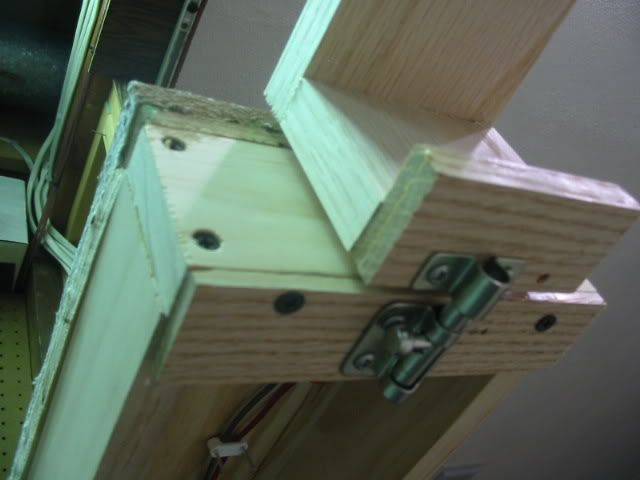
Ok, first of all thanks for all the ideas. I went with Scotts suggestion of a hinged track that opens downward.Only I added a simple slide lock for easy access. Here are the pictures of my completed hinged track section. I completed the lift out as well, but that one was boring. Just 4 bolts and it worked great so no pics for that. I used a 1X4 solid OAK piece of wood to lay the track on. This gives both the 4’ and 2 1/2’ span a solid feel with NO warping or sagging. The lumber was fairly cheap at Lowes. Only 6.98 for a 4’ piece and 9.99 for a 6’ piece. I felt it was worth the extra dough to have a solid piece of liftout/hinged track.

That drop down looks great I’ll probably do the same when I do my mine I like the non-mortise hinge idea.

my only suggestion is for some type of guard rail on the drop down section to keep a derailed train from going over the edge.

bill