I have a small area for an “L” shaped layout; 4x8x4x7 in the corner of my room. I would like to model a shortline and have 2 towns along with a hidden staging yard. I would like to do it in HO but I don’t think it will fit very well in this relative small area. Now I am considering building the layout in N scale. I have never done N scale but it looks like I can do a lot more in this small space. Any thoughts?
In either scale, you aren’t going to want the layout to be wider than 24" except for “blobs” at either end to allow trains to turn around, if you choose to go for continous running vs. a switching layout.
In HO you’d be limited to 22" R curves if you have a max width of 4’, fine for smaller engines and 40’-50’ cars but too sharp for large steam or passenger cars…at least, to small for large equipment to look good, though you might get it to work. If you go to an HO switching layout, you could do a fair amount in that small space.
In N you could do more of course, and still have a continous run. Most N stuff will do an 11"R curve or sharper, but for passenger trains and big engines you’d want to do at least 15"R. You could do that by having the main part of the layout be 16"-24" wide, with two end “blobs” of around 36" to allow for the 15"curves, or around 42" if you go with 18"R curves. N scale will give you more space for scenery and structures.
I’d say if you’re primarily interested in switching cars around, go HO; if you’re primarily interested in setting up one or two trains (esp. passenger trains) and letting them run on the mainline, you’d want to do N.

Here we go! Be prepared to be warned about manual dexterity, failing eyesight, terrible performance and bulky details… N scale, afterall was spawned by Satan himself…
Of course I jest. Lately these discussions have been very helpful and even civil! I just thought I’d get that out of the way![:D]
Anyway, what would really be helpful would be a sketch of the area you’re working in, not just the size of the table top. It sounds like what you have is an L shaped space that’s roughly 12’ x 8’?
The main advantage you’ll find with N scale is that you don’t need your table to be a full 4’ wide. That makes it very difficult to reach the back, and in the corner of your L, you won’t be able to reach that at all, unless you pull it away from the wall to be able to walk behind it.
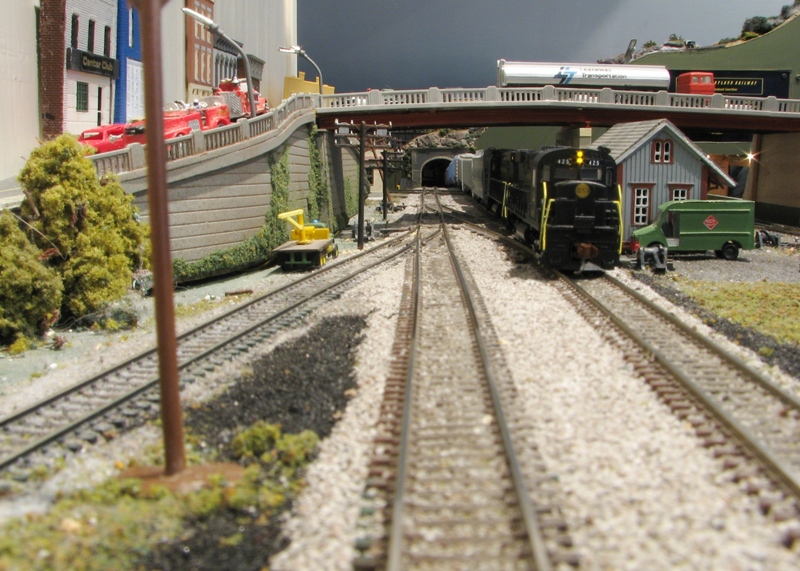
N-Scale will give you more possibilities in your given space, as you can reduce the table width to 36", and still have a reasonable main line run, and plenty of room for scenery and structures. To give you an idea, the area in the photo below occupies about the space that you describe…
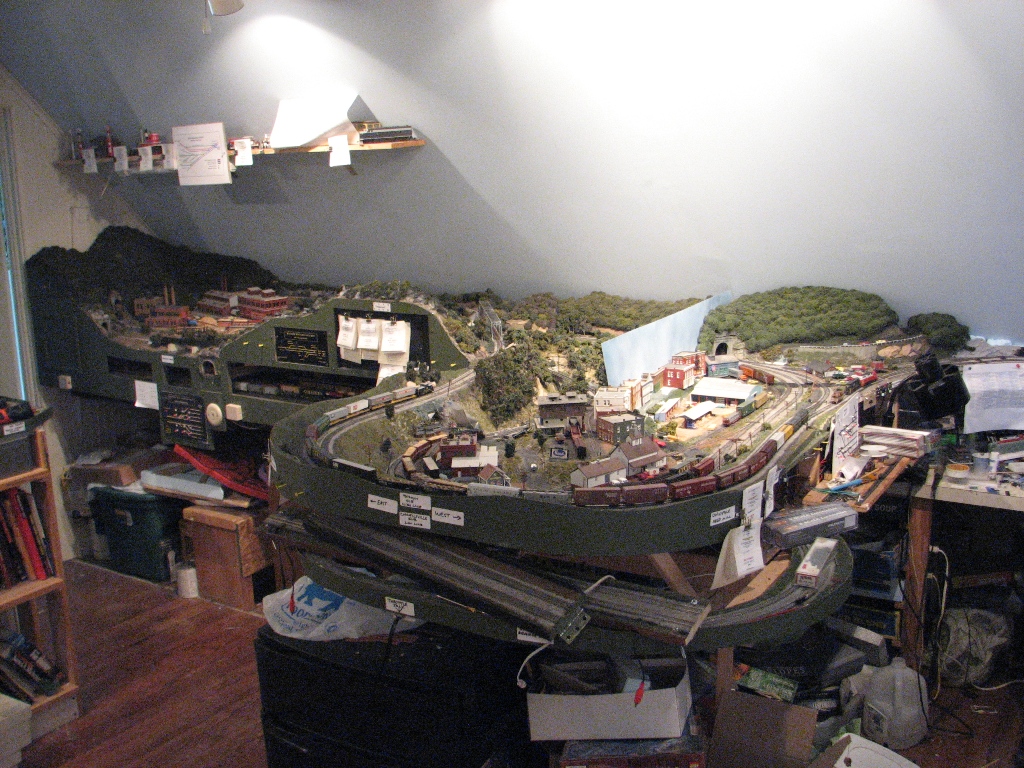
Never mind the debris!
Now there are lines that extend around the room to support things like a yard and some staging, but the basic layout can stand alone, if need be. Here’s the track plan:
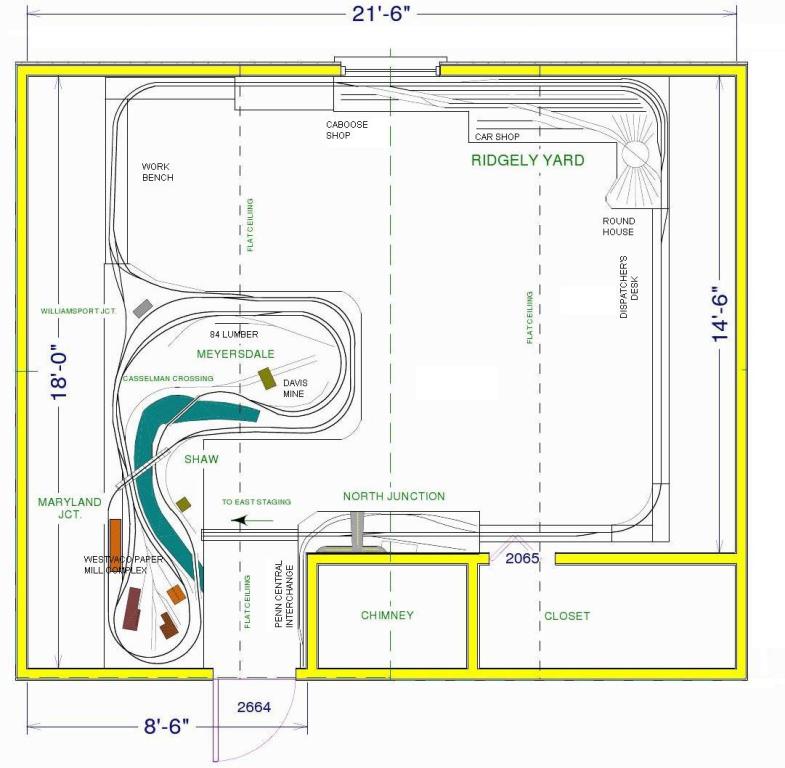
To dip your toes into N scale, I recommend you invest a little into an
N scale provides more space to implemt whatever you dream of IF you can do it.
It depends on your capabilities. How good are your eyes, how good can your fingers handel small parts? Only you can know the answer.
I had to give up and go to H0 due to my limited capabilities.
My suggestion is to buy a low cost N scale boxcar and give is a real boost in quality. Add grab irons etc. Than buy a simple N scale building kit and assemble and paint it. Add all details you want to. How about the door knob?
You know if N scale is your scale after that small test. Good luck!
You had to open that can with that opener didn’t you?[swg]–LOL!!
But I can see that happening—Me? I have bifocals, floaters in the eyeballs, shakey hands and what all else–and I’m still in N scale—why? Because I love the detail work–I love the space saving and the fact that one can build up a large layout in a smaller area. There are many reasons I’d go for this scale----
Now, if you had those problems such that it becomes an issue—you could always go “O” scale—[:-,][:-^]
I’m an HO guy myself. I had HO as a teen, and kept them for 40 years until I had the time and space to start again. But, if I hadn’t already started with a large collection of rolling stock, I’d have given N-scale a serious look. Even then, I was tempted by the amount of layout you can put into your available space.
Of course, I love my HO trains, too. I like sound engines, and that’s something that’s not there yet in N. And, they don’t make subway trains in N, but that’s just one of my own personal passions.
By the way, my personal “reach limit” for layout width is 30 inches. My layout is 60 inches wide, so the center line is just 30 inches from either edge. I can work there, add scenery, ballast track and re-rail the occasional car, but it is not easy. So, heed the warnings of layout width.
You can do any scale (except maybe G might need a little more than 4 ft) in the space you have.
The 1st question is: how much town do you want? In O for each town you’ll probably have the station, a couple of short sidings, and maybe a store all small. In Z you could have several streets and multi story buildings.
2nd question is: can you mount the layout on wheels and roll it a little way out of the corner for building and maintenance? Otherwise the 4 ft reach (5 1/2 to the corner) are a bit far.
3rd question: Is watching the trains the goal or do you plan to do switching or other operating - run 2 trains at once. For this space smaller scales are probably better for a railfan layout where watching the trains is the goal. OTOH if switching and sound are your goal then a larger scale, even S or O, might be best.
4th question: do you like to build? Bigger scales are usually favored for the level of detail you can add.
Enjoy
Paul
I have been into just about every scale there is, from Z all the way up to G, including all sorts of narrow gauge. There is a lot to say about any scale, but which way to go is mainly a question of space available and funds.
HO scale still offers the biggest variety in equipment and accessories, but N scale is not far behind any longer. The level of detail available in N scale is amazing when compared to the beginnings of this scale in the 1960´s. In addition to that, numerous companies offer parts to super-detail the locos. Sound is available, too, but don´t expect high fidelity sound out of these little speakers… N scale is also a little cheaper than HO scale…
If you don´t have the space to build the layout of your dreams in HO scale, then do it in N scale - it ´ll be a good choice!
Thanks all for your comments and suggestions. Love the can of worms pic. I had to save that so I can use that at a later date. I will be attending my first N scale opperating session sometime next month. Hopefully this will give some direction on whether I like that scale or not. I have operated on Dave Holl’s layout, MR Oct 08, for a few months and like that scale, HO. My club has both N and HO, but the N scale, and don’t kill me, seems a bit “toyish”, sorry…
Thinking outside the box…
What, if anything, do you have now? If you already have some rolling stock, do a paper plan in the scale you have now. If HO won’t work, try planning in N. Either way, you have an actual area smaller than you think.
If you don’t have any rolling stock, your space could accept anything from a Z-scale empire to beautiful downtown Toonerville, complete with 4-wheel Birney, in G!
Given my personal likes and dislikes, I’d take your stated area and model the Kiso Forest Railway in HOn762, aka HOe - 1:87 scale, 9mm gauge. The same scale is good for European tramways, or can stand in for 2 foot gauge (Sandy River and Rangeley Lakes in Maine, Gilpin County Tram in Colorado…)
I know it’s comfortable to simply say standard gauge, ? scale. Standard isn’t the only gauge, and HO and N aren’t the only scales.
Chuck (Modeling Central Japan in September, 1964 - in twice-N 1:80 scale, aka HOj)
No, I am not going to kill you - N scale requires the “correct” viewing aspect even more than HO scale in order to avoid this toy-like appearance. Most layouts are built way to low to be viewed properly - a killer for N scale!
I currently have a switching layout in HO, 2’x8’, and have been running that for the last year. I am bored with that and would like to have a layout where I could operate trains.
You’re perfectly justified in describing some N scale as toyish. I’m sure that without a lot of effort, we could also find examples of HO, O, TT, G, S or what have you that have a toyish quality. Heck, there’s even a 1:1 Thomas out there running around!
If you’re looking for detailed rolling stock, and super fine scale details, you’ll be hard pressed to achieve that in N scale. It’s not impossible, there are some real masters out there. Like, you, I’m an operator, so my concern is mainly that the car “works” by staying coupled and on the track. A little bit of weathering is all that’s required for me to consider a car “done”.
As for scenery and the overall look of a layout, that’s going to be driven by the skill and vision of the builder, not by the scale itself.
The following are all N scale:
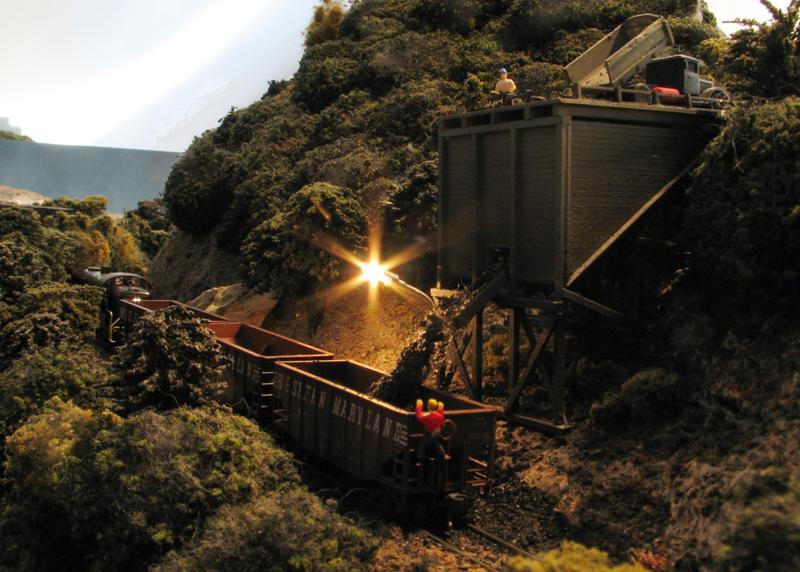

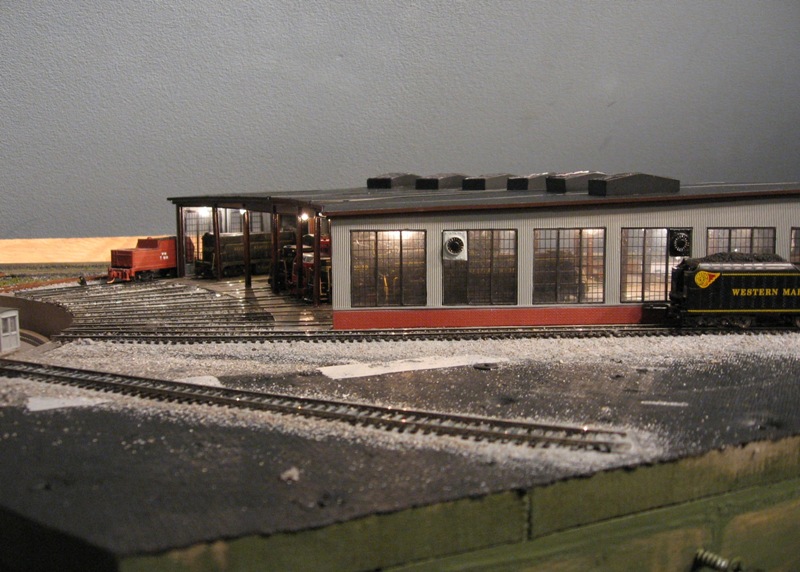
So you see, hopefully, that with the right products, and some care, you can get whatever results you’re looking for both in terms of looks as well as operationally.
Lee
N scale can be more costly in terms of engines and rolling stock. There was an article (IIRC MRP '09) that was about a room sized plan where the person was debating between HO and N. He chose HO because he needed fewer engines (around 2-3) and fewer cars (20-30) compared to an equivalent sized (same area) N scale layout, which as he stated could use up to 35 engines and 100 or MORE cars. This was just freight handling too, he didn’t factor in any additional cars and engines for passenger service.
In general what would be a good viewing/layout height for N scale then? I know there’s a difference between a good viewing height (for N 50", or about mid neck) and a good working height. I have a little bit long arms so I can reach the back of a 30" shelf at 4 feet high no problem. I know this will show some stupidity, but at one point I tacked some N track (did this with HO too) down to a shelf board laying around, set some N scale rolling stock and an engine, and came up with a 54" viewing height (chin height on me). It would have been excellent for making me and any operators feel like they’re in the layout, but veeeeeeeeery cruddy when trying to build the thing, or hand turn an engine, or rerail a derail, or pretty much every aspect of model RRing except for watching a train run around.
N scale does have sound available, but it’s very limitid. Athearn makes there N F45 and FP45 with sound, Precision Metal Craft makes a 4-8-2 with sound, but they can be as expensive and in some cases more expensive than an HO train with sound. The speaker is small, so sound quality and volume lack, modifications will need to be made to the chassic, possibly the body as well, and this is with longer 6-axle diesels, forget smaller 4 axles. Shoot I think I might have just made an N-hater [%-)]
Ah Yes!!! The old “what-scale” question rears its head. I faced it about 27 years ago . . . . . . . . . . and I opted to change from HO-Scale to N-Scale.
For me the decision was made around the issue of curvature: the 18" radius curves I was forced to use in my space allocation just didn’t feed the bulldog as far as my stable of Cary/Mantua and Bowser steam locomotives went. During the years that I had been building and detailing these die-cast locomotives I had hoped that when I retired from the Air Force in 1978 I would have had a space sufficient for 30" or better curves; such was not turning out to be the case – at least in the short run. I suppose that I could have used a little bit better initiative in my track planning and come up with 24" – “standard” curves – or better; I had yet to discover the advantage of high benchwork which would have mediated the observation of my “large” steam engines. Better still I could have “stored” those “large” locomotives and built and superdetailed and operated smaller steamers a la MDC
These “deficiencies” led me to converting my modeling interest from HO-Scale steam locomotive to N-Scale diesel. N-Scale looks great on 18" radius curves. It also allows for “longer” trains than HO-Scale. Those issues may or may not be significant to you but they are matters worthy of consideration in your “what scale” debate.

So it looks like a scale bashing a comeing.
Very nice pics!
Not so start anything, but why do the rails on the N scale track look high, or said another way "out of proportion.
I think my best bet is to layout, no pun intended, my space on cardboard in my garage then use paper templates for turnouts tracks and curves along with the space needed for the sidings, inorder to see how things will fit or not fit using both N scale and HO scale track dimentions[:)]
Interesting discussion so far. Here is my 2 worms… er… two cents:
First, you might give some consideration to an HO narrow gauge layout. It offers a lot of the n-scale advantages while keeping most HO advantages. Since you’re thinking short line, you probably will be running small equipment anyway, so big locos and long passenger cars are probably not an issue.
Also, I’ve built my HO scale layout almost exclusively with vintage/used/new-old-stoc
They look high because they are high (by scale ruler). Wheel flanges are too deep, wheel treads are too wide, turnout flangeways are too wide, and couplers are generally oversize. The most common commercial track is oversize for what the prototype would use in the situation being modeled, regardless of scale. N scale tends to have more disparity than other scales when it comes to track. Fortunately, the disparity is not as obvious in person as it is on the camera, again regardless of scale.
In all scales, scale size track is practical, but not readily available at the mass market and discount stores. In N, Micro-Engineering makes code 40 flex track, which would be correct size rail for many situations. Code 40 turnouts have to be built from kits (BK) or built by yourself or built by a custom builder. HO is a similar situation once you get smaller than code 83 rail, which is correct only for transition era and later main lines. Shinohara and ME do make HO code 70 track and turnouts, but it is not always easy to find.
my thoughts, your choices
Fred W