Something I find interesting is that if you build and HOn3 or On3 layout, your layout is more correctly in scale than if you build an HO or O standard gauge layout, since both HO and O standard gauge trains are built to a slightly incorrect linear scale.
[:S]
Real standard gauge is 56.6" wide. O gauge track is 1.25" gauge. If you divide 56.5 by 1.25, you get 45.2 - so O ‘scale’ is 1:45.2 scale, or “17/64ths scale”. No one really liked that, so in America, we used a linear scale of 1/4" = 1 foot, or 1:48 scale. So US O scale standard gauge trains are slightly undersized. In Europe, where they were more familiar with metric measurements, they went to 7mm = 1 foot, or 1:43.55 scale. (That’s why so many European made “O scale” model automobiles are 1:43 scale.) So their “O scale” trains are slightly oversized.
When 5/8" gauge trains started, that gauge was half of O scale…“Half O” or “HO”. If you divide 56.5" real standard gauge by HO’s 5/8" gauge (.625") you get a ratio of 1:90.4 - exactly half of correct O scale. However, since HO started in Europe, they built the trains to 1/2 of 7mm / 1:43.55 scale: 3.5mm = 1 foot, or 1:87.1 scale.
But, if you build a US O scale 3’ gauge layout, it uses a gauge of 3/4", based on 1/4" = 1 foot times 3 equals 3/4" gauge. That means 1:48 On3 trains are exactly correctly proportioned, while their standard gauge 1:48 counterparts are not. Same works for HO, since you start with 3.5mm per foot linear scale, and determine what 3’ gauge is from that.
It would work for On30 or HOn30, provided you were actually modelling a 30" gauge prototype, and not 2’ or 3’ gauge trains adjusted to fit 30" gauge track.
Some folks have a tendency to make things as complicated as possible and you seem to belong to that group.
The OP had a question regarding Blackstone HOn3 products being to scale or being out of scale, narrowed down products. It escapes my understanding why you put TT scale “on the table” in this discussion.
You seem to imply that because the gauge is slightly out of scale that the rest of the dimensions of “the trains” are off as well. This is not the case (at least on the stuff I’ve measured).
The posts about bogie changes is interesting as here in Australia I know of one train that changed bogies at the border to another state… One state was standard(4ft8 1/2in) gauge and the other was narrow(3ft6in) gauge…
I also remember something about the Orient express needing to do the same at one stage…
Anyway, some people just dont understand that some railroads running different size equipment and as such rail world wide is really an individual thing just like model rails…
Lets not get too standardized, it would boring seeing layouts and equipment all looking the same…
Well really my point was that if you are in 1:48 O scale for example, and you’re building a 3’ gauge layout using 3/4" gauge track, your track and your models are in the same exact scale in relation to each other, as in 1:48 scale 1/4" = 1 foot, so 3 feet = 3/4". If you’re in 1:48 modelling standard gauge using 1-1/4" track gauge, your rails are a scale 5’ apart, not 4’ 8-1/2". So in that sense, On3 is more perfectly to scale, as the track gauge and scale are both correct.
Remember the gauge came first. Marklin in the 1800’s made trains in 4, 3, 2 and 1 gauge, with 1 gauge (today known as “G gauge” unfortunately) of 1-3/4" (or 1.77" to be technically correct) being the smallest. When they made a new, even smaller size of 1-1/4 inch, they called it 0 (zero) gauge, and made toy trains to fit the tracks. It was later when people adopted the gauge to use for making true scale layouts that they worked out what the scale was (which
Well, you’ve been around these forums to know how things roll. Should you be surprised? I’m not, but you can certainly try to reason with a post sometimes but not sure if it’s ever going to bear fruit.
So to the OP, was this just another “know-it-all” who was actually sounding knowledgable (as people sometimes do) but was really full of it? What is the truth here when it’s all shaken down and pressed over?
Yes, traditional American O and HO gauges are close, but not quite 100% correct. Most of us can’t tell the difference at normal viewing distance. For those who can tell, and for whom this is an important issue, there are Proto 48 and Protpo 87. I’m not aware of any regular contributors to the forum who model these gauges. For those who do, you have my admiration. But I’m too heavily invested in the tradfitional stuff to change at this point.
Okay, guys, the question was not about TT gage, standard gage on HOn3 trucks, the fact that large and small objects in the prototype will have the same size relationship if they are both reduced to the same scale, loading gage, or anything else.
The other individual involved had been in discussion with a third party who did HOn3 and had derived from that discussion that the Labelle kits were “true” narrow gage, and that the Blackstone models of similar cars had HOn3 trucks but bodies that were not true to scale but were somewhere between HO and N.
Visually, as he pointed out to me in my discussion with him, the Labelle cars had more bulk, heft, were larger, or however else one could describe the size difference.
7j43k, above, has given me some dimensions to which I can compare the Blackstone models. That information should be adequate to end the discussion.
HOn3, 3.5mm = 1’ running on 10.5mm gauge track, is HO scale.
Narrow gauge is anything less than (scale) 56.5" gauge.
There is a whole spectrum of track gauges, ranging from ‘ride-on’ garden railways and (very) skinny industrial tramways to Herr Hitler’s 3 meter gauge dream-scheme and some even bigger under ship cradles. A decade or so ago I downloaded seven pages of same from a web site now dead. Standard gauge and 3’ gauge are dark lines on that spectrum. So are 3’6" gauge, meter gauge, 5 foot gauge… I personally model narrow and narrower gauges, neither of which are 3’ gauge. (3’6" or 1067mm and 2’6" or 762mm if you just have to know.) Everything, however, is built to uniform (1:80, aka HOj) scale.
Very large systems (PRR, SAR, IGR>JNR>JR…) have fairly uniform standards. Smaller railroads, especially those without interchange arrangements, tend to go their own way, often leading to some odd results. The recent problem on the SNCF (French) when the car designers widened some cars without considering the clearance required by existing high platforms, comes to mind…
Chuck (Modeling Central Japan in September, 1964 - with high platforms)
As has been pointed out, Blackstone went to a lot of trouble to accurately model the chosen prototypes. Blackstone has gone out and measured surviving prototypes and done an excellent job reproducing them.
Most of Labelle’s HOn3 models were designed when such prototype-specific information was not available or in general use. Nevertheless, Labelle kits are generally quite accurate dimensionally, but are not models of the specific still-existing prototypes that Blackstone used. Unless you are comparing models of the same prototype, there are bound to be differences between boxcars and gondolas from different prototypes and different model makers. Narrow gauge is not know for its conformity from one railroad to the next!
That said, the current owner of Labelle has been steadily redesigning and upgrading the Labelle line of kits. Detail parts are becoming finer, and bodies more prototype-specific and accurate. The trick is to find new Labelle production - there is plenty of older production available and unbuilt in both standard and narrow guage and plenty of both O and HO (I think Labelle also made some S rolling stock at one time).
And since I don’t model the D&RGW, Blackstone’s acccuracy has little bearing on my modeling. It’s not as if a D&RGW car was going to show up on my Southern Oregon-based free-lance logging line as interchange traffic. Altering a Labelle wood kit is both easier and cheaper than Blackstone RTR plastic bodies. When I do buy Blackstone, I seek the unlettered and most generic bodies I can find (I have a couple of Blackstone unlettered flat cars that model D&RG pre-1900 version of the car).
Blackstone is gorgeous stuff, and as has been pointed out, very accurate. The narrow gauge community is very particular in terms of wanting accurate models. Blackstone’s models are very popular in Hon3 circles.
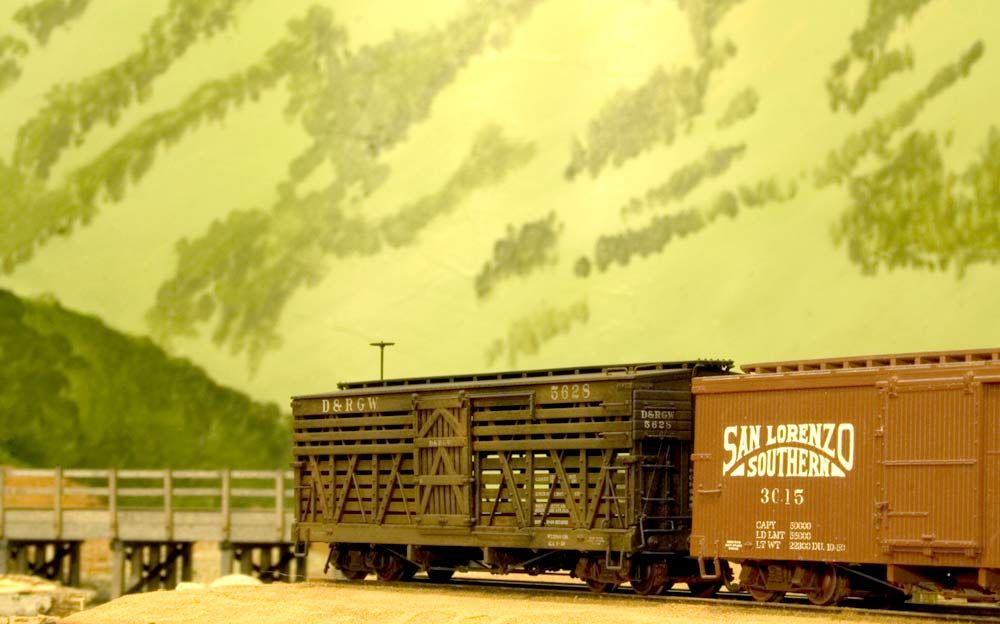
The stock car in this shot is Blackstone. Ever looked at the typical Hon3 stock car kits out there??? You would be a very skilled modeler to build most of these kits out as nice as this Blackstone car.
One thing I’m interested in is Blackstone’s “Pro-Traxx” HOn3 track system, especially if expands in the near future. I wonder if there will be a lot of people who finally decide to take the plunge to HOn3 because of a reliable, easy-to-use narrow-gauge ‘click track’ being available?
I really like Pro-Traxx (made by Kato, BTW). Turnouts are on the horizon and I’d expect to see some movement to bring them to market once the K-36 finally rolls out of the factory. Both have taken a back seat to many other things in Durango, but with the next gen Tsunami II now on the market, things are probably ramping up to these much-anticipated products. It would certainly light a fire under the HOn3 T-track concept to have turnouts and some other options available.