HOn3 - Is it "Scale" or Just "Narrow"?

For those who wish to get into another discussion, I was at the club this past week and one individual stated that the cars on the narrow gage were not really HOn3 narrow gage, but just “narrow gage”.

I said what do you mean. So he pointed to a bunch of cars, primarily Blackstone, and said that those cars were not protoype cars scaled down to HOn3, but were really cars somewhere between HO and N made to run on HOn3 track.

Then he pointed to another couple cars, probably Labelle, and said "see, those cars are bigger and are truly scaled down from the prototype.

So, what is the expert opinion???

He is nuts!

Totally false.

Here’s the expert opinion…

http://www.nmra.org/beginner/scales

Without seeing the particular cars he was referring to it’s hard to say. HO and HOn3 are the SAME scale, so a door, an automobile or a human figure will be the exact same size. A ratio of 87.1 to 1 or 3.5 mm/foot. The only thing that would change is the distance between the rails.

From what I know about Blackstone Models, they are regarded as industry leaders in the narrow gauge field.

Try to sort out the G scale—gauge #1, 1:22.5 or 1:29 or 1:32 so and so! That really gets into some hairy discussions! It all runs on 45mm gauge track.

Regards, Ed

No expert here, but I would suggest that aforementioned individual has not taken into consideration “Loading Gauge”.
https://en.wikipedia.org/wiki/Loading_gauge

Cheers, the Bear.[:)]

"He is nuts!

Ulrich"

Well, that part is not debateable [:)]

I agree with this. Unfortunately when he pointed to the Blackstone boxcar and compared it to the similar kit-built boxcar, the kit-built was physically larger. So I wasn’t able to come up with a reasonable reason why that might be.

Sometimes the East Broad Top would place narrow gauge trucks under a standard gauge car when time could be saved by not having to trans-load the freight.

http://www.totalracing.com/ebt/stdgauge.htm

I’ll have to see if I can find photos of this. They had a large timber crane for lifting the car and swapping the trucks. A cast aluminum coupler adapter was used to make up the coupler height difference.

Mention of THAT would have made your expert red-faced!

Regards, Ed

I kind of did that with placing N-scale trucks under an HO boxcar. Looked wierd but did work on N-scale track.

Dennis

I’m looking at a copy of the ORER that shows various dimensions for D&RGW narrow gage freight cars. Since essentially all of the models Blackstone makes are from that road, I’ll supply dimensions for the boxes and the reefers.

D&RGW 3000-3749 (698 cars July 1945) boxcar

Outside length–30 feet

Outside width at eaves or top of sides–8 feet 4 1/4 inches

Outside height to top of running board–10 feet 1 11/16 inches

Outside height to eaves or top of sides–9 feet 5 11/16 inches

Door opening width–5 feet

Door opening height–5 feet 8 1/2 inches

D&RGW 32-78 (37 cars July 1945) reefer

Outside length–30 feet

Outside width at eves–7 feet 7 7/8 inches

Outside height to top of running board–10 feet 2 inches

Outside height at eves–9 feet 6 3/4 inches

Door opening width–4 feet

Door opening height–5 feet 10 inches

Go measure the models and report back. I can look up other cars for the road, also. Should you supply the car numbers.

Looking at the LaBelle narrow gage listings, it is not at all clear what car their typical boxcar was modeled after. I see what looks to be the same model used repeatedly for various road names. Perhaps it is a faithful model of a somewhat larger narrow gage car that wasn’t D&RGW.

If I were guessing (which I am, right now), I would suspect any dimensional errors would be with the LaBelle models. IF there are any. IF.

Say, would the guy making these claims just happen to BE THE ONE WHO OWNS the LaBelle cars? Just wondering.

Ed

Some of the “Gramps” cars on the DRGW had their trucks switched with standard gauge trucks to ship in oil from California, the trucks were switched back when they returned.

Is every standard gauge box car exactly the same height and width? No. Same is true about the prototypes of narrow gauge equipment. Generally speaking, as mentioned above, the “loading gauge” (not a term widely used in North America), or plate clearances, or simply clearances (more common North American terms), of narrow gauge railroads are generally smaller than standard gauge railroads.

Typical car widths for 3’ gauge are 8-9’ rather than the 10’ of standard gauge. While passenger doors, etc, would be standard sizes, overall car heights would be less than most standard gauge cars, but would vary just like standard gauge cars have varied in height over the years.

Comparing the Blackstone cars to some other narrow gauge cars requires knowledge of each prototype.

Now here is the most important difference. Because narrow gauge lines were generally “closed systems” with no interchange, each was built to its own standards

Thanks for this info. I’ll give this a try, but it will be next week before I get to the club again.

The subject of changing trucks ala East Broad Top was brought up, but none of the cars in question were large enough to be standard gage prototypes.

And no, none of the cars belonged to Mr. Fluffer-Nutter.

In the railroad industry, the “gauge” is the space between the rails. You don’t stand on the track; you “stand in the gauge.” The inside face of a rail is the “gauge face.” “Narrow gauge” in the US is any gauge smaller than 56.5". A car whose trucks mount wheels spaced to run on rails 36" apart is ipso facto narrow gauge, no matter how wide the body (that’s a matter of the “clearance plate”).

The way I see it HO is a scale 1:87,n-3 is a gauge (36" in this case).From pictures I have seen narrow gauge cars came in all sorts of lengths and heights just like standard gauge.

If I’m not mistaken, I think D&RGW may have re-trucked some standard gauge gons or flats and used them on their narrow gauge operations with minimal modifications. Somebody like Mike Lehman can tell you whether I’m also nuts.

Maybe the use of N scale track for HOn30 has clouded your friend’s thinking.

I have seen some compromises of this kind in the larger scales. I know there is a 7-1/2" gauge hopper car that is obviously patterned after an EBT car. It is scaled for 2-1/2" = 1’ 0" scale, which is correct. For those operating standard gauge equipment on that same 7-1/2" gauge track, the scale would be approx. 1.5" or 1.6" = 1’ 0". That EBT car is sold simply as a usable hopper for 7-1/2" gauge, and both narrow gaugers and standard gaugers use it, even though it’s not really accurate for any standard gauge car.

In general, narrow gauge equipment was smaller than standard gauge equipment. A car that is some kind of cross between HO and N is probably an inaccurate model. Those exst, but I don’t think you will find them in the Blackstone or LaBelle lines.

Tom

Here’s what’s going on. Blackstone cars have always been to scale. They match the drawings to scale.

LaBelle cars have been produced by several different owners over a number of decades. Each owner has revised and improved these kits, although probably the most effort has been be the current owner. The passenger cars are where this can be most easily seen. I’ll try to pull up a direct comparison and add to this in a moment.

Yes, LaBelle kits have been oversize or disproportioned in several ways. You can improve this considerably with a little effort and care. They’re the kind of old school kits where this is possible.

There were different size boxcars on the Rio Grande and other Colorado raods before the rebuilt 3000 series was left as the familiar ones that most think of, like the fellow who didn’t quite get this right. I have some LaBelle Silverton Northern boxcars and Silverton, Gladstone & Northerly gons that are really pretty close. I haven’t built the DRGW 3000 series car in LaBelle (have done plenty of RailLine ones, though, in plastic) so can’t advise how close or far they are from right.

But they all should be considered HO scale as far as measuring goes, intended for ops on HOn3 gauge trucks.

OK, a basically unmodded build of a LaBelle combine kit (bought from consignment at Caboose Hobbies years ago) next to the stock Blackstone coach.

Next, a modded LaBelle build by me, next to the Blackstone. Keep in mind that most Rio Grande headend cars were slightly taller than coaches, in large part where RPO’s were involved due to postal regulations.

In this pic, I added a fairly good layout level model of the Silverton RR combine Red Mountain I built from a Labelle coach kit.

This pic

I will be polite, and simply say the guy in question is mis-informed about narrow gauge prototype and scale model equipment.

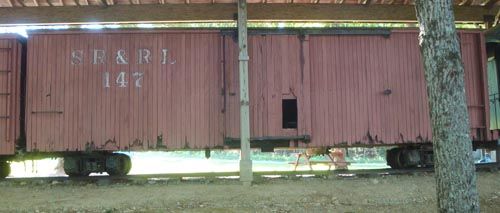
I can not give examples of 3 foot gauge equipment, but every time I go to Boothbay Railway Village, I am surrounded by vintage, prototype 2 foot gauge equipment. For instance this is Sandy River & Rangley Lakes RR 2 foot gauge boxcar 147 that is on dispaly and awaiting restoration:

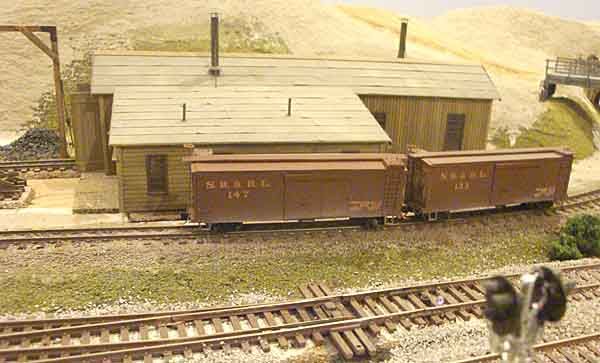
These are HO scale models, one of them the exact car, in HOn30 which represents 2 foot gauge. Except for the trucks and couplers, the model’s dimensons match the prototype car in 1/87 scale

Maybe the guy is confused about which scale/gauges cheat a little.

One of the quick, easy, less expensive ways to model narrow gauge is to use HO standard gauge cars for Sn3 by swapping the trucks. This isn’t exactly correct, but change the grab irons and ladders and you can get by. Or just do Sn42 using HO equipment - change some of the details, like larger locomotive cabs and smoke stacks and you can by for less money.

HOn30 started out using N scale trucks and locomotive mechanisms on N scale track.

You can go the other way too. Some S scalers use On30 cars (particularly passenger cars) for S standard gauge. Again you can change some of the details for a better impression. Or even regauge the locomotives to S standard, rebuild the cab, and change some of the detail parts.

Paul

Nope not nuts.

I bet nobody has considered TT scale. TT scale cars have sometimes been mistaken for HOn3. They are close but no cigar.

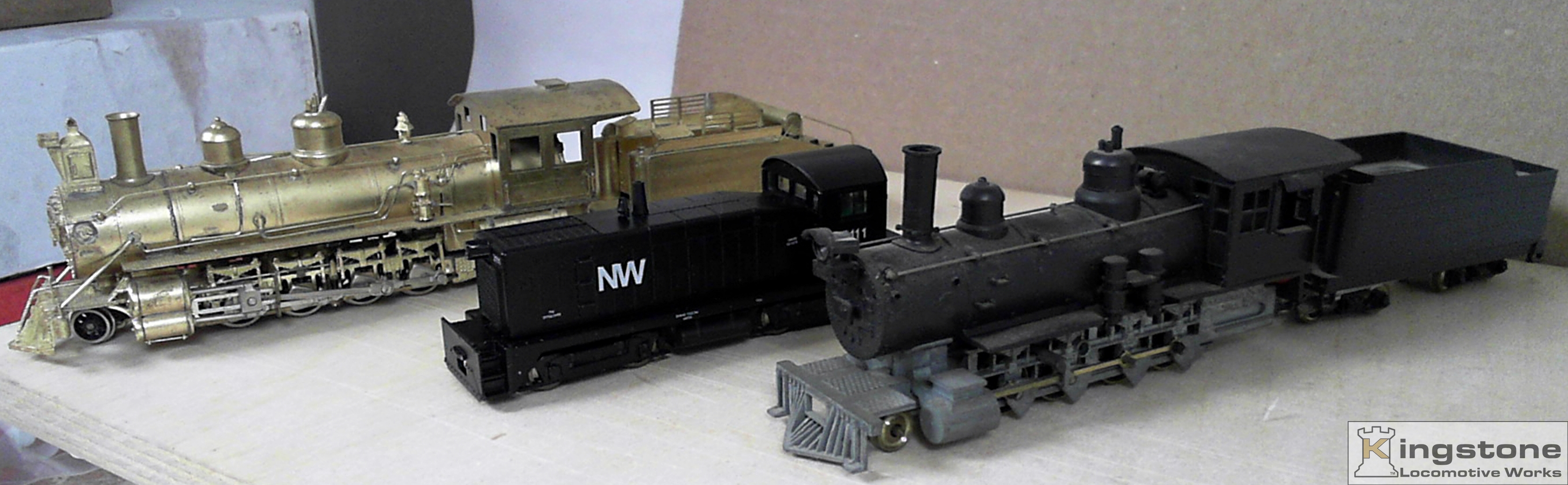
Here’s a comparison of two HOn3 steamers to a TT scale SW1200.

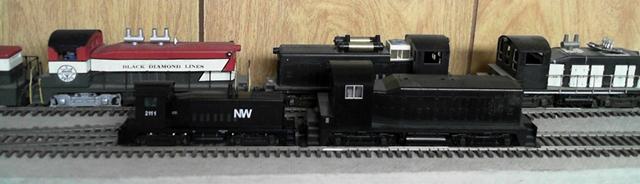
Here’s a comparison between HO standard gauge and TT scale standard gauge.

I’ll have to dig out some of my TT scale boxcars and HOn3 and take some pictures for better comparison.

Bernd

I should have re-phrased my answer - he is not nuts, but one of the many know-it-alls, who are just plain wrong.

That´s not what was asked for.